


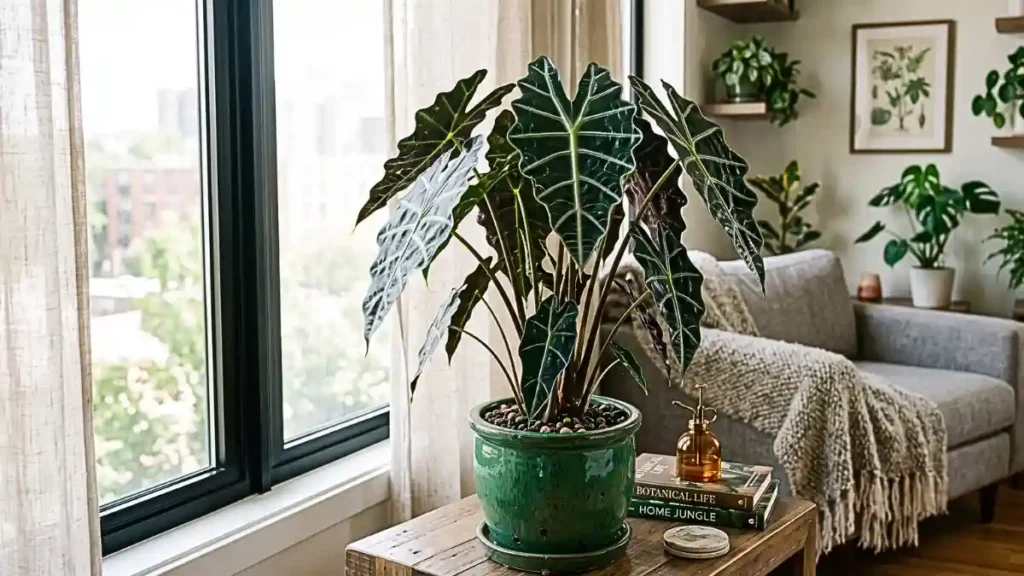
If you’ve ever walked past a plant with leaves so dramatic they looked almost fake, there’s a good chance it was an Alocasia. Known colloquially as elephant ear plants, Alocasia varieties are some of the most visually commanding houseplants in existence — with arrow-shaped leaves that can range from deep jewel-black to iridescent silver-green.
But here’s the thing: not all Alocasias are made equal. With over 97 identified species and hundreds of cultivars, choosing the ideal type for your home, garden, or collection might be daunting.
This guide breaks down the most popular, unusual, and beginner-friendly Alocasia varieties — with honest care notes so you know exactly what you’re getting into before you buy.
What is an Alocasia? A quick overview
Alocasia is a genus of tropical perennial plants that are native to tropical and subtropical Asia, as well as Eastern Australia. They belong to the Araceae family (aroids), which includes Monstera, Philodendron, and Peace Lily.
Their signature look is defined by:
- Large, arrowhead or shield-shaped leaves with dramatic venation
- Waxy or velvety leaf texture, depending on the variety
- Distinct petioles (stems) that hold leaves upright at attention
- Striking colour contrasts — often dark green against bright white or silver veins
They develop from corms (underground storage structures), thus even if a plant loses all of its leaves under stress or winter, it may recover from the corm.
The best Alocasia varieties: Complete visual guide
Popular & easy-to-find Alocasia varieties
1. Alocasia amazonica ‘Polly’ (African mask plant)
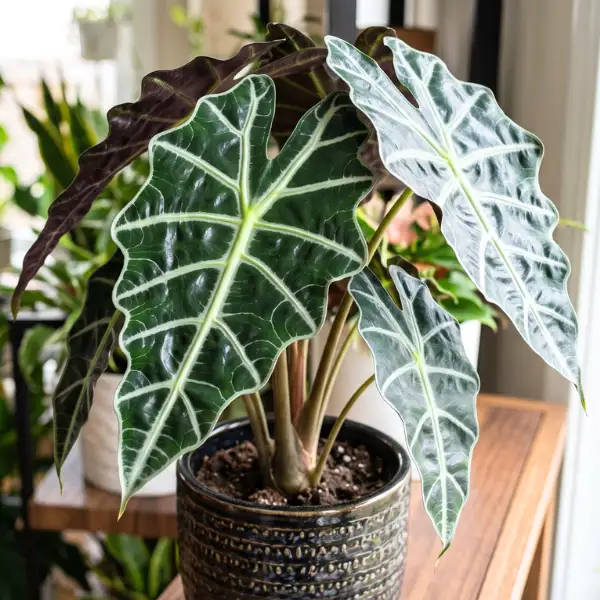
One of the most easily identifiable Alocasia varieties in the world. Polly has rich green, wavy-edged leaves with dramatic, contrasting white veins that appear hand-drawn. Despite the name, it is not an African cultivar, but rather a hybrid developed in Florida.
- Leaf size: 30–45 cm
- Light: Bright indirect light
- Best for: Beginners, tabletop display
- Difficulty: Easy–Moderate

2. Alocasia macrorrhiza (Giant taro)
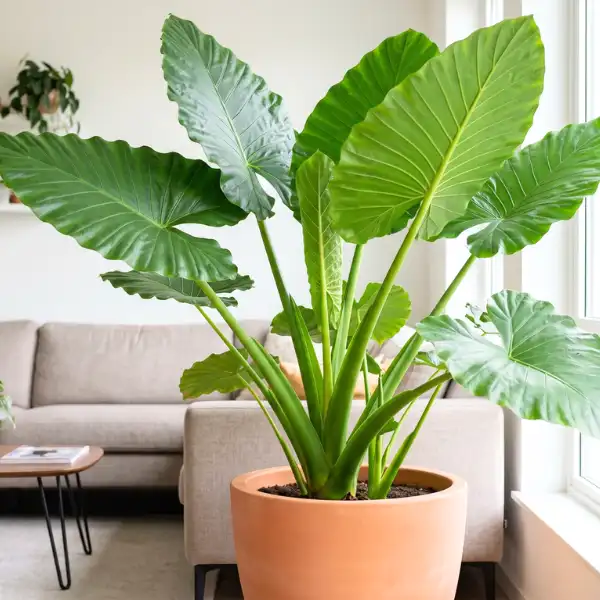
If you want to go big, this is the plant. Alocasia macrorrhiza develops massive, erect leaves that can grow to be 1-2 metres long in tropical gardens. Indoors, it makes a strong impression in huge spaces with high ceilings.
- Leaf size: Up to 90 cm indoors; 2 m+ outdoors
- Light: Bright indirect to filtered sun
- Best for: Outdoor gardens, conservatories
- Difficulty: Easy
3. Alocasia zebrina (Zebra plant)
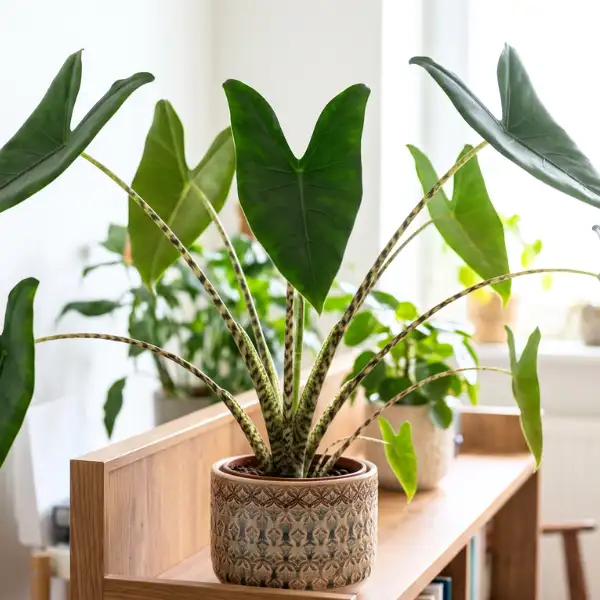
The remarkable zebra-striped petioles are what set this cultivar apart, not the leaf. The pale green foliage is subtle, but the yellow-and-black striped stems make it one of the most popular Alocasias on social media.
- Leaf size: 40–60 cm
- Light: Medium to bright indirect light
- Best for: Minimalist interiors, living rooms
- Difficulty: Moderate
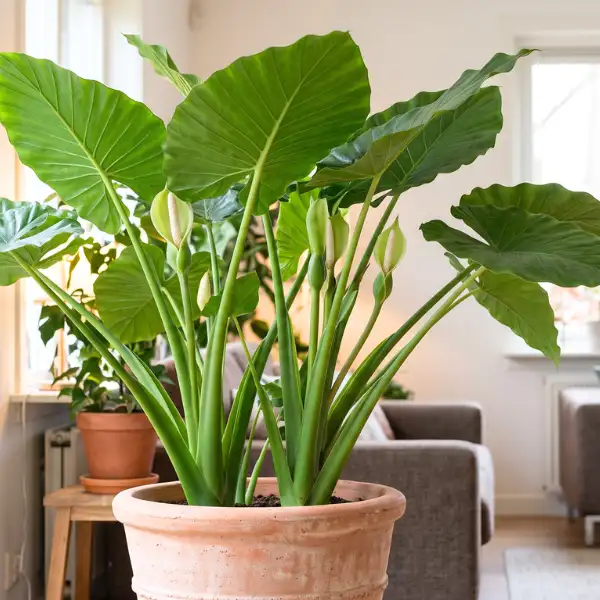
4. Alocasia odora (Night-scented lily)
A large-growing cultivar with paddle-shaped, silky foliage. What distinguishes it is its fragrant white blossoms, which produce a lovely aroma at night. It is unusual for an Alocasia to be cultivated for its blossoms, but this one deserves it.
- Leaf size: 60–90 cm
- Light: Bright indirect to partial sun
- Best for: Patios, large indoor spaces
- Difficulty: Easy
Mid-range & collector Alocasia varieties
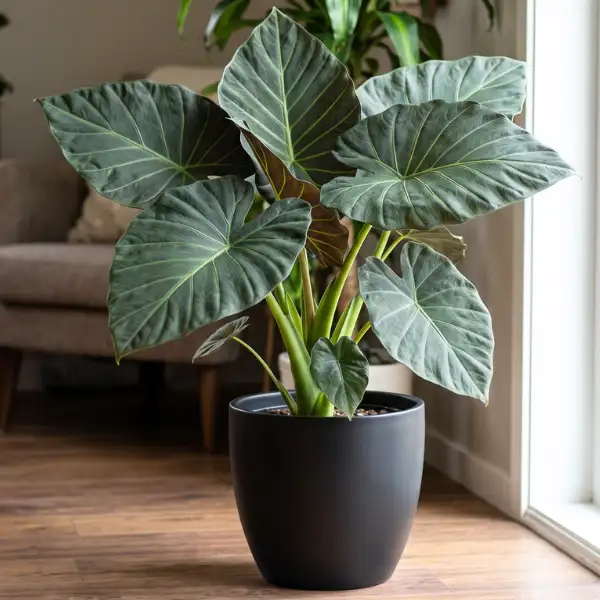
5. Alocasia ‘Regal Shields’
A hybrid monster with massive, deep olive-green leaves bordered with dark purple-bronze on the underside. It exudes royal, tropical drama that few plants can equal. In favorable conditions, it grows rapidly.
- Leaf size: 60–90 cm
- Light: Bright indirect light
- Best for: Large spaces, dramatic focal points
- Difficulty: Moderate
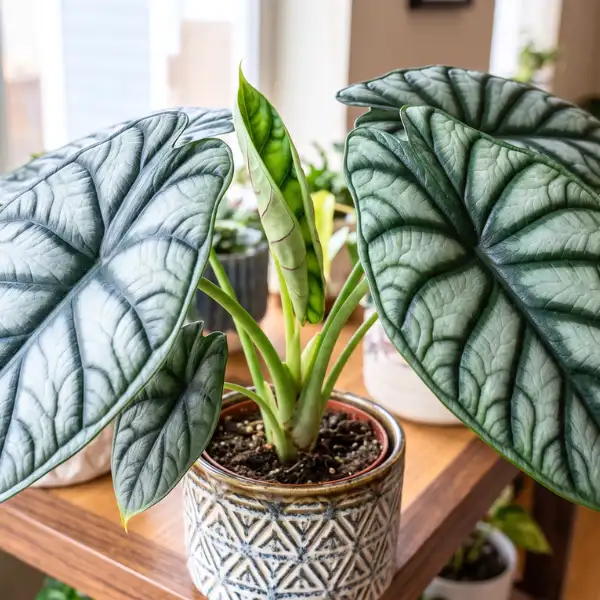
6. Alocasia baginda ‘Dragon Scale’
One of the most popular Alocasia types among collectors. Dragon Scale has broad, silvery-green leaves with dark green venation that closely resemble reptile scales. Stunning in dim light, where the texture truly shines.
- Leaf size: 20–40 cm
- Light: Medium to bright indirect light
- Best for: Shelves, terrariums, collectors
- Difficulty: Moderate–High
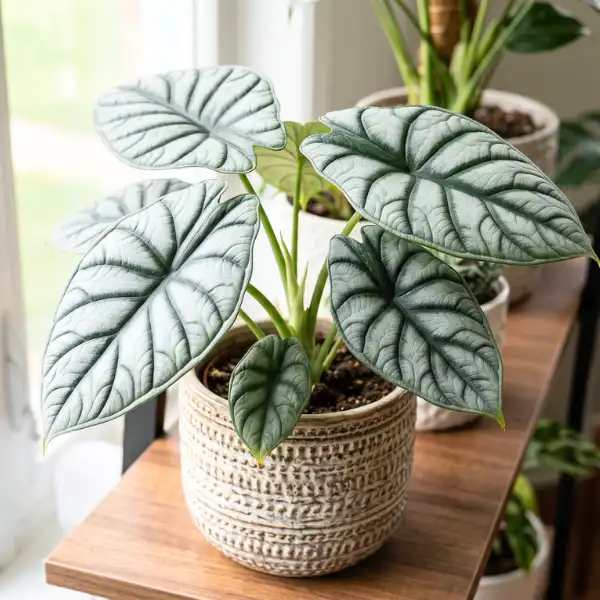
7. Alocasia baginda ‘Silver Dragon’
A sibling of Dragon Scale, Silver Dragon has pale, almost white-silver leaves with green veining — the reverse colour scheme. It is more compact and, perhaps, more ethereal in appearance.
- Leaf size: 15–25 cm
- Light: Medium indirect light
- Best for: Desks, bookshelves, terrariums
- Difficulty: Moderate–High
8. Alocasia cucullata (Chinese taro / Buddha’s hand)
In certain Buddhist traditions, a compact variation is regarded as holy. It has smooth, heart-shaped, brilliant green leaves and is one of the simplest Alocasias to care for. Often grows in both water and soil.
- Leaf size: 20–35 cm
- Light: Medium indirect light
- Best for: Beginners, bedrooms
- Difficulty: Very Easy
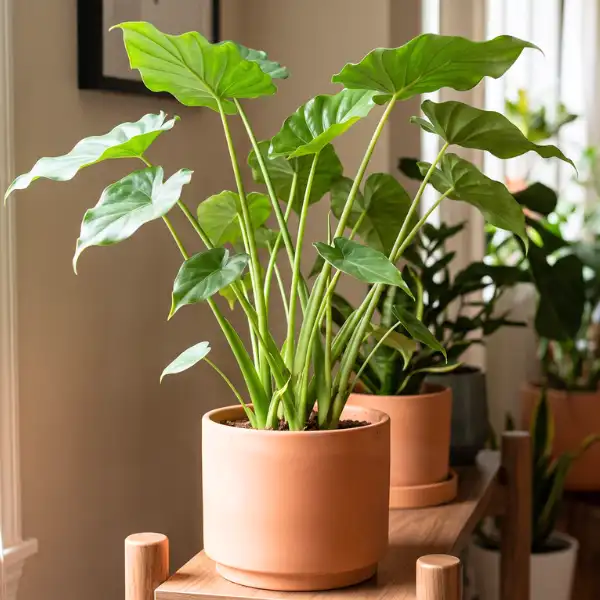
9. Alocasia wentii (Hardy elephant ear)
Notable for its magnificent purple-bronze undersides, which contrast brilliantly with the glossy, dark green crowns. One of the most cold-tolerant cultivars, it can withstand lower temperatures better than most.
- Leaf size: 40–70 cm
- Light: Bright indirect light
- Best for: Semi-shaded outdoor spots, UK gardens
- Difficulty: Easy–Moderate
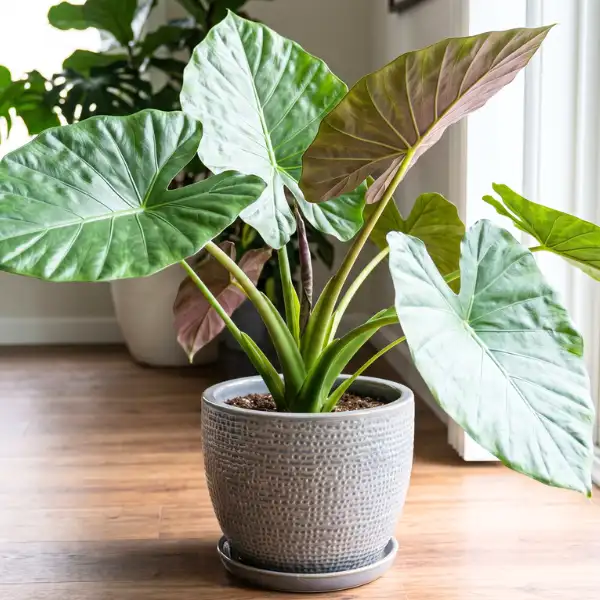
10. Alocasia longiloba (Malaysian monster)
Longiloba, which is sometimes mistaken with Amazonica, has longer leaves with silvery-grey veining on blue-green foliage. The bottom is usually purple. A really undervalued variety.
- Leaf size: 40–60 cm
- Light: Bright indirect light
- Best for: Collectors who want something less common
- Difficulty: Moderate
Rare & statement Alocasia Varieties
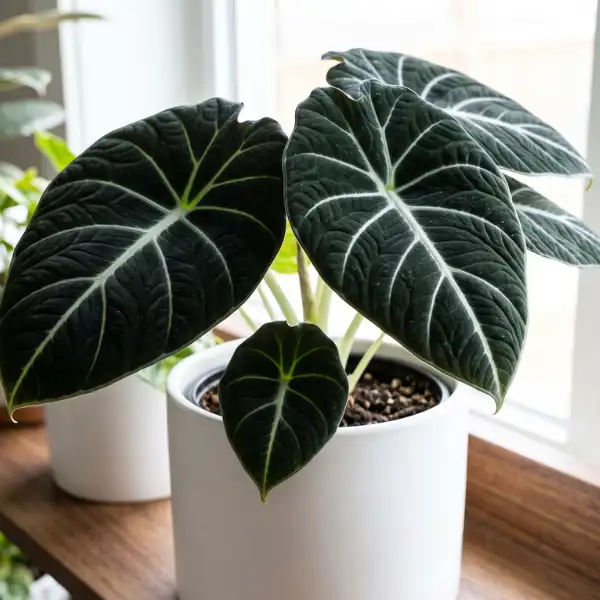
11. Alocasia reginula ‘Black Velvet’
This is considered the pinnacle of compact Alocasia varieties. Black Velvet’s leaves are near-black with a velvety feel and sharp white veins. Small in size, yet huge in impact.
- Leaf size: 15–25 cm
- Light: Medium indirect light
- Best for: Collectors, terrariums, dark-themed interiors
- Difficulty: Moderate–High
12. Alocasia ‘Portora’ (Giant upright elephant ear)
An architectural monstrosity. Portora produces massive wavy-edged leaves on purple-hued stalks. In the appropriate conditions, it may reach 2 meters tall in a single season, making it a garden showpiece.
- Leaf size: 90 cm+
- Light: Full sun to bright indirect light
- Best for: Outdoor summer gardens, conservatories
- Difficulty: Moderate
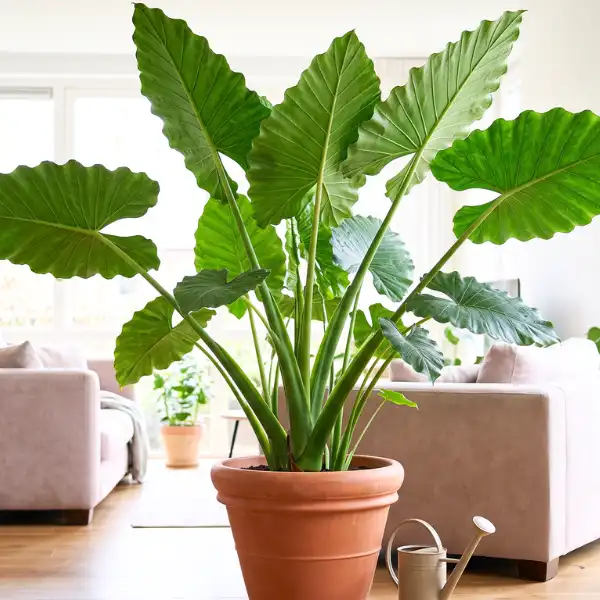
13. Alocasia micholitziana ‘Frydek’ (Green Velvet)
The green equivalent of Black Velvet. Frydek has rich green velvety leaves with bright white veins. It’s tiny, beautiful, and one of the most textured plants you may have.
- Leaf size: 25–40 cm
- Light: Medium to bright indirect light
- Best for: Shelves, accent plants
- Difficulty: Moderate–High
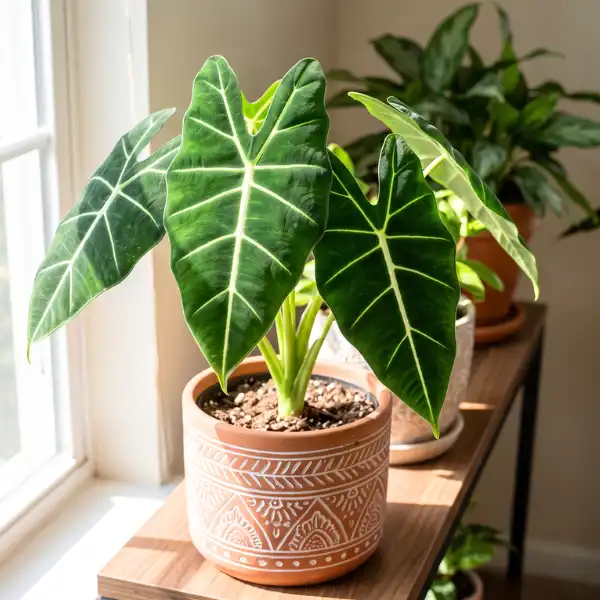
14. Alocasia ‘Stingray’
An easily identifiable variation, its leaves feature a slender tail that curls upward like a stingray’s tail. It has pale green and white speckled petioles. Truly unlike any other Alocasia.
- Leaf size: 40–60 cm
- Light: Bright indirect light
- Best for: Conversation-starter plant, unique collections
- Difficulty: Moderate
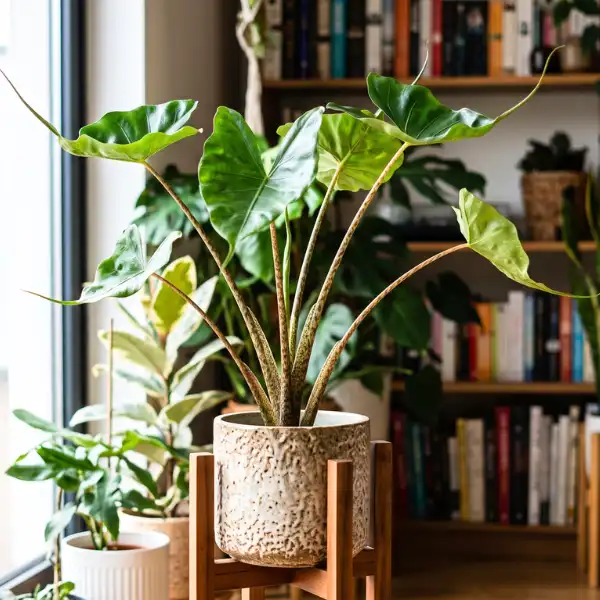
15. Alocasia ‘Calidora’ (Persian palm)
A towering behemoth with enormous, palm-like, erect leaves on long, slender stalks. Calidora may grow up to 3 metres outside in warm conditions. The leaves have a striking architectural silhouette.
- Leaf size: 60–100 cm
- Light: Bright indirect to partial sun
- Best for: Tropical gardens, large conservatories
- Difficulty: Moderate
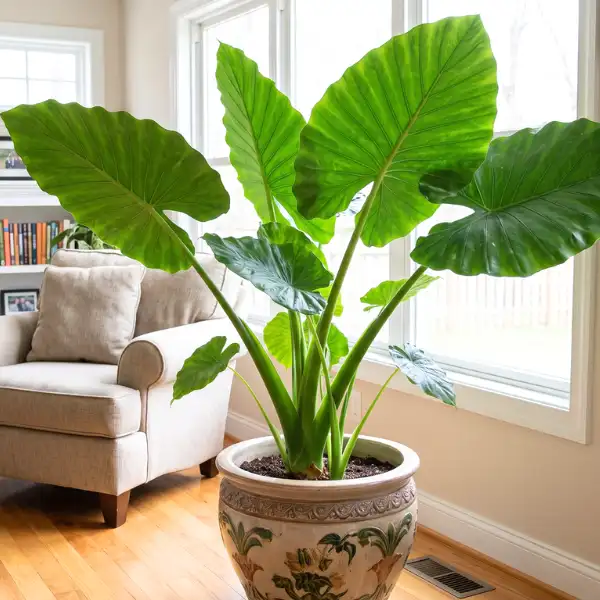
16. Alocasia macrorrhiza ‘Variegata’ (Variegated Giant Taro)
One of the most valuable and costly Alocasia varieties in the collector market. Each leaf has random splashes of white, cream, or pale green against dark green; no two leaves are ever the same.
- Leaf size: 60–100 cm
- Light: Bright indirect light (no harsh direct sun on variegated sections)
- Best for: Advanced collectors
- Difficulty: High
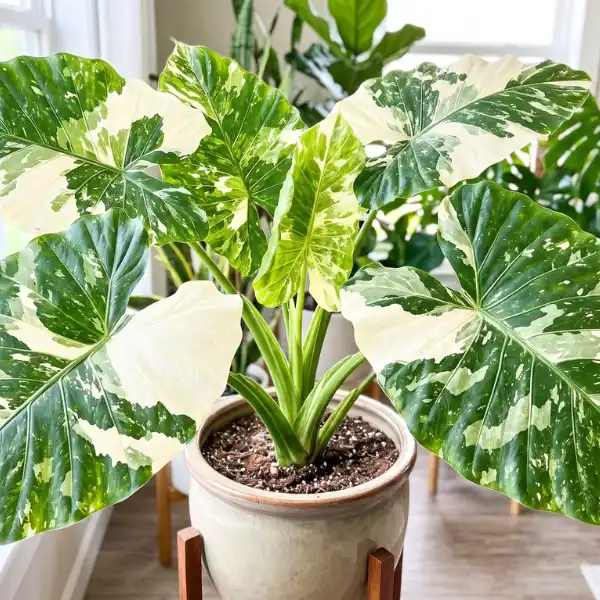
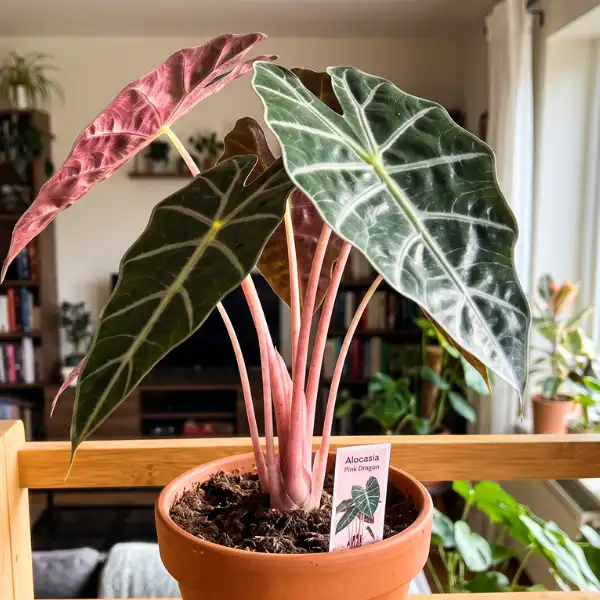
17. Alocasia ‘Pink Dragon’
An attractive hybrid with glossy, dark green leaves and – the major draw — pink or rose-colored petioles. A dramatic hue combination that looks well against white decor.
- Leaf size: 30–50 cm
- Light: Medium to bright indirect light
- Best for: Colourful plant collections, Instagram aesthetics
- Difficulty: Moderate–High
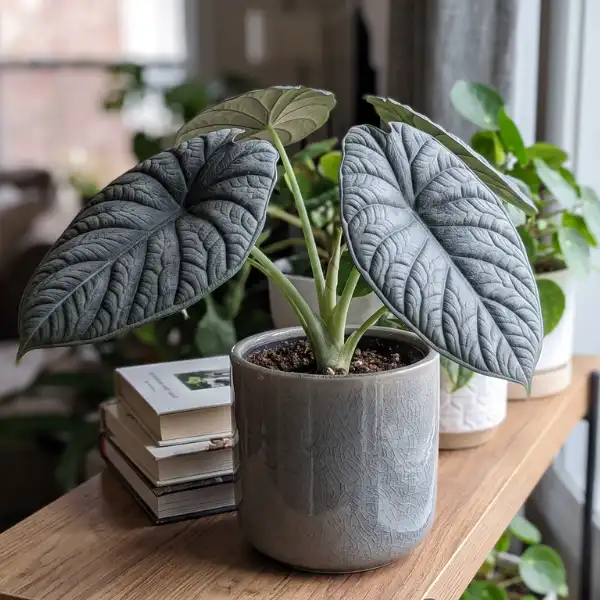
18. Alocasia ‘Maharani’ (Grey Dragon)
A small type with thick, leathery leaves in a grey-green hue with prominent black veining. It has a less shiny feel than most, resembling stone. Extremely photogenic.
- Leaf size: 15–25 cm
- Light: Medium indirect light
- Best for: Terrariums, shelf displays
- Difficulty: Moderate–High
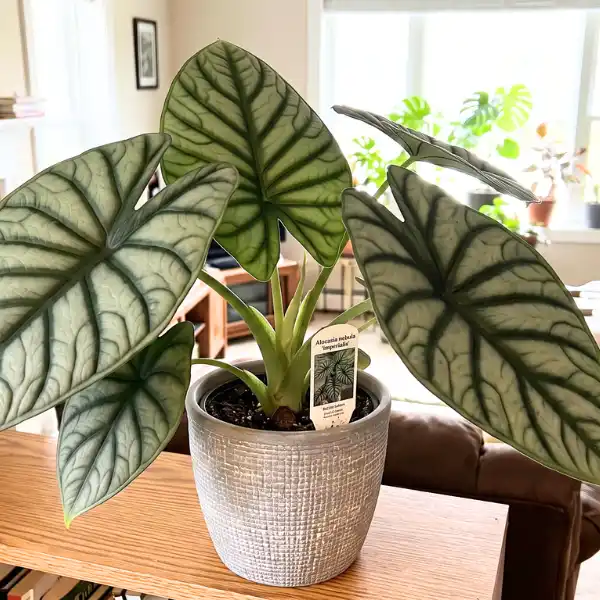
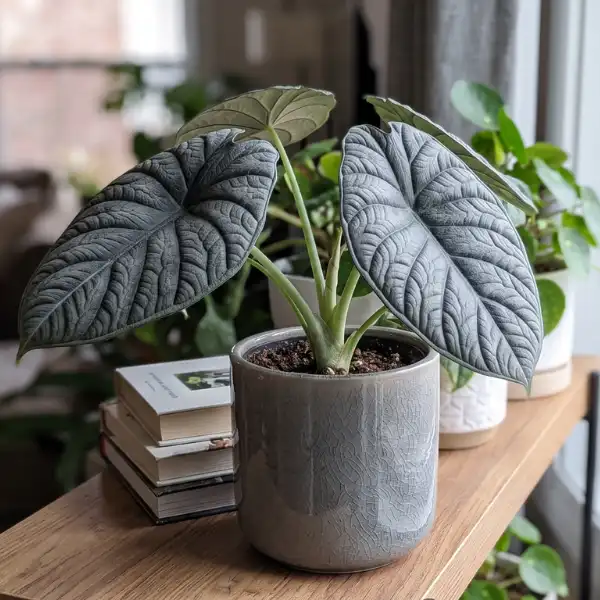
19. Alocasia nebula ‘Imperialis’
A small-to-medium cultivar with silver-grey, almost metallic leaves and black petioles. The leaf surface has a unique corrugated, almost embossed appearance. A real collector’s item.
- Leaf size: 20–35 cm
- Light: Medium indirect light
- Best for: Advanced collectors
- Difficulty: High
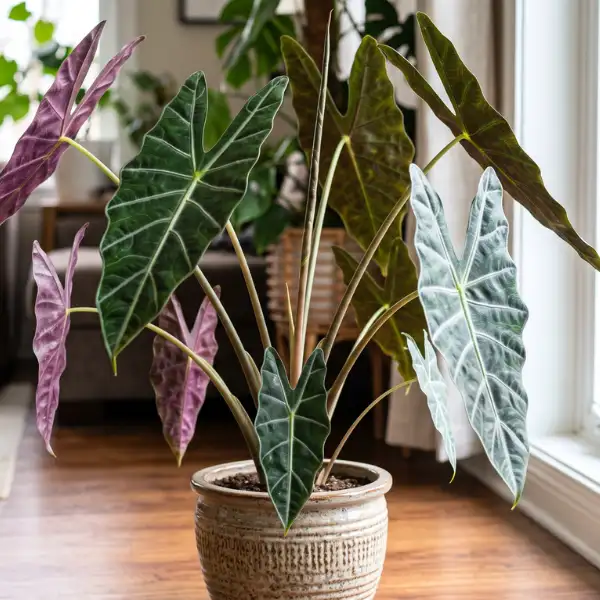
20. Alocasia lauterbachiana (Purple Sword)
Long, slender, lance-shaped leaves with wavy, purple-tinted undersides—quite distinct from the normal Alocasia profile. It grows tall and graceful, like a tropical sword plant.
- Leaf size: 50–80 cm long, narrow
- Light: Bright indirect light
- Best for: Dramatic vertical interest, shelves with height
- Difficulty: Moderate
Essential Alocasia care Tips (All varieties)
Light
Most Alocasia varieties thrive in bright, indirect light. Avoid harsh direct sun, which scorches leaves. Variegated and velvet varieties prefer slightly lower light levels to protect their delicate foliage.
Watering
Alocasias prefer consistently moist but never waterlogged soil. Always check the top 2–3 cm of soil before watering. Overwatering is the number one killer — it leads to corm rot.
Humidity
Being tropical plants, most Alocasia varieties love humidity above 60%. Use a pebble tray with water, a humidifier, or group plants together to raise humidity naturally.
Soil
Use a well-draining, chunky aroid mix — a blend of potting soil, perlite, and orchid bark works perfectly. Good drainage is non-negotiable.
Dormancy
Many varieties go semi-dormant in winter, dropping leaves and appearing dead. Don’t panic — the corm is alive. Reduce watering, maintain warmth above 15°C, and wait for spring regrowth.
Conclusion:
Whether you’re after a bold, architectural giant or a tiny, jewel-like collector’s piece, there is an Alocasia varieties perfectly suited to your space, skill level, and aesthetic. The diversity within this single genus is genuinely extraordinary — from the silky drama of Black Velvet to the prehistoric grandeur of Giant Taro.
Start with one of the easier species, perfect your watering and humidity regimen, and you’ll soon find yourself wanting more than one, just like so many other plant enthusiasts before you. That’s the Alocasia effect, and there is no remedy.
Certainly! If you’d like to learn more, please consider following our WhatsApp Channel, Facebook, Instagram, YouTube, Twitter, and Pinterest.
FAQs about Alocasia varieties
Q1: How many Alocasia varieties are there?
A1: There are over 97 recognised Alocasia species, plus hundreds of hybrids and named cultivars. The total number of available varieties exceeds 200 when including collector cultivars.
Q2: Can Alocasia varieties grow outdoors in the UK?
A2: Some cold-tolerant varieties like Alocasia wentii can be grown outdoors in sheltered UK spots during summer. Most are frost-tender and should be brought indoors when temperatures drop below 10°C.
Q3: Are Alocasia plants toxic?
A3: Yes. All Alocasia varieties contain calcium oxalate crystals and are toxic to humans, cats, and dogs if ingested. They can cause oral irritation, swelling, and gastrointestinal distress. Keep them away from pets and children.
Q4: Do Alocasia varieties flower?
A4: Yes, though they rarely flower indoors. Blooms are typical aroid-style spathes — not particularly showy — except for Alocasia odora, which produces fragrant flowers.