


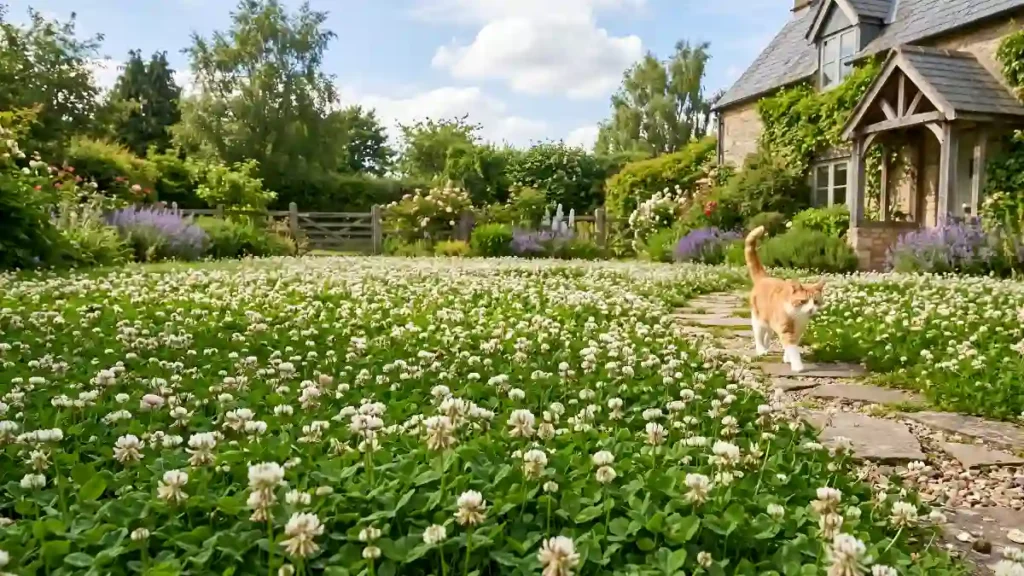
Your neighbor’s yard is thick, green, and practically care-free — and they haven’t mowed in weeks. Chances are, they’ve made the switch to a clover lawn.
Once considered as a “weed,” clover is now one of the most popular lawn trends in sustainable gardening. Homeowners around the country are praising it for its velvety texture, drought resilience, and ability to remain green without fertilizer. And honestly? This makes a lot of sense.
Whether you’re beginning from scratch or overseeding an existing grass lawn, this book will teach you all you need to know about planting, establishing, and keeping a beautiful clover lawn that also works hard.
What is a clover lawn?
A clover lawn is one that employs clover as the primary ground cover or in combination with grass, rather of (or in addition to) standard turfgrass. The most common kind is white clover (Trifolium repens), a low-growing perennial that spreads by stolons and produces tiny white blooms that bees like.
Other popular varieties include:
- Microclover — A finer-leafed, less flowering variety bred specifically for lawns. It blends seamlessly with grass and creates a dense, carpet-like surface.
- Red Clover (Trifolium pratense) — Taller, with vibrant pink-red blooms. Better suited for meadows or low-traffic areas.
- Strawberry Clover (Trifolium fragiferum) — Excellent for wet or saline soils; very drought-tolerant once established.
Most homeowners opt for white clover or microclover for a traditional “lawn” look.
Top benefits of a clover lawn
It fixes nitrogen — naturally
Clover has a superpower: it extracts nitrogen from the air and changes it into a form that plants can utilize. This implies your grass will fertilize itself. There are no synthetic fertilizer bags, no runoff damaging surrounding rivers, and no brown areas caused by overapplication. Neighboring grass even benefits when clover is blended in.
It stays green through drought
While grass turns straw-brown in summer heat, clover stays remarkably green with minimal water. Its deep roots allow it to access moisture that shallow turfgrass simply can’t reach.
It rarely needs mowing
When let to grow naturally, a white clover can reach a height of 2-8 inches. Many clover lawn owners mow only once a month or fewer. Microclover grows much lower and can survive longer between cuttings.
It’s a haven for pollinators
A clover lawn in bloom is a buffet for bees and butterflies. If you’re concerned about bee stings, simply mow before bloom or choose microclover, which flowers far less.
It outcompetes weeds
Clover spreads aggressively and forms a dense mat that leaves little room for weeds to take hold. It’s natural ground cover — no herbicides needed.
It saves you money
Less mowing. No fertilizer. Less water. The long-term savings on lawn care are real.
How to plant a clover lawn
Step 1: Choose the right time
The best time to plant a clover lawn is spring (late March through May) or early fall (August through September). Clover germinates best when soil temperatures are between 50–65°F (10–18°C). Avoid planting in midsummer heat or when frost is expected.
Step 2: Prepare the soil
Clover thrives in slightly acidic to neutral soil with a pH of 6.0–7.0. Before seeding:
- Mow existing grass short or remove it entirely for a pure clover lawn.
- Loosen the top inch of soil with a rake or aerator — clover seeds are tiny and need soil contact.
- Do a simple soil test if possible. Amend with lime if pH is too low, or sulfur if too high.
- Avoid applying herbicides at least 4–6 weeks before seeding.
Step 3: Seed the right amount
Clover seed is fine and lightweight, so a little goes a long way.
- Pure clover lawn: Use 2–8 oz of seed per 1,000 sq ft.
- Overseeding into existing grass: Use 2–4 oz per 1,000 sq ft.
Mix the seed with sand or dry soil to make spreading easier and more even.
Step 4: Spread and press the seed
Spread the seed using your hands or a spreader. After application, gently rake or push the seeds into the ground using a lawn roller or just walking over the area. Do not bury the seed; clover need sunshine to germinate.
Step 5: Water consistently
Keep the seeded area moist (but not waterlogged) until germination occurs — typically 7–15 days. Water lightly once or twice daily if there’s no rain. After the clover is established (4–6 weeks), deep watering once or twice a week is plenty.
How to grow a healthy clover lawn
Sunlight requirements
Clover likes full sun over partial shade. White clover can withstand more shade than other turfgrasses, making it an excellent choice for problematic situations beneath trees or along fence lines. Microclover grows best in full light.
Soil and fertilization
Here’s the greatest part: clover requires no fertilizer. Its capacity to fix nitrogen eliminates the need for synthetic feeding. In fact, high-nitrogen fertilizers can reduce clover while promoting weeds. If a soil test shows a shortfall, add phosphorus or potassium.
Watering after establishment
Once planted, clover is extremely drought resistant. In most areas, natural rainfall is sufficient. During long dry conditions, water deeply once a week.
Dealing with clover pests and disease
Clover lawns are generally resilient, but watch for:
- Clover mites — Tiny red mites that appear in dry, hot weather. They rarely cause serious damage.
- Root rot / crown rot — Caused by poor drainage. Avoid waterlogging and improve soil structure if needed.
- Slugs — Common in damp climates. Iron phosphate bait is a safe, effective control.
How to maintain a clover lawn
Mowing
Mow clover at 3–4 inches for the best appearance. Cut too short and you’ll stress the plants; let it get too tall and it can become unruly. Mow every 3–4 weeks in the growing season — far less frequently than grass. Use a sharp mower blade to avoid tearing the soft stems.
Overseeding and filling bare spots
Clover spreads naturally, but if bare patches appear, simply scratch the soil and sprinkle fresh seed. No fuss required.
Weed management
Established clover is naturally resistant to most weeds. Hand-pull any aggressive weeds like as thistle or dock in the weeks leading up to establishment. Avoid broadleaf herbicides, since they will harm your clover too.
Foot traffic and wear
Clover handles moderate foot traffic well, but it isn’t as tough as bermuda or zoysia under heavy use. For high-traffic areas like play zones or pathways, consider a clover-grass blend (50/50 with tall fescue works beautifully) to add durability.
Reseeding in fall
Clover is a perennial and returns each spring, but reseeding lightly every 2–3 years helps maintain density, especially after harsh winters.
Clover lawn vs. Grass lawn: A quick comparison
| Feature | Clover Lawn | Grass Lawn |
| Fertilizer needed | No | Yes |
| Mowing frequency | Monthly | Weekly |
| Drought tolerance | High | Low–Medium |
| Water requirement | Low | Medium–High |
| Pollinator-friendly | Yes | Rarely |
| Weed resistance | Strong | Moderate |
| Cost over time | Low | High |
| Foot traffic tolerance | Moderate | High |
Common mistakes to avoid
Using nitrogen-heavy fertilizer. It suppresses clover. Just don’t do it.
Planting too deep. Clover seed is tiny — cover it with no more than ¼ inch of soil, or simply press it into the surface.
Skipping the soil prep. Poor seed-to-soil contact is the #1 reason clover fails to germinate. Take the extra 15 minutes to rake.
Applying weed killer after seeding. Post-emergent broadleaf herbicides will destroy young clover. Time it carefully.
Expecting instant results. Clover takes 2–4 weeks to germinate and 6–8 weeks to fully establish. Patience pays off.
Conclusion:
If you’re tired of the endless cycle of fertilizing, mowing, watering, and weeding — a clover lawn is a genuinely smart alternative. It’s softer, greener, and better for the environment than most traditional grass lawns. And with the right setup, it practically takes care of itself.
Whether you go full clover or blend it with grass, the results speak for themselves: a lush, living lawn that works with nature instead of against it.
Start small, stay patient, and let the clover do what it does best.
Certainly! If you’d like to learn more, please consider following our WhatsApp Channel, Facebook, Instagram, YouTube, Twitter, and Pinterest.
Frequently asked questions about clover lawns
Q1: Is a clover lawn safe for kids and pets?
A1: Yes! Clover is non-toxic to children, dogs, and cats. The soft texture is actually more comfortable barefoot than many grass types.
Q2: How long does it take a clover lawn to establish?
A2: Expect germination in 7–15 days and full establishment within 6–8 weeks. Fall-planted clover will fully fill in by the following spring.
Q3: Is a clover lawn cheaper than a grass lawn?
A3: Yes, significantly. With no fertilizer, less mowing, and minimal watering, the annual cost of maintaining a clover lawn is considerably lower than a traditional grass lawn.