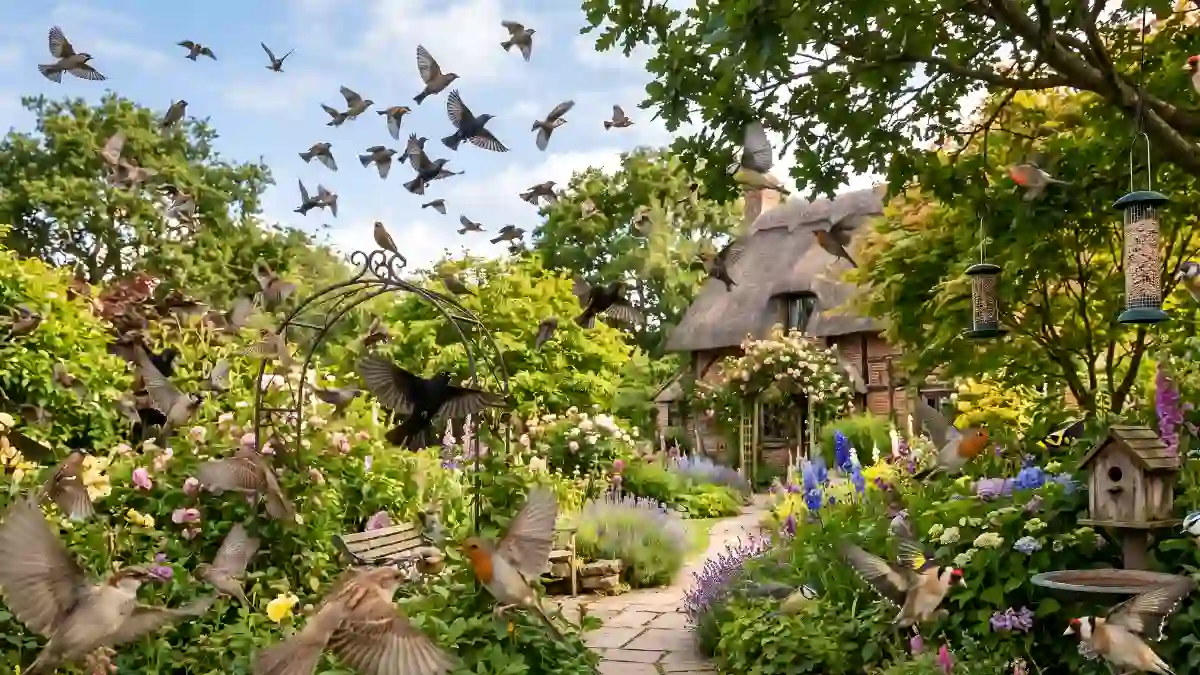
Imagine waking up every morning to the sound of cardinals, bluebirds, and goldfinches right outside your window — not because you hung a feeder, but because your garden itself became their natural home.
That’s the quiet magic of bird-friendly plants.
Across America, native bird populations are declining. Habitat loss, pesticide usage, and the expansion of ornamental-only gardens have depleted the food, shelter, and nesting supplies that birds rely on. What is the good news? You don’t need a lot of land to make an impact. The correct plants, strategically chosen, may transform even the smallest residential garden into a healthy wildlife corridor.
This guide covers the best bird-friendly plants for every region of America, why native species outperform exotic ones, and exactly how to design a yard that birds will never want to leave.
Why bird-friendly plants matter more than feeders
Most bird lovers start with a feeder. It’s simple, enjoyable, and functional—to a point. However, feeders simply supply supplementary nutrients. Bird-friendly plants go much further:
- They produce natural food — berries, seeds, nectar, and insects that birds are biologically adapted to eat.
- They offer shelter and nesting sites year-round, not just during feeding hours.
- They support insect populations — the real foundation of most bird diets, especially during breeding season.
- They’re self-sustaining, requiring far less maintenance than a feeder stocked with seed.
The Cornell Lab of Ornithology routinely finds that yards with native plants attract much more bird species than yards with standard landscaping, regardless of whether feeders are provided.
The secret ingredient? Native plants co-evolved with native birds. They produce the correct berries at the right time, attract the right insects, and grow in ways that birds naturally use for shelter.
Top bird-friendly plants for american backyards
1. Eastern red cedar (Juniperus virginiana)
If you could plant only one tree for birds, many ornithologists would recommend this one. Eastern Red Cedar yields rich, blue-gray berries that are eaten by over 50 species, including Cedar Waxwings, American Robins, Bluebirds, and Yellow-rumped Warblers.
Its lush evergreen foliage also makes it the best winter roosting and nesting location in the eastern United States. It tolerates drought, grows quickly, and flourishes from the Gulf Coast to southern Canada.
Best for: Eastern and Central U.S. Birds attracted: Cedar Waxwing, Eastern Bluebird, American Robin, Purple Finch
2. Oak trees (Quercus spp.)
Oaks are possibly the most significant genus of animals in North America. A single mature oak tree may host over 500 types of caterpillars and insects, which provide the necessary protein for juvenile birds to thrive. Acorns nourish woodpeckers, jays, turkeys, and ducks.
There are natural oaks for every location, including White Oak and Red Oak in the East, Valley Oak and Blue Oak in California, and Texas Live Oak in the south. Plant an oak, no matter where you live.
Best for: All regions (species vary by area) Birds attracted: Red-headed Woodpecker, Blue Jay, Wild Turkey, Wood Duck, Brown-headed Nuthatch
3. Serviceberry (Amelanchier spp.)
Serviceberry, one of spring’s most generous presents to birds, yields little red-to-purple berries in late spring, just as migrating songbirds arrive. It’s one of the earliest fruiting trees of the season, and birds flock to it in droves.
Beautiful white blooms in early spring make it a landscape treasure as well. Multiple kinds are suitable for diverse temperatures, ranging from the multi-stemmed Shadblow Serviceberry in the east to the Western Serviceberry in drier areas.
Best for: All regions Birds attracted: Baltimore Oriole, Rose-breasted Grosbeak, Scarlet Tanager, Hermit Thrush
4. American holly (Ilex opaca)
Holly berries bloom in the fall and last into winter, offering a vital food source when other options are few. The thick, prickly evergreen foliage provides ideal nesting and roosting habitat. American Holly is an excellent food source for winter birds.
Plant male and female trees together (both are required for berry production), and your yard will convert into a winter bird magnet.
Best for: Eastern U.S. Birds attracted: American Robin, Eastern Bluebird, Cedar Waxwing, Mockingbird
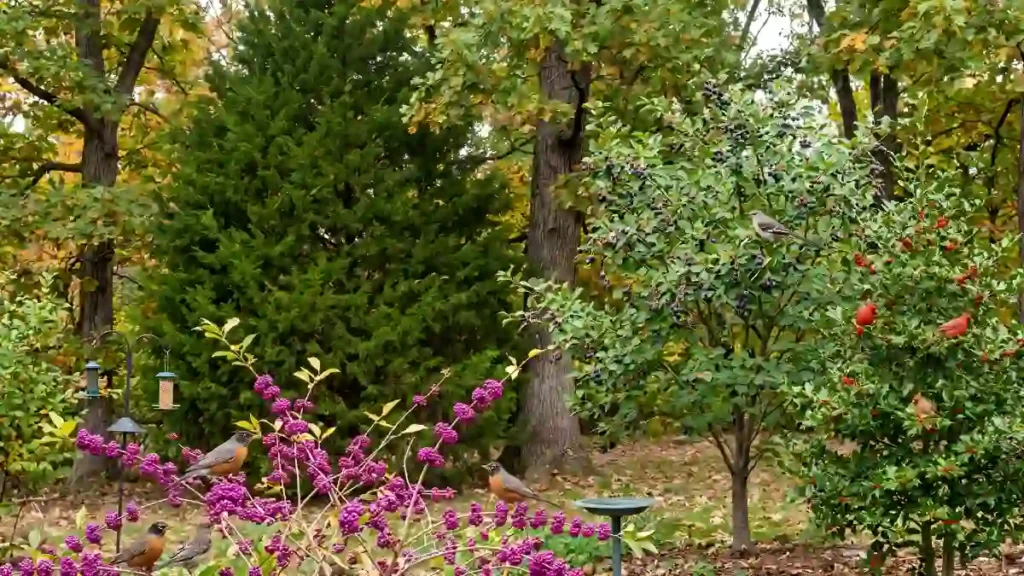
5. Beautyberry (Callicarpa americana)
Few plants can rival Beautyberry’s visual drama in the fall, when its branches are completely covered in clusters of vibrant purple berries. It’s beautiful in the garden, and the birds can’t get enough.
Native to the southeastern U.S. but adaptable across much of the country, it’s fast-growing, low-maintenance, and works beautifully as a mid-border shrub. Over 40 bird species have been observed eating the berries.
Best for: Southeast and Mid-Atlantic U.S. Birds attracted: Brown Thrasher, Eastern Towhee, American Robin, Northern Mockingbird
6. Elderberry (Sambucus canadensis)
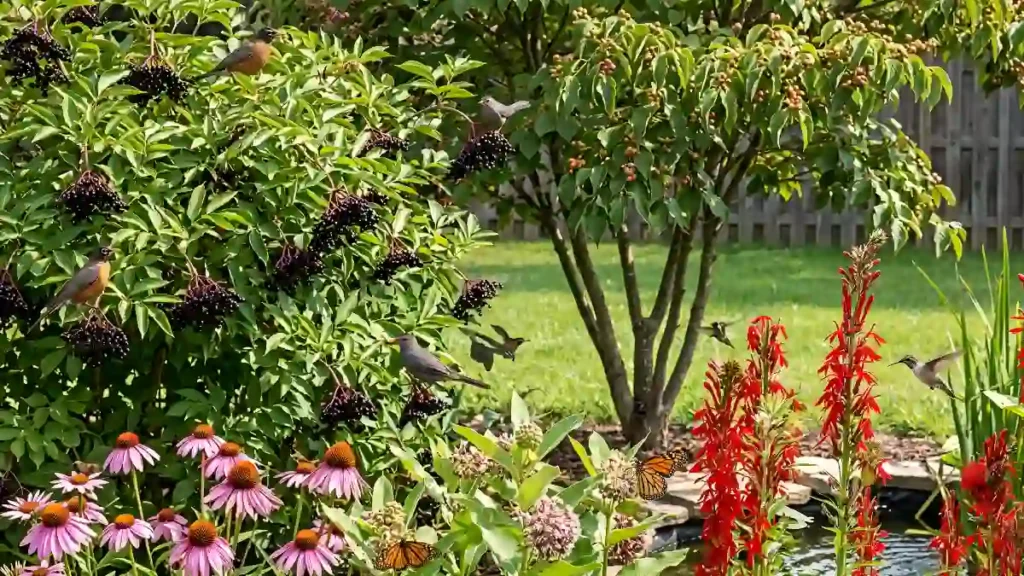
Elderberry is one of the most prolific, bird-friendly plants you can grow. It produces massive clusters of small black berries in late summer, which birds of all sizes eat, from little warblers to bigger thrushes and catbirds.
It also attracts dozens of moth and butterfly species, providing an insect smorgasbord for insectivorous birds. Elderberry grows quickly, tolerates moist circumstances, and may be heavily pruned each year to maintain its neat appearance.
Best for: Eastern and Central U.S. Birds attracted: Gray Catbird, Red-eyed Vireo, Swainson’s Thrush, Indigo Bunting
7. Dogwood (Cornus florida and other natives)
Flowering Dogwood is a classic American native that provides year-round value, including gorgeous spring blooms, summer foliage, fall color, and bright red berries that mature in late summer and early October, just in time for southern migration to refuel.
The berries are heavy in fat, which is exactly what migrating birds require throughout their lengthy flights. Few plants attract a wider variety of migratory songbirds.
Best for: Eastern U.S. Birds attracted: American Robin, Wood Thrush, Eastern Bluebird, Pileated Woodpecker
8. Purple coneflower (Echinacea purpurea)
Coneflower is the ultimate bird-friendly perennial. Its enormous seed heads last into the fall and winter, making it a favorite of American Goldfinches, House Finches, and Dark-eyed Juncos. The blooms also attract insects that warblers, wrens, and chickadees feed on.
Leave the seed heads hanging throughout winter – don’t trim them back in the fall — and you’ll have a steady stream of finches and sparrows visiting even in the coldest months.
Best for: Eastern and Central U.S. Birds attracted: American Goldfinch, House Finch, Dark-eyed Junco, Chickadees
9. Milkweed (Asclepias spp.)
Beyond its famous role supporting Monarch butterflies, milkweed is an exceptional bird-friendly plant. Its fluffy seed pods are harvested by Yellow Warblers and American Goldfinches for nest lining. The insects it attracts — particularly aphids and beetles — feed many insectivorous species.
Common Milkweed, Butterfly Weed, and Swamp Milkweed are all excellent native options depending on your moisture conditions.
Best for: All regions (species vary) Birds attracted: Yellow Warbler, American Goldfinch, Baltimore Oriole (for nesting fiber)
10. Cardinal flower (Lobelia cardinalis)
Named for the brilliant red color of its blooms (not the bird, interestingly), Cardinal Flower is the top hummingbird plant native to the eastern U.S. Ruby-throated Hummingbirds are powerfully drawn to it, and its tubular red flowers are perfectly shaped for their bills.
It thrives in moist, partly shaded spots — along streams, at pond edges, or in rain gardens — and self-seeds reliably once established.
Best for: Eastern U.S. Birds attracted: Ruby-throated Hummingbird
11. Native grasses (Panicum virgatum, Andropogon gerardii)
Switchgrass, Big Bluestem, and other native grasses offer something many gardeners overlook: dense, low cover for ground-foraging birds and sparrows, as well as seed-filled heads that last into the winter. Grasses also support a vast number of insects, notably leafhoppers and grasshoppers, which ground birds hunt.
Once grown, they require very little maintenance, and their winter structure enhances any landscape.
Best for: Central and Eastern U.S. Birds attracted: Song Sparrow, Field Sparrow, American Tree Sparrow, Bobolink
Designing your bird-friendly backyard: practical tips
Layer your plantings
Birds use different vertical zones. Aim for:
- Canopy trees (oaks, elms) for aerial hunters and large frugivores
- Understory trees (serviceberry, dogwood) for songbirds and thrushes
- Shrubs (elderberry, holly, native viburnums) for ground-feeders and nesters
- Herbaceous layer (coneflowers, grasses, milkweed) for finches, sparrows, and hummingbirds
Go native — always
Exotic decorative plants such as Burning Bush, English Ivy, Bradford Pear, and Japanese Barberry may appear appealing, yet they give absolutely little benefit to birds. Many are invasive, aggressively degrading natural habitat. Replace them one by one with natural counterparts and watch your bird diversity increase.
Skip the pesticides
Pesticides not only kill insects, but they also deplete the food sources that birds require the most. Insect-eating birds such as warblers, flycatchers, and swallows rely nearly completely on insects during the mating season. A yard with bird-friendly vegetation but high pesticide use remains a food desert for birds.
Add water
A shallow birdbath or small pond dramatically increases your yard’s attractiveness. Birds that rarely visit feeders — warblers, vireos, tanagers — are reliably drawn to moving water. Keep it clean and refill it frequently.
Let some things be “Messy”
Leave leaf litter beneath trees and plants. It is an ideal hunting field for thrushes, towhees, and sparrows. Leave dead stems remaining throughout winter because they attract insects and offer perches. Allow some regions to get a little wilder. Birds thrive on that.
Regional quick reference
| Region | Top Bird-Friendly Plants |
| Northeast | Serviceberry, Oak, Coneflower, Eastern Red Cedar |
| Southeast | Beautyberry, American Holly, Elderberry, Coral Honeysuckle |
| Midwest | Big Bluestem, Elderberry, Oak, Purple Coneflower |
| Southwest | Desert Willow, Salvia, Agave, Penstemon |
| Pacific Northwest | Red-flowering Currant, Osoberry, Oregon Grape, Camas |
| California | Toyon, Coffeeberry, Native Sages, Canyon Sunflower |
Conclusion:
Creating a garden with bird-friendly plants is simple; all you have to do is choose plants with purpose. Every native plant you add is a modest step toward habitat restoration, and birds notice it immediately.
Begin with one berry-producing bush. Create a patch of coneflowers. Allow the leaf litter to rest. Over time, your yard will transform into something quite extraordinary: a living piece of native habitat in the heart of the suburban landscape, teeming with birds and song in every season.
The birds are seeking for exactly what you can offer them. All you need to do is plant it.
Certainly! If you’d like to learn more, please consider following our WhatsApp Channel, Facebook, Instagram, YouTube, Twitter, and Pinterest.
Frequently asked questions about bird-friendly plants
Q1: What are the best bird-friendly plants for a small backyard?
A1: For limited space, prioritize multi-purpose plants that provide food, shelter, and insect habitat simultaneously. Serviceberry, native viburnums, coneflowers, and a single oak or native holly can support dozens of bird species even in a small yard. Vertical layering — shrubs beneath a small tree with perennials in front — maximizes habitat value per square foot.
Q2: Do bird-friendly plants attract only certain bird species?
A2: Different plants attract different birds. Berry-producing plants like dogwood and holly attract thrushes and waxwings. Seed-producing plants like coneflower draw finches and sparrows. Tubular flowers like Cardinal Flower attract hummingbirds. Oaks and other insect-hosting trees attract warblers and chickadees. The more plant diversity you create, the greater your bird diversity will be.
Q3: Are there bird-friendly plants that work in containers or on balconies?
A3: Yes. Native salvia species, coneflowers, and native grasses all grow well in large containers and attract hummingbirds, finches, and insectivorous birds. Even a single container planting of native flowers on a balcony can attract migrants during fall and spring movements.
Q4: Should I remove exotic ornamental plants to add bird-friendly plants?
A4: Replacing non-native ornamentals with native bird-friendly plants is one of the most effective things a homeowner can do to help local bird populations. Prioritize removing invasive exotics (English Ivy, Japanese Barberry, Burning Bush, Multiflora Rose) first, since they aggressively destroy nearby environment. Replace them one at a time with native replacements.