
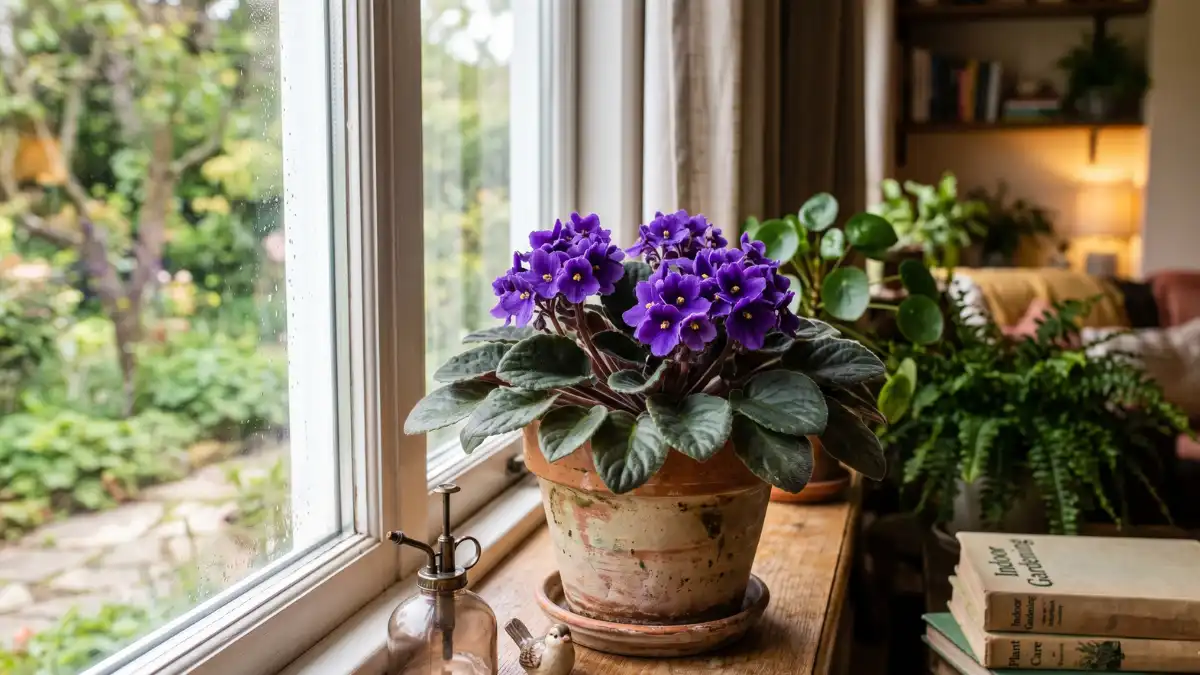
They sit on windowsills. They bloom for months without complaint. And with hundreds of named cultivars in shades from snow-white to near-black purple, African violet varieties have earned their place as the world’s most popular flowering houseplant.
Whether you’re a first-time grower or a seasoned collector looking for your next show-worthy specimen, this book cuts through the hype and provides a sensible, practical explanation of the finest kinds to know, nurture, and love.
What are african violets?
African violets (Saintpaulia ionantha) are native to the cloud forests of Tanzania and Kenya. They have now been hybridized into hundreds of recognized varieties, which are classed according to flower shape, leaf type, plant size, and growth behavior.
Understanding these categories is your first step to picking the right variety — not just any pretty one.
African violet varieties by flower type
Single-flowered varieties
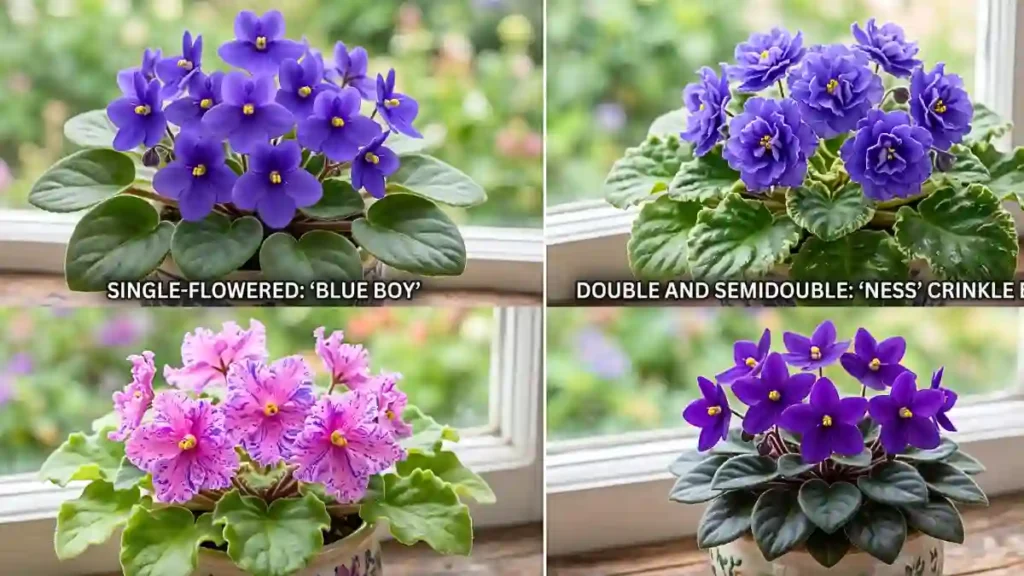
The traditional look. Five round petals, a single hue, simple and classic. Single-flowered varieties such as ‘Optimara Little Maya‘ and ‘Rob’s Choc-O-Lot‘ are suitable for beginners and bloom consistently under normal indoor lighting conditions.
Best for: New growers, low-maintenance windowsill displays.
Double and semidouble varieties
More petals, more drama. Double African violets produce layered, rose-like blooms that hold longer than singles. ‘Ballet Kiki’ and ‘Aca’s Raspberry Splash’ are standout examples — dense, ruffled, and show-stopping.
Best for: Collectors, tabletop centrepieces, gift plants.
Fringed and fantasy varieties
Fringed petals feature delicate, lace-like edges, as if the flower was hand-cut. Speckles, streaks, and two-tone patterns are popular choices among fantasy artists. ‘Lyon’s Magestic‘ (white with purple fantasy markings) is a collector’s choice.
Best for: Advanced growers, competitive shows, statement displays.
Star-shaped varieties
Five equal, pointed petals make a beautiful star. These have a geometric, almost graphic appearance. ‘Tommie Lou‘ (white with a green border) is one of the most photographed star cultivars in cultivation.
Best for: Anyone who loves clean, architectural beauty in plants.
African violet varieties by plant size
Size matters — especially if you’re working with limited shelf or window space.
| Size Class | Size Class | Example Varieties |
| Micro Miniature | Under 3 inches | ‘Pip Squeak’, ‘Tiny Pink’ |
| Miniature | 3–6 inches | ‘Optimara Little Angel’, ‘Rob’s Boolaroo’ |
| Semi-Miniature | 6–8 inches | ‘Jolly’, ‘Ma’s Pride’ |
| Standard | 8–16 inches | ‘Blue Boy’, ‘Optimara Wonderland’ |
| Large/Giant | Over 16 inches | ‘Giant Pink Smoke’, ‘Pacific Plum’ |
African violet varieties by growth habit
Rosette (Symmetrical) varieties
Most African violets grow in a flat, symmetrical rosette. This is the standard form — tidy, uniform, ideal for single-pot display. ‘Optimara Europa’ is the textbook example of a perfect rosette form.
Trailing varieties
Trailing African violets (Saintpaulia grotei hybrids) have a cascading habit in which several crowns flow outward, resulting in a rich, mounded look. They look great in hanging baskets or large, shallow pots.
Top trailing varieties include:
- ‘Frozen in Time’ — soft white with lavender edges
- ‘Candy Shower’ — pink blooms over dark green foliage
- ‘Harmony’s Kewpie’ — one of the most floriferous trailing types
Best for: Hanging baskets, wide terracotta bowls, experienced growers.
Best African violet varieties for beginners
If you’re just starting out, skip the rare cultivars and begin with proven performers. These varieties bloom readily, tolerate minor neglect, and adapt to lower light conditions:
- ‘Optimara Little Maya’ — compact, purple, near-indestructible
- ‘Blue Boy’ — the variety that made African violets a household name
- ‘Rhapsodie Elfriede’ — prolific pink bloomer, widely available
- ‘Buckeye Cascade’ — forgiving and fast-growing
All four are available at most garden centres and online African violet specialists.
Rare and collector African violet varieties
For the serious enthusiast, the African Violet Society of America (AVSA) registers hundreds of new varieties each year. Current collector favourites include:
- ‘Rob’s Vanilla Trail’ — cream-white trailing variety with exceptional form
- ‘Ness’ Cinnamon Toast’ — coppery-pink tones, virtually unique in the genus
- ‘Lyon’s Shocking Pink’ — vivid neon pink that photographs beautifully
- ‘Granger’s Wonderland’ — deep burgundy foliage with pink blooms
Many rare varieties are only available through speciality nurseries or AVSA chapter sales.
How to choose the right African violet variety
Ask yourself four questions before buying:
- How much light do I have? Low-light homes suit darker-leaved varieties like ‘Purple Ruffles’. Bright spots open up fantasy and chimera types.
- How much space? Measure your windowsill or shelf before falling for a giant variety.
- Am I a beginner or collector? Start standard, then go rare.
- What’s my bloom preference? Singles for simplicity, doubles for drama, fantasy for flair.
Conclusion:
The world of African violet varieties is far larger and more intriguing than most people realize. From a perfectly formed miniature on your kitchen windowsill to a trailing cascade in a hanging basket, there’s something for every location, skill level, and aesthetic preference.
Begin with a well-established beginning variety. Understand how it grows. Then investigate.
The rabbit hole is worth it.
Certainly! If you’d like to learn more, please consider following our WhatsApp Channel, Facebook, Instagram, YouTube, Twitter, and Pinterest.
Frequently asked Questions about African violet varieties
Q1: How many African violet varieties exist?
A1: Over 16,000 named varieties have been registered with the African Violet Society of America since records began — and new hybrids are introduced every year.
Q2: Do different African violet varieties need different care?
A2: The basics — bright indirect light, watering from the bottom, well-draining soil — apply to virtually all varieties. Trailing types prefer wider, shallower pots, and miniatures may need slightly less fertiliser.
Q3: Can I grow African violet varieties indoors year-round?
A3: Yes. African violets are strictly indoor plants in most climates and bloom continuously when given consistent warmth (65–75°F / 18–24°C) and 10–14 hours of light per day.
Q4: Where can I buy rare African violet varieties?
A4: Specialty online nurseries, AVSA affiliate shows, and growers’ Facebook groups are the best sources. eBay and Etsy also have active African violet seller communities.