


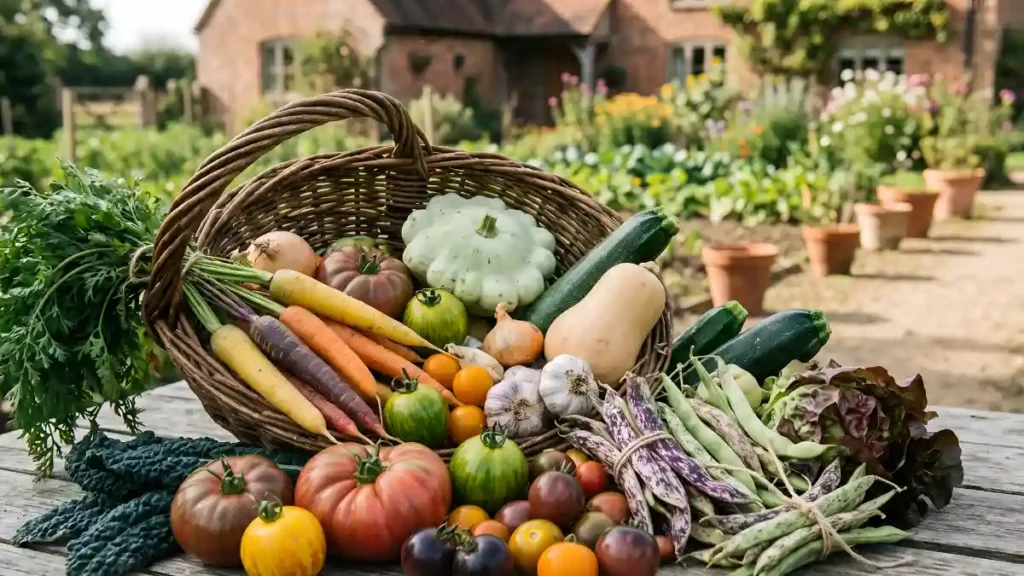
Somewhere in your supermarket, every tomato looks identical — perfectly round, uniformly red, and almost entirely flavourless. Now imagine biting into a deep-purple Cherokee Purple tomato, its flesh rich, sweet, and tangy all at once. Or slicing open a Chioggia beetroot to reveal concentric pink-and-white rings like a tiny, edible bullseye.
Welcome to the world of heirloom vegetables, which are making a strong resurgence in home gardens, farmers’ markets, and Michelin-starred restaurants.
This book will teach you all you need to know about heritage vegetables, including what they are, why they disappeared, why they are more important than ever, and how to start growing them now.
What are heirloom vegetables?
The term “heirloom vegetable” refers to any plant type that has been open-pollinated and passed down through generations, usually at least 50 years old, although many variations date back centuries. Unlike current hybrid types, heritage vegetables reproduce true from seed, which means you may store seeds from this year’s crop and raise the identical plant the next year.
Three key traits define an heirloom variety:
- Open-pollinated: Pollinated naturally by insects, wind, or birds — not artificially controlled.
- Genetically stable: Seeds produce offspring identical (or near-identical) to the parent plant.
- Historical lineage: Most recognised heirlooms have documented histories of at least 50 years, with many tracing back to the 1800s or earlier.
Heirloom vs. Hybrid vs. GMO — What’s the Difference?
This distinction confuses many gardeners, so let’s clarify it once and for all.
Heirloom varieties are open-pollinated, genetically consistent, and may be saved as seeds. They illustrate the variety that predated modern agriculture.
Hybrid varieties (F1) are formed by purposely cross-breeding two different parent plants to generate offspring with certain desirable features such as disease resistance, higher yields, and uniformity. What about the trade-off? Seeds from hybrids do not breed true. Each generation loses the parent qualities, rendering seed saving unreliable.
GMO (Genetically Modified Organisms) involve laboratory-level genetic engineering — inserting genes from entirely different species. These are a separate category altogether and are not available to home gardeners in most countries.
Heirloom vegetables are on the opposite end of the spectrum: no laboratory, no patents, no corporate seeds, just thousands of years of meticulous human cultivation.
A brief history of heirloom vegetables
For most of human history, all vegetables were heirlooms. Farmers carefully selected the best plants each season, saved their seeds, and traded varieties with neighbours and travellers. Over millennia, this created an extraordinary genetic library — thousands of distinct varieties adapted to specific climates, soils, and culinary traditions.
The mid-20th century changed everything.
The green revolution’s unintended consequence
The post-World War II agricultural revolution emphasized production, shelf life, and consistency in industrial transportation. Seed corporations began to create and patent hybrid types. Supermarkets need product that appeared identical and could withstand long-distance shipping. In the 1970s and 1980s, hundreds of traditional cultivars had silently gone from commercial agriculture.
According to the Food and Agriculture Organisation (FAO), approximately 75% of the world’s plant genetic diversity was lost between 1900 and 2000. What took thousands of years to cultivate was nearly erased in a single century.
The heirloom revival
Fortunately, a subtle opposition was constantly brewing. Home gardeners, seed savers, and small-scale farms continued to cultivate traditional types. Organisations such as the Seed Savers Exchange (established in 1975 in the United States) and the Heritage Seed Library (UK) began collecting, cataloging, and sharing at-risk types before they lost forever.
Today, the heirloom vegetable movement has spread throughout popular culture. These ancient plants are now getting the attention they deserve, from seed exchanges in community gardens to upscale restaurant menus that prominently display variety names.
Why heirloom vegetables are worth growing
1. Extraordinary flavour
This is why most people convert—and stay converted. Heirloom veggies were chosen over ages for their flavor, not their mobility. The distinction is not subtle.
A Brandywine tomato tastes not just “more tomatoey” than a retail variety, but also like a tomato: nuanced, acidic, sweet, and strongly aromatic. The Dragon Tongue beans snap with a delightful crunch. When Jimmy Nardello peppers are cooked in olive oil, they caramelize and become nearly jammy.
Modern commercial cultivars emphasise thick skins (for mechanized harvesting), consistent ripening (for logistics), and long shelf life. Flavour is rarely at the top of the list.
2. Biodiversity and food security
A world that relies on just a handful of crop varieties is a vulnerable world. The Irish Potato Famine of the 1840s, which killed over a million people, was exacerbated by an overreliance on a single potato type. When a new illness emerged, there was no genetic backup.
Heirloom vegetables provide unique genetic variety. Different cultivars have varying tolerance to diseases, pests, and climatic conditions. Maintaining this DNA library isn’t a nostalgic gesture; it’s an insurance policy for humanity’s food security.
3. Seed saving = seed freedom
Growing heirloom vegetables means you can save seeds at the end of the season and grow the same variety again next year — indefinitely, for free. Over time, your saved seeds even adapt subtly to your specific local conditions, making each generation slightly better suited to your garden.
Hybrid seeds must be repurchased each year. With heirlooms, you invest once and grow forever.
4. Potential nutritional advantages
The nutritional science is still developing, but some studies indicate that heritage varieties may have more antioxidants, vitamins, and phytonutrients than commercial types. One explanation is that many of the molecules that give veggies their vibrant colors and diverse flavors (anthocyanins, lycopene, and beta-carotene) also act as potent antioxidants. Many of these chemicals were lost as flavor was bred out.
5. Connection to culture and history
Heirloom vegetables are living cultural artefacts. The Mortgage Lifter tomato was bred in the 1930s by a man who sold plants to pay off his house. Bloody Butcher corn has been grown in Appalachian communities since the early 1800s. Costoluto Genovese tomatoes have graced Italian tables for centuries.
Growing these varieties is participating in an unbroken chain of human cultivation — there’s something genuinely moving about that.
Top heirloom vegetables varieties to grow
Tomatoes
- Brandywine (Pink) — The gold standard. Large, beefsteak-style, incredibly rich flavour. Indeterminate, mid-to-late season.
- Cherokee Purple — Dusky rose-purple skin, sweet-smoky flavour, highly ornamental.
- Green Zebra — Striped green-yellow skin, tangy and bright. A farmers’ market favourite.
- Black Krim — Russian heirloom with dark, almost chocolate flesh and a deep, savoury flavour.
Beans
- Dragon Tongue — Yellow with purple streaks. Buttery flavour, productive, and beautiful in the garden.
- Scarlet Runner — Ornamental and edible; striking red flowers attract pollinators.
Squash & courgette
- Delicata — Sweet, nutty, thin-skinned. Much easier to prepare than large winter squashes.
- Costata Romanesco — A ribbed Italian courgette with nutty, firm flesh that doesn’t go watery when cooked.
Beetroot
- Chioggia — Stunning pink-and-white striped rings inside. Milder and sweeter than standard red varieties.
- Golden Beet — Yellow-orange, sweet, and won’t stain your hands or chopping board.
Lettuce & salad leaves
- Forellenschluss (Flashy Trout’s Back) — Austrian heirloom with gorgeous red-speckled leaves. Buttery, mild flavour.
- Drunken Woman Frizzy Headed — Yes, that’s its real name. Loose-leaf, heat tolerant, and superb texture.
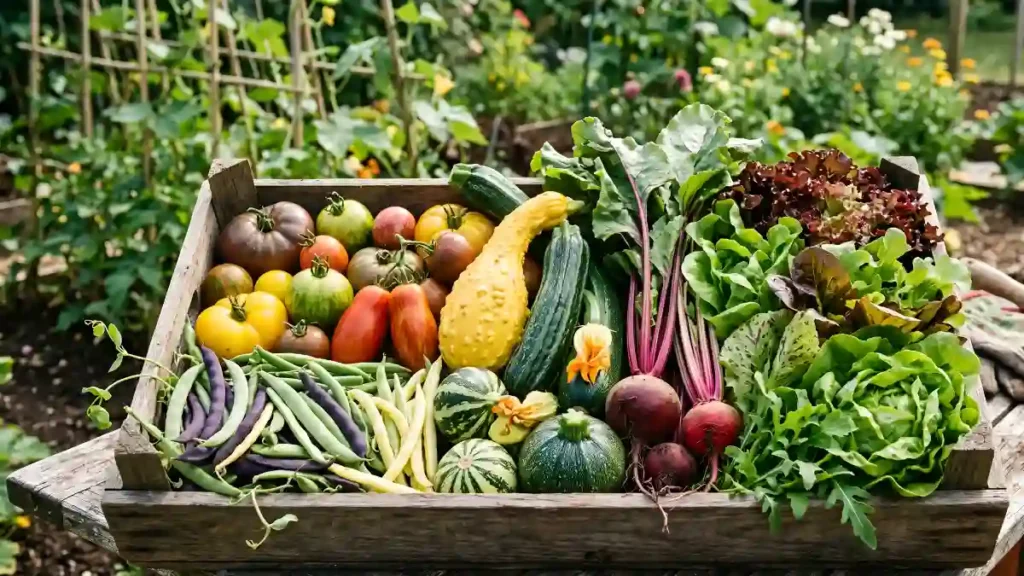
How to grow heirloom vegetables: A practical guide
Start with quality seeds
Source seeds from reputable suppliers who specialise in heirlooms: Real Seeds (UK), Seeds of Change, Baker Creek Heirloom Seeds, or your local seed library. Seeds or a local seed library. Check that the kinds are clearly labeled as open-pollinated.
Soil preparation
Heirloom vegetables generally reward rich, healthy soil. Before planting:
- Add generous amounts of well-rotted compost or manure.
- Aim for a loose, well-draining structure.
- Test your soil pH — most vegetables prefer a pH of 6.0–7.0.
Starting from seed
Most heirloom tomatoes, peppers, and aubergines must be started indoors six to eight weeks before the latest frost date. Sow in trays or small pots, maintain warm (20-25°C), then transfer outside once frost has past.
Hardier crops like beetroot, beans, salad leaves, and courgettes can be direct-sown outdoors once the soil has warmed.
Spacing and support
Check the precise needs for each variety; heirloom tomatoes, in example, vary greatly, from compact bush varieties to spreading indeterminate vines that can exceed 2 meters. Most will require staking or caging.
Watering and feeding
Consistent watering is key, especially for tomatoes — irregular watering causes blossom end rot and fruit splitting. A mulch layer around plants helps retain moisture. Feed with a balanced liquid fertiliser once plants start flowering.
Saving seeds for next year
This is where heirloom growing becomes truly sustainable:
- Tomatoes: Scoop out seeds, ferment in water for 2–3 days (this removes the gel coating), rinse, and dry thoroughly on paper.
- Beans and Peas: Let pods dry completely on the plant before harvesting. Shell and store.
- Squash: Scoop seeds from fully ripe fruit, rinse, and dry.
Store seeds in labelled paper envelopes in a cool, dark, dry location. Most heirloom seeds remain viable for 3–5 years or longer.
Where to buy heirloom vegetables
If you’re not growing your own yet, heirloom vegetables are increasingly available at:
- Farmers’ markets — the best source, with vendors who can tell you exactly what you’re buying.
- Farm box subscriptions — many small farms specialise in unusual heirloom varieties.
- Specialist greengrocers — in larger cities especially.
- Community gardens and seed swaps — free, social, and brilliant.
When shopping, look for labels that say “heirloom,” “heritage,” or list a specific variety name (e.g., “Brandywine tomatoes” rather than just “tomatoes”).
Heirloom vegetables in the kitchen
The best advice: get out of their way. Heirloom vegetables are at their finest with simple preparation that lets their flavour shine.
- Heirloom tomatoes: Slice thickly, drizzle with good olive oil, sea salt, and torn basil. Nothing more needed.
- Heirloom beans: Blanch briefly and dress with butter and fresh herbs.
- Delicata squash: Halve, roast cut-side down until caramelised — no peeling required.
- Chioggia beetroot: Roast whole, peel while warm, and serve with whipped goat’s cheese. The rings fade when cooked, so slice raw for visual impact.
The kitchen rewards you for choosing well at the seed catalogue or market.
Conclusion:
Heirloom vegetables are more than just a garden trend. They signify a return to flavor, variety, and the painstaking, deliberate effort of generations who grew these plants long before anybody considered patenting a seed. In a world of homogenized commercial food, they represent a radical act of taste.
Begin with one variety. Taste the difference. Then attempt to go back.
Certainly! If you’d like to learn more, please consider following our WhatsApp Channel, Facebook, Instagram, YouTube, Twitter, and Pinterest.
Frequently asked questions about heirloom vegetables
Q1: Are heirloom vegetables more nutritious than regular vegetables?
A1: Emerging research suggests some heirloom varieties may contain higher levels of certain antioxidants and phytonutrients, particularly compounds linked to rich colour and complex flavour. However, growing conditions, freshness at harvest, and preparation methods also significantly affect nutritional content.
Q2: Can I save seeds from heirloom vegetables?
A2: Yes — this is one of their greatest advantages. Because heirloom vegetables are open-pollinated, their seeds produce offspring true to the parent plant. Save seeds each year, and you’ll build up a personal seed bank adapted to your local conditions.
Q3: Are heirloom vegetables organic?
A3: Not automatically. “Heirloom” refers to the variety’s genetics and history, not how it’s grown. You can grow heirloom vegetables conventionally (with synthetic fertilisers and pesticides) or organically. Many heirloom growers do choose organic methods, but the two terms are separate.