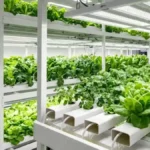
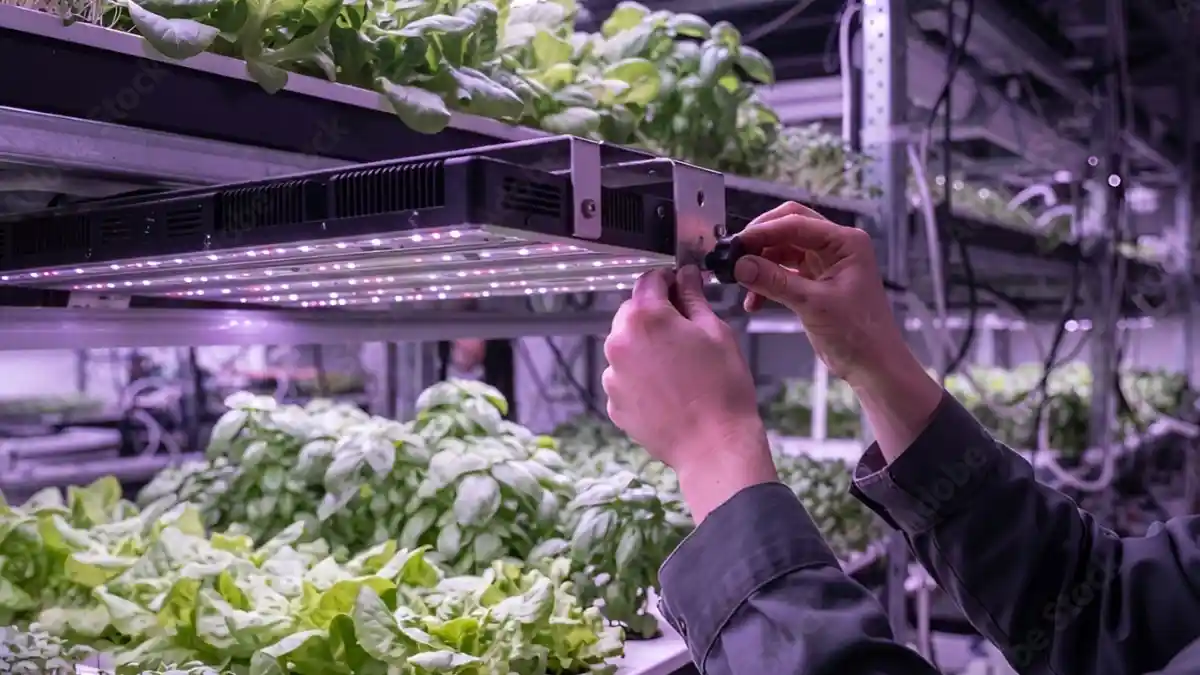
Walk into any thriving indoor farm and you will notice one thing before anything else: the glow. Pink, white or purple, that light is doing the job of the sun, and it decides how fast your plants grow, how dense your harvest is and how much you pay on your electricity bill. Hydroponic lights are the engine of every indoor water-based garden, and choosing the wrong ones is the most expensive mistake a grower can make.
The good news is that selecting the right lights is far less complicated than the product listings make it seem. In this guide you will learn exactly how hydroponic lights work, which types are worth your money, how much light each crop needs, and how to set everything up for maximum yield. Whether you are growing a few pots of basil on a shelf or planning a multi-tier lettuce farm, you will leave with a clear plan.
What are Hydroponic Lights?
Hydroponic lights are specially designed lighting systems that provide artificial light to plants growing in hydroponic environments. Unlike traditional gardening, where plants receive natural sunlight from the outdoors, hydroponic gardening often takes place indoors, inside greenhouses, or in controlled growing spaces where sunlight may be limited. These lights help plants receive the energy they need for photosynthesis, even when natural daylight is unavailable. They are particularly useful for indoor gardeners, vertical farms, small apartments, and commercial hydroponic growers who want to maintain consistent growing conditions throughout the year.
The primary goal of hydroponic lighting is to deliver adequate light intensity, spectrum, and duration for optimum plant growth. varying plants have varying lighting requirements, so selecting the right system is critical. For example, leafy vegetables like lettuce and spinach require different amounts of light than fruiting plants like tomatoes and peppers. A good lighting system can promote healthy leaf development, robust stems, and prolific growth. Modern LED technology has made indoor hydroponic growing more accessible by providing usable plant light with adjustable intensity and spectrum.
Another intriguing characteristic of hydroponic lights is that they enable gardeners to better manage the growing environment. Natural sunshine varies with weather, season, and location, but artificial lighting can give a more consistent daily schedule. This makes it easy to stick to a regular growing schedule and plan subsequent harvests. Whether you’re growing a few herbs in your kitchen or running a huge indoor garden, knowing hydroponic lights can help you create a better environment for your plants.
What are Hydroponic Lights and Why Do They Matter?
Hydroponic lights are artificial light sources designed to supply the wavelengths plants use for photosynthesis when sunlight is missing or insufficient. They are sometimes called grow lights, and in a hydroponic setup they are especially important for one reason: there is no soil buffer to forgive mistakes. Nutrients, water and light all work together, and when you push growth with perfect nutrition, plants demand matching light to turn that nutrition into biomass.
The role of light in a hydroponic system
Plants convert light, carbon dioxide, and water into sugars. These sugars develop into leaves, stems, roots, flowers, and fruit. Roots in a hydroponic system receive precisely dosed nutrients, therefore light is typically the limiting factor. Increase the amount of light within the appropriate range, and growth will accelerate. No matter how flawless your fertilizer solution, if you deprive plants of light, they will develop strained, pale, and weak stems.
Why sunlight alone is not enough
Even a bright south-facing window provides significantly less usable light than most people assume. Winter days are short, window glass filters some of the spectrum, and light intensity decreases rapidly as you walk away from the glass. Reliable hydroponic lights allow you control over intensity, duration, and spectrum every day of the year, which is the primary benefit of indoor cultivation.
How Plants Use Light: PAR, PPFD, PPF and DLI
Before comparing products, you need four terms. Learning them takes five minutes and saves hundreds of dollars.
PAR: Photosynthetically active radiation
PAR is the range of light between roughly 400 and 700 nanometers that plants use for photosynthesis. A light can look extremely bright to your eye and still deliver weak PAR, which is why you should never judge a grow light by how it looks.
PPF and PPFD: The numbers that matter
- PPF (Photosynthetic Photon Flux) measures the total amount of PAR light a fixture produces per second, in micromoles per second (µmol/s).
- PPFD (Photosynthetic Photon Flux Density) measures how much of that light actually lands on a square meter of your plant canopy per second, in µmol/m²/s.
PPFD is the most useful number for growers because it tells you what the plants actually receive. A fixture with a high PPF can still give poor PPFD if the light is spread unevenly or hung too high.
DLI: Daily light integral
DLI refers to the total quantity of PAR light received by your plants during the day, measured in moles per square meter per day (mol/m²/day). Consider PPFD as the speed of a car and DLI as the total distance travelled. You can achieve the same DLI using a powerful light for fewer hours or a dimmer light for longer hours.
Types of Hydroponic Lights Compared
There are five main technologies on the market. Each still has a place, but one clearly leads for most growers today.
1. LED Hydroponic Lights (Best Overall)
LED grow lights have become the standard for hydroponics. They convert electricity to usable light very efficiently, run cooler than older technologies, last tens of thousands of hours and can be tuned to specific spectrums.
Pros:
- High efficacy (excellent µmol/J)
- Low heat output, so lower cooling costs
- Long lifespan, often 50,000 hours or more
- Dimmable and available in full spectrum
- Slim designs ideal for multi-tier racks
Cons:
- Higher upfront cost than fluorescents
- Quality varies widely, so cheap no-name units can disappoint
2. Fluorescent Lights (T5 and CFL)
T5 high-output fluorescent tubes are a classic choice for seedlings, clones, microgreens and herbs. They are inexpensive, give gentle even light and are easy to find.
Pros: Low cost, low heat, gentle on young plants.
Cons: Lower intensity, bulbs fade over time, less efficient than LED, bulky for tight spaces.
3. High-Pressure Sodium (HPS)
HPS lamps produce intense light with a heavy red and orange output, which long made them popular for flowering and fruiting crops.
Pros: Strong, proven output.
Cons: Very hot, lower efficiency than modern LED, bulbs need replacing, and extra ventilation and cooling are usually required.
4. Metal Halide (MH)
Metal halide lamps give a bluer, cooler spectrum that suits vegetative growth. Today they are mostly replaced by LED because of higher energy use and heat.
5. Ceramic Metal Halide (CMH / LEC)
CMH lights produce a broad spectrum close to natural sunlight, including some UV. They are efficient compared with older HID lamps but still produce more heat than LED.
| Light Type | Efficiency | Heat Output | Lifespan | Best For |
| LED | Very high | Low | 50,000+ hrs | All crops, all stages |
| T5 Fluorescent | Moderate | Low | 10,000–20,000 hrs | Seedlings, clones, herbs |
| HPS | Moderate | Very high | 10,000–24,000 hrs | Large flowering setups |
| Metal Halide | Lower | High | 10,000–20,000 hrs | Vegetative growth |
| CMH | Moderate–high | Medium | 10,000–20,000 hrs | Full spectrum with UV |
Light Spectrum: What Colors Do Plants Really Need?
Plants do not use all colors equally, and the spectrum you choose shapes how they grow.
Blue light (400–500 nm)
Blue light drives compact, sturdy vegetative growth, thick leaves and strong stomatal function. A good dose of blue prevents tall, floppy seedlings.
Green light (500–600 nm)
Once dismissed as useless, green light is now known to penetrate deeper into the canopy and support photosynthesis in lower leaves. It also makes plants easier to inspect, since colors look natural under white light.
Red light (600–700 nm)
Red is highly efficient for photosynthesis and strongly influences stem elongation, flowering and fruit development. Many “blurple” lights lean heavily on red and blue for this reason.
Far-red and UV
Small amounts of far-red (700–750 nm) can affect leaf expansion and flowering timing. UV can influence plant defense compounds and leaf color, but too much can damage plants, so treat it as an advanced option.
Full spectrum vs. Blurple lights
Purple “blurple” lights are efficient but make it hard to spot pests, deficiencies and disease. Full spectrum white LEDs give a balanced mix, produce natural-looking foliage and are the best choice for most growers. For color temperature, look for roughly 4000–6500K for vegetative growth and 2700–4000K for flowering and fruiting, although quality full spectrum fixtures handle both.
How Much Light Does Each Crop Need?
| Crop Type | Target PPFD (µmol/m²/s) | Target DLI (mol/m²/day) | Typical Hours |
| Microgreens | 100–250 | 8–12 | 12–16 |
| Lettuce and leafy greens | 200–400 | 12–17 | 14–16 |
| Herbs (basil, mint, cilantro) | 200–400 | 14–20 | 14–16 |
| Strawberries | 300–500 | 15–25 | 12–16 |
| Tomatoes, peppers, cucumbers | 500–900 | 20–30+ | 14–18 |
How to Choose the Best Hydroponic Lights
With the basics covered, here is a practical checklist for choosing the best hydroponic lights for your space.
Step 1: Measure your growing area
Measure the canopy footprint, not the whole room. A 2×4 ft tray needs a very different fixture than a 4×4 ft tent. Always match the light’s coverage area to your plant area.
Step 2: Decide your target PPFD
Pick your crop from the table above and choose a fixture able to deliver the target PPFD across the canopy. A light that can be dimmed gives you room to adjust as plants grow.
Step 3: Check efficacy and real data
Look for published efficacy in µmol/J and, ideally, a PPFD map showing intensity across the coverage area. Brands that publish real measured data deserve more trust than those quoting only “equivalent wattage.”
Step 4: Compare features
- Dimming control for different growth stages
- Full spectrum output for balanced growth
- Passive or quiet cooling for living spaces
- Daisy-chaining for multi-light setups
- IP rating for humid grow rooms (look for water-resistant protection)
- Timer or smart controller compatibility
- Warranty length (three to five years signals confidence)
Step 5: Think about total cost of ownership
A cheaper light that wastes electricity and fades quickly costs more over time. Divide purchase price plus several years of electricity by total light produced to see the true cost. This is where efficient LED hydroponic lights usually win.
Step 6: Plan for growth
If you may expand, choose a modular system you can add to. Bar-style LED fixtures work well for multi-tier shelving, while larger panel or board-style lights suit tents and single-level grows.
Common Mistakes to Avoid
Growers often struggle with the same problems. Avoid these and you are already ahead.
- Buying by watts, not PPFD. Wattage tells you cost to run, not light delivered.
- Using too much light on seedlings. Young plants burn easily.
- Ignoring heat. Even LEDs generate heat. Check canopy temperature and airflow.
- Forgetting airflow and CO₂. High light without ventilation limits growth.
- Choosing blurple lights for convenience. It is harder to detect deficiencies under purple light.
- Not tracking DLI. Measure and adjust rather than guessing.
- Skipping a timer. Manual switching leads to inconsistent photoperiod.
- Overlooking reflective surfaces. Dark walls waste light that could reach your plants.
- Buying the cheapest option. Poor drivers, weak warranties and inflated specs can cost more later.
- Not cleaning fixtures. Dust and humidity residue reduce output over time.
Conclusion:
The right hydroponic lights can transform an average indoor garden into a fast, productive and efficient growing system. Remember the essentials: focus on PPFD and DLI instead of watts, choose efficient full spectrum LED fixtures, match intensity to your crop, hang lights at the correct height and keep a steady photoperiod with a timer.
Start with a light matched to your space and your crop, measure results, and adjust. Small tweaks in height, schedule and spectrum often deliver the biggest gains. Choose well once, and your lights will reward you with healthier plants and bigger harvests for years.
Ready to build your setup? Explore related guides: [Internal link: Best Hydroponic Systems for Beginners] • [Internal link: Hydroponic Nutrients Guide] • [Internal link: How to Grow Lettuce Hydroponically]
Certainly! If you’d like to learn more, please consider following our WhatsApp Channel, Facebook, Instagram, YouTube, Twitter, and Pinterest.
Frequently Asked Questions (FAQs)
Q1: What are the best hydroponic lights for beginners?
A1: Full spectrum, dimmable LED lights are the best choice for beginners. They are efficient, run cool, suit every growth stage and make it easy to adjust as plants grow. Start with a fixture sized to your grow area rather than the biggest light you can afford.
Q2: Are LED lights better than HPS for hydroponics?
A2: For most growers, yes. LED lights are more energy-efficient, produce less heat, last longer and offer better spectrum control. HPS still produces strong light, but it needs more cooling and ventilation, which raises your total costs.
Q3: How many hours of light do hydroponic plants need?
A3: Most leafy greens and herbs do well with 14–16 hours of light per day. Seedlings can take 16–18 hours, and fruiting crops often use 12–16 hours depending on the variety. Most plants also need a dark period, so avoid running lights nonstop.
Q4: How far should hydroponic lights be from plants?
A4: It depends on the fixture’s power and the crop’s stage. Many LED fixtures are hung about 12–24 inches above the canopy, with seedlings farther away or on a dimmed setting. Always follow the manufacturer’s height guide and watch for signs of light stress.
Q5: Do hydroponic lights use a lot of electricity?
A5: Lighting is usually the biggest ongoing cost of indoor growing, but efficient LED hydroponic lights use far less electricity than older technologies for the same amount of usable light. Dimming, reflective surfaces and good timer cut costs further.