
Your neighbors’ lawns appear pristine. What’s their secret? They haven’t used a mower in months.
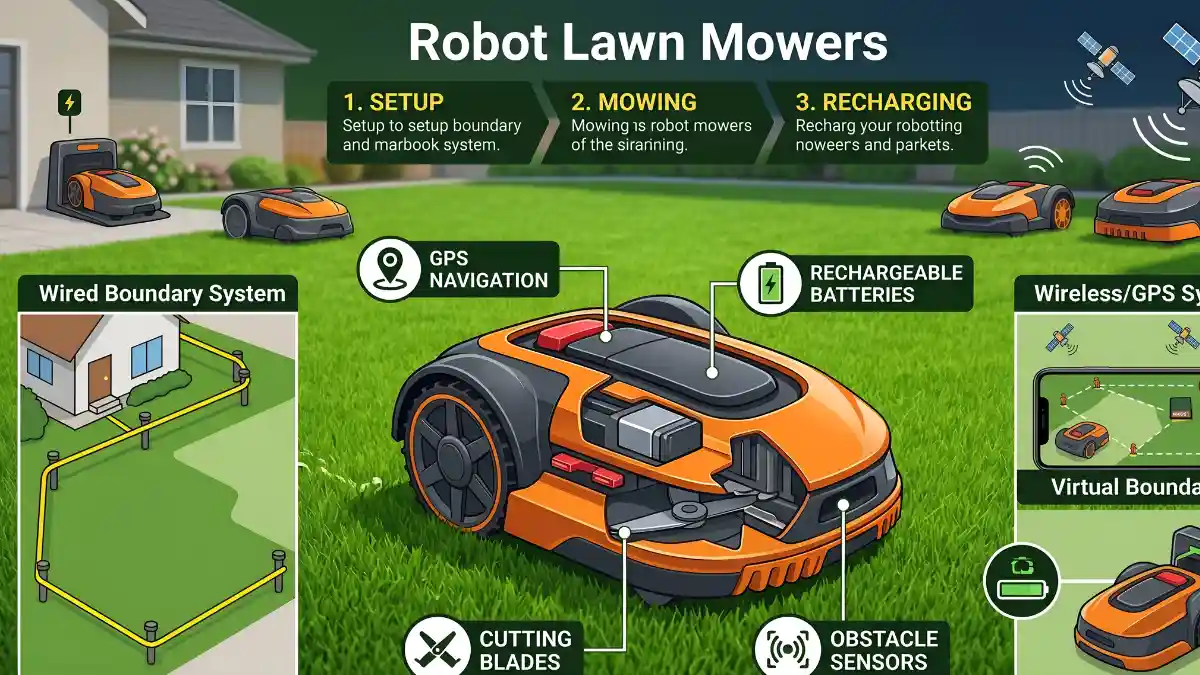
Robot lawn mowers in 2026 have crossed a major threshold — they’re no longer gadgets for tech enthusiasts or premium-only purchases for the well-heeled. They’ve grown more clever, shockingly inexpensive, and simple to set up than a new smartphone. AI-powered obstacle recognition, centimeter-accurate GPS navigation, and wire-free limits have transformed these devices into the most appealing lawn care update in years.
If you’ve been debating between two options, 2026 is the year to make a decision. Here’s all you should know.
Why 2026 is the breakout year for robot lawn mowers
The robotic mower market has been building momentum since the early 2010s, but 2026 represents something of a tipping point. Three converging forces are making these machines better than ever:
AI has finally come to your garden
The biggest leap in 2026 models isn’t battery life or cutting width — it’s intelligence. New-generation robot mowers utilize integrated AI cameras and machine learning to tell the difference between a football left on the grass, a sleeping cat, and a decorative stone. They avoid collisions by navigating around them. Some models also learn your lawn’s specific patterns over time, optimizing their courses for optimal efficiency.
Wire-free technology is now the norm
Until recently, installing a robot mower included spending a Saturday afternoon laying boundary wires around your whole lawn, a tedious and error-prone task. In 2026, RTK-GPS (Real-Time Kinematic GPS) navigation became commonplace, providing centimetre-level precision without a single cable in the ground. Map your lawn once using an app, confirm your no-go zones, and you’ll be done in less than an hour.
Prices have dropped significantly
Premium features that cost £2,000 or more two years ago may now be found in mid-range devices priced between £700 and £1,000. Entry-level robot mowers cost roughly £350, bringing the technology available to the majority of UK homes for the first time.
How robot lawn mowers work in 2026
Understanding the technology makes choosing the right mower much easier.
Navigation methods
RTK-GPS wire-free (recommended for 2026 purchases): Premium features that cost £2,000 or more two years ago may now be found in mid-range devices priced between £700 and £1,000. Entry-level robot mowers cost roughly £350, bringing the technology available to the majority of UK homes for the first time.
Traditional perimeter wire: A low-voltage wire defines the mowing boundary. Still reliable and often more affordable, but installation is time-consuming and wires can be accidentally cut during gardening.
Vision-based navigation: The most advanced 2026 models pair GPS with AI cameras to build a live visual map of the lawn, detecting changes like newly placed furniture, garden toys, or pets in real time.
The cutting process
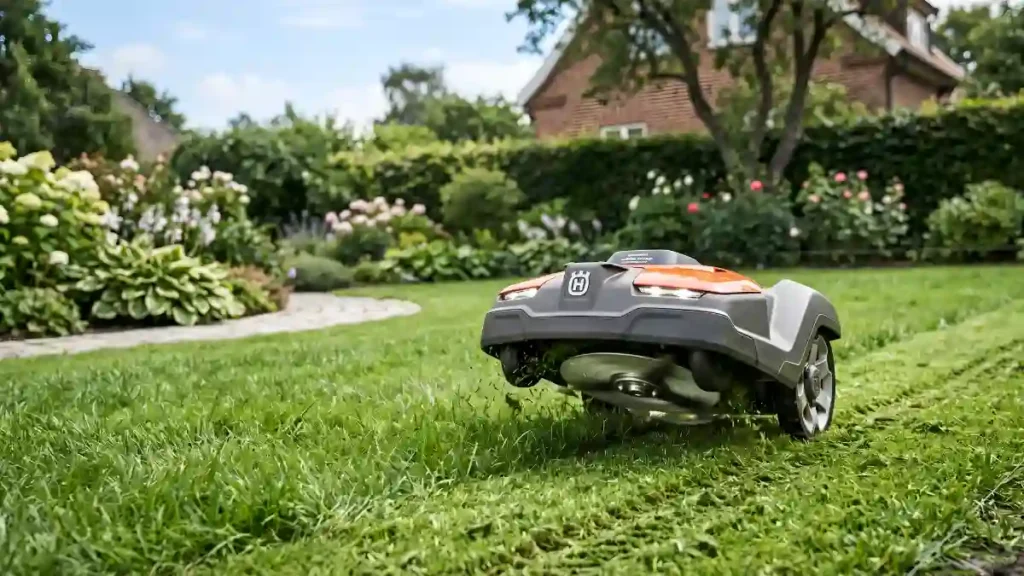
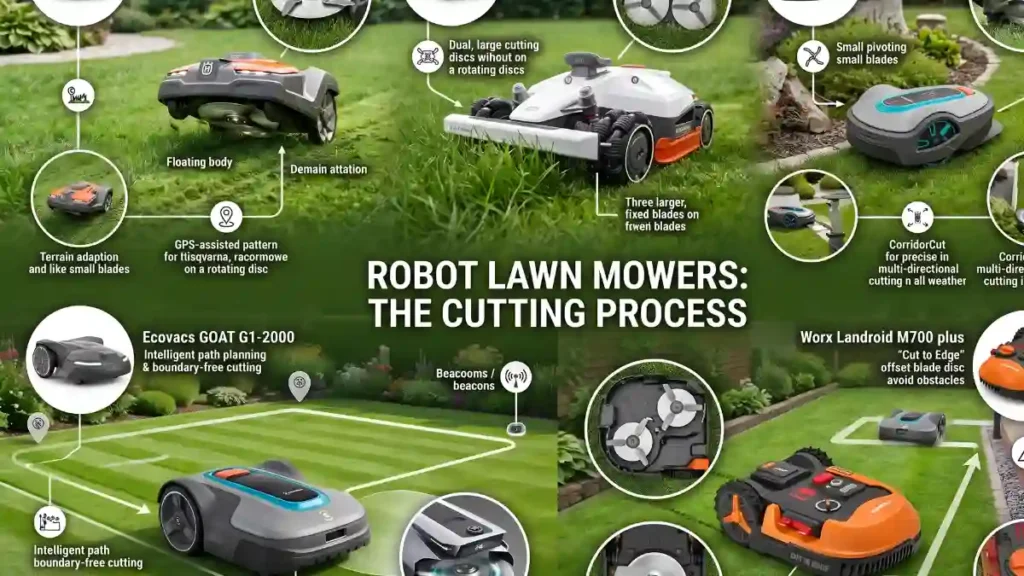
Robot mowers employ tiny, razor-like cutting blades placed on a spinning disk. They cut continually in overlapping patterns, using either random (earlier approach) or systematic grid/parallel passes (newer models). Clippings are sliced so finely they fall back into the soil as natural fertiliser through a process called mulching, which actively improves lawn health over time. No collection box, no disposal, and no garbage.
Charging and scheduling
When the battery gets low, the mower automatically returns to its docking station, recharges, and begins from where it left off. Modern scheduling via app allows you to arrange it to mow overnight, throughout the week while you are at work, or on a bespoke rotating schedule over various grass zones.
What to look for: The 2026 robot mower buying checklist
Lawn size rating — Go one tier up
Always get a model rated larger than your real grass size. A mower rated for 800 m² on a 600 m² area requires fewer cycles, saves battery life, and lasts longer. Size values provided by manufacturers are based on ideal conditions; actual gardens rarely meet these standards.
Wire-free vs. perimeter wire
For most buyers in 2026, wire-free RTK-GPS is the smarter choice — faster setup, easier relocation, and no risk of accidentally severing a buried wire. Perimeter wire models remain a solid choice if you’re on a tight budget or have a very simple rectangular lawn.
Slope capability
One of the most commonly overlooked specs. Slopes are measured as a percentage gradient:
- Up to 35% — suitable for most domestic gardens
- 35–45% — mid-tier and premium models
- 45–50%+ — AWD (all-wheel drive) specialist models only
Buying underpowered for your slope leads to slipping, poor coverage, and premature motor wear.
Obstacle detection quality
Look for ultrasonic + camera AI detection as a minimum in 2026. Basic bump-and-reverse sensors are adequate for empty lawns, but they are inconvenient if you have children’s toys, beautiful pots, or dogs who spend time outside.
App quality and smart integration
A excellent app alters the user experience. Key features include easy scheduling, real-time GPS monitoring, zone management, firmware upgrades, rain delay options, and interaction with Alexa or Google Home. Read user evaluations that are particular to the app; hardware and software quality may not always match.
Security features
Robot mowers are a common target for thieves. Prioritise: PIN lock, motion-triggered alarm, GPS monitoring, and lift detection with alert. Several 2026 models offer geofencing notifications in case the mower leaves your yard.
Blade replacement ease
Blades need replacing every 1–3 months. On the best models, this is a 60-second, tool-free job. On poorly designed ones, it’s a frustrating chore. Check this in reviews before buying.
The best robot lawn mowers in 2026
Best overall: husqvarna automower 430X NERA
The standard for serious gardeners. Husqvarna’s EPOS precision navigation allows for wire-free operation and can manage up to 3,200 m² and 45% slopes. It also connects with most smart home ecosystems. The application is top-tier. Expensive but bulletproof—owners usually claim 7-10 years of dependable service.
Ideal for medium to large gardens, slope-heavy terrain, and tech-savvy users.
Price range: £2,200 to £2,600.
Best value: mammotion LUBA 2 AWD 3000H
The most talked-about robot mower of 2026 among value-conscious buyers. Wire-free RTK-GPS navigation, all-wheel drive for complex terrain, handles up to 3,000 m², and has multi-zone capability. The companion app is intuitive and frequently updated. Delivers premium features at a genuinely mid-range price.
Best for: Value seekers, gardens with varied terrain, first-time buyers upgrading to wire-free Price range: £900–£1,200
Best for small gardens: gardena sileno life 1000
Quiet, stylish, and really easy to use. Gardena’s Bluetooth app allows for scheduling and coverage of up to 1,000 m², including slopes up to 35%. Its whisper-quiet operation (57 dB) makes it suitable for urban gardens where noise is an issue. One of the most straightforward configurations accessible.
Best for: Gardens under 1,000 m², first-time robot mower owners, quiet neighbourhoods Price range: £550–£700
Best AI obstacle detection: ecovacs GOAT G1-2000
The top performer for obstacle-filled gardens. GOAT’s AI Vision system can detect and avoid items as tiny as 10 cm, including as dogs, toys, and uneven terrain characteristics. GPS navigation system with 2,000 m² capacity and no wires. The camera-based intelligence adds to the sense of being truly cutting-edge.
Best for: Families with children/pets, complex gardens, obstacle-rich environments Price range: £1,100–£1,400
Best budget entry: worx landroid M700 plus
For anyone who wants to explore robot mowing without making a large financial investment. Covers 700m² with perimeter wire navigation and features. OLGa AI anti-collision features a useful companion app for scheduling and zone administration. Wire installation is required, however the product gives outstanding dependability for the price.
Best for: Budget buyers, small–medium lawns, straightforward garden shapes Price range: £400–£550
Robot lawn mowers vs. traditional mowers in 2026
| Feature | Robot Mower (2026) | Petrol Mower | Corded Electric |
| Weekly Time Required | 0 minutes | 60–120 minutes | 45–90 minutes |
| Annual Running Cost | ~£20–£40 | £80–£200+ | £25–£50 |
| Grass Health Outcome | Excellent (mulching) | Good | Good |
| Noise Level | 55–65 dB | 90–100 dB | 75–85 dB |
| Carbon Emissions | Zero | Significant | Minimal |
| Setup Complexity | Low–Medium | None | None |
| 5-Year Cost (typical) | £800–£1,800 | £600–£1,500 | £400–£900 |
| Best For | Busy homeowners | Rural, rough terrain | Budget-conscious |
Setting up a wire-free robot mower in 2026: step by step
Gone are the days of complex multi-hour installations. Here’s what modern wire-free setup actually looks like:
- Charge the mower fully before first use — typically 2–3 hours
- Download the companion app and create your account
- Place the charging station in a flat, sheltered spot accessible from all areas of your lawn
- Walk the boundary — carry the mower slowly around your lawn’s perimeter while the app records the GPS path, or draw it manually on the app’s satellite map
- Mark no-go zones — tap out areas you want the mower to avoid (flower beds, vegetable patches, play areas)
- Set your mowing schedule — most users choose 4–5 sessions per week during growing season
- Run a test cycle — watch the first mow to confirm zones and obstacle detection are working correctly
Total setup time: 45–75 minutes for most gardens.
Caring for your robot mower: A simple maintenance routine
Robot mowers are low maintenance by design — but not zero maintenance. Keep yours running perfectly with this easy routine:
Every 1–2 weeks:
- Rinse the underside with a garden hose to remove clippings and debris
- Check cutting blades for wear or nicks
Every 1–3 months:
- Replace the cutting blades (quick, cheap, tool-free on most 2026 models)
- Clean the charging contacts on the mower and dock
Every season:
- Check for app/firmware updates
- Inspect the charging station cable for wear
- Re-calibrate GPS boundary if you’ve rearranged the garden
Annually (pre-winter storage):
- Full clean and blade replacement
- Battery health check
- Store at room temperature with a 50–80% charge
The bottom line: should you buy a robot lawn mower in 2026?
Yes — and here’s the honest case for it.
Robot lawn mowers in 2026 are no longer a compromise. They don’t require a weekend of installation, they don’t need a massive budget, and they don’t produce patchy results. They cut better than most weekend mowing sessions, promote healthier grass through consistent mulching, run almost silently, and cost next to nothing to operate.
The question isn’t really whether robot mowers are worth it in 2026 — the technology has definitively answered that. The real question is which model fits your garden, your budget, and your lifestyle.
Pick your size, pick your budget, set it up on a Sunday afternoon, and enjoy every Saturday morning you get back from here on out. Your lawn has never been in better hands — even when those hands are entirely mechanical.
Certainly! If you’d like to learn more, please consider following us on WhatsApp, Facebook, Instagram, YouTube, Twitter, and Pinterest.
Frequently asked questions about robot lawn mowers in 2026
Q1: Can robot lawn mowers handle uneven or bumpy lawns?
A1: Yes, performance varies per model. Standard models can handle slight undulations easily. For really uneven or rugged terrain, seek for AWD (all-wheel drive) models with active suspension, such as the Mammotion LUBA 2 AWD, which are particularly intended for such circumstances.
Q2: How long do robot lawn mowers last?
A2: With proper maintenance, a quality robot mower should last 7–12 years. Battery packs typically last 5–7 years before needing replacement, which costs £100–£250 depending on the model. Cutting blades are consumables replaced every 1–3 months at minimal cost.
Q3: How much does it cost to run a robot lawn mower per year?
A3: Running costs are remarkably low. Electricity expenditures normally range from £15 to £35 per year. Add cutting blade replacements (about £10-£25 per year), and the total yearly cost is frequently less than £60 — a fraction of petrol mower upkeep, gasoline, and your own time.
Q4: Are robot lawn mowers worth buying in 2026?
A4: Absolutely – 2026 is likely the finest year ever to purchase one. Prices are lower, AI technology is more powerful, and wire-free GPS setup has eliminated the most significant barrier to entrance. For anyone with a regularly mowed lawn, the time savings alone justify the purchase within a single growing season.