Imagine stepping outside on a warm evening and seeing your garden glow — no electrician, no running cables, no electricity bill. That is exactly what solar garden lights offer. Whether you’re framing a pathway, emphasizing flower beds, or creating a cozy atmosphere on your patio, solar-powered lighting has become one of the most popular and cost-effective garden enhancements of the decade.
However, with dozens of types, brands, and specifications on the market, selecting the perfect ones might be difficult. This guide cuts right through the noise.
How solar garden lights actually work
Solar garden lights are elegantly simple. A tiny photovoltaic (PV) panel on top of each lamp receives sunlight during the day and turns it into electrical energy, which is then stored in a rechargeable battery, often NiMH or lithium-ion. When darkness falls, a built-in photosensor automatically turns on the light, taking power from the stored energy.
Most excellent solar lights give 6-10 hours of lighting on a full day’s charge, making them dependable even in mild regions. The better versions now have dusk-to-dawn sensors, motion detection, and customizable brightness modes.
The real benefits of going solar
| Zero Running Costs | Free energy from the sun, every single night |
| No Wiring | Simple DIY install — no electrician needed |
| Eco-Friendly | Powered by clean, renewable energy |
| Safer Home | Lit paths deter intruders and prevent falls |
Beyond convenience, solar garden lights contribute to meaningful reductions in household carbon emissions. A conventional set of ten solar pathway lights may save up to 150 kWh of electricity per year when compared to mains-powered alternatives, representing a small but significant step toward a greener living.
Types of solar garden lights
Not all solar lights serve the same purpose. Matching the type to your garden’s needs is the key to a stunning result.
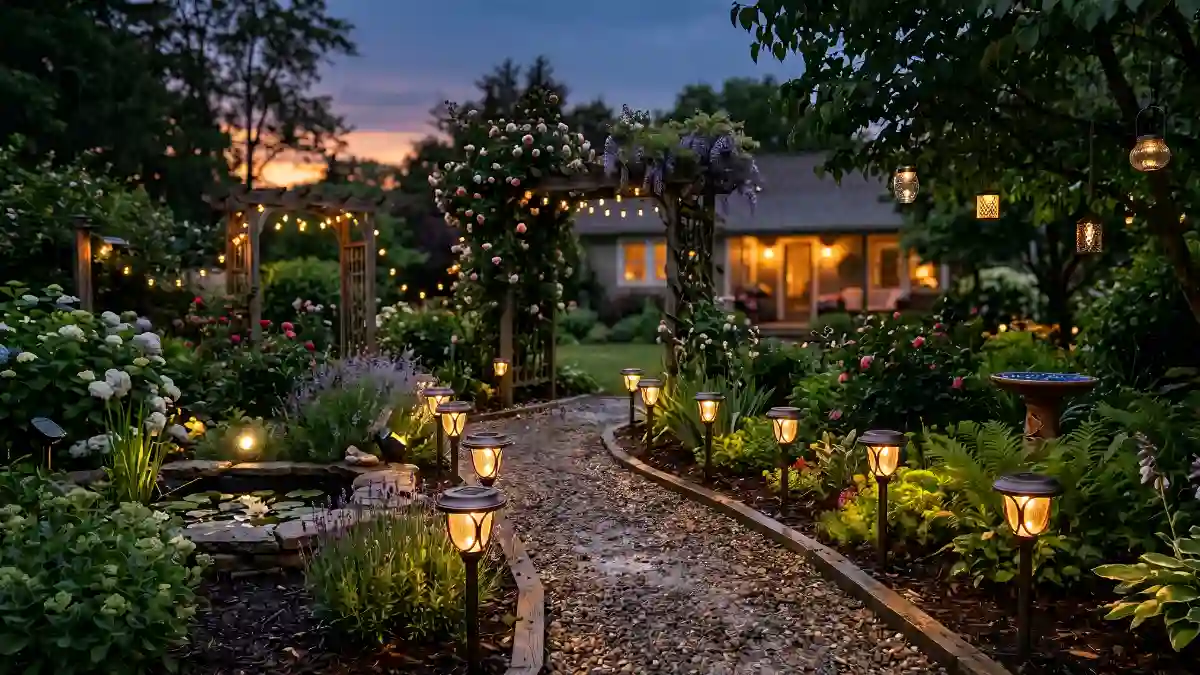
- Pathway lights — Low-profile stakes that line walkways and driveways, guiding footsteps safely after dark.
- Spotlights — Directional beams ideal for highlighting statues, trees, or architectural features.
- String lights — Festive, decorative strands for fences, pergolas, or outdoor dining areas.
- Flood lights — High-lumen output with motion sensors for security and wide-area illumination.
- Lanterns & decorative lights — Style-forward designs that double as garden ornaments by day.
- Deck & step lights — Flush-mount options for patios, decking edges, and garden steps.

What to look for when buying
1. Lumens, not watts
With solar lights, lumens (brightness output) are significantly more important than watts. Pathway lights normally require 10-50 lumens, whereas security flood lights should provide 700 lumens or more. Always verify the lumen rating before purchasing.
2. Battery capacity
Look for lights with a battery capacity of at least 1,200 mAh for dependable nighttime use. Lithium-ion batteries beat NiMH batteries in cold weather and survive longer—typically 2-3 years before needing replacement.
3. IP rating (weatherproofing)
Outdoor lighting must be weatherproof. An IP65 classification indicates that the lamp is fully protected from dust and water jets, making it ideal for the majority of UK and European climatic conditions. Avoid anything less than IP44 for long-term outdoor use.
4. Solar panel quality
Monocrystalline panels are more efficient and perform better in low-light or cloudy environments than polycrystalline panels. If you reside in a foggy area, monocrystalline is worth the small additional expense.
Installation tips for maximum performance
Even the best solar garden lights will underperform if not installed correctly. Follow these easy guidelines: face the solar panels south (in the northern hemisphere), keep them away from overhanging branches or eaves, and wipe them periodically with a wet cloth to eliminate dust and bird droppings. Before you turn on your lights for the first time, charge them in direct sunshine for a full day.
Spacing also crucial. For paths, 1.5-2 meters between pegs produces a balanced, welcome glow without the “airport runway” look.
Conclusion:
Solar garden lights are no longer a novelty — they are a smart, sustainable, and stylish choice for any outdoor space. Free to run, easy to install, and kinder to the planet, they offer everything a modern homeowner needs from garden lighting. As the technology keeps improving and prices remain accessible, there has never been a better time to let the sun light up your garden after dark.
Certainly! If you’d like to learn more, please consider following us on WhatsApp, Facebook, Instagram, YouTube, Twitter, and Pinterest.
Frequently asked questions about solar garden lights
Q1: Do solar garden lights work in winter or cloudy weather?
A1: Yes, though less efficiently. Modern solar lights with monocrystalline panels can still charge on overcast days. Expect shorter run times in winter — typically 4–6 hours instead of 8–10. Lights with larger battery reserves handle seasonal variation best.
Q2: How long do solar garden lights last?
A2: The LED bulbs themselves can last 50,000+ hours (effectively decades). The limiting factor is the rechargeable battery, which typically needs replacing after 2–3 years. Many brands sell replacement battery packs, extending the light’s total lifespan significantly.
Q3: Can solar lights charge through glass (e.g., on a windowsill)?
A3: Glass filters out a significant portion of UV light, so charging through a window is far less efficient than direct outdoor exposure. It’s not recommended as a primary charging method, though it may work as a temporary solution.
Q4: Are solar garden lights bright enough for security?
A4: Solar security flood lights with motion sensors can currently output 1,000-2,000 lumens, which is entirely equal to mains-powered versions. For security, choose high-lumen versions with PIR (passive infrared) motion detection and a detection angle of at least 120 degrees.
Q5: What’s the best way to maintain solar garden lights?
A5: Clean the solar panels monthly, replace batteries every 2–3 years, and store lights indoors or switch them off during extended periods of very low sunlight (such as deep winter) to preserve battery health. A little maintenance goes a long way.