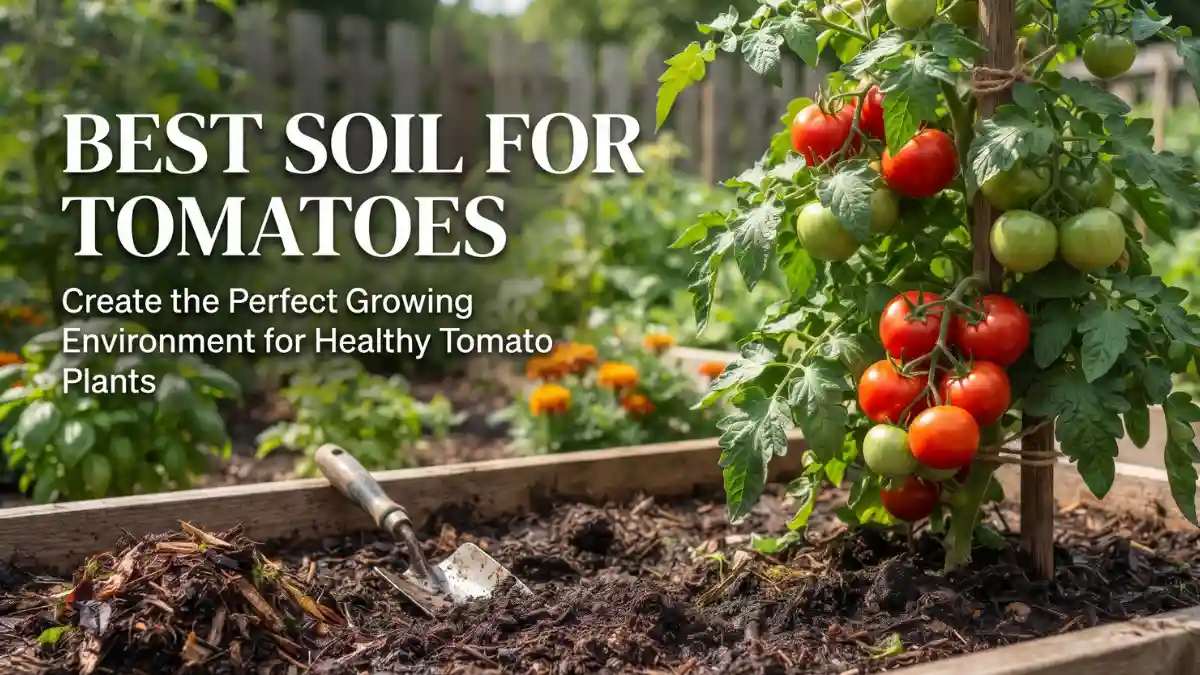
Choosing the correct soil is the first step in growing tomatoes. You can buy healthy seedlings, give them plenty of sunlight, and water them on a regular basis, but bad soil will prohibit them from generating a good yield. The key to developing healthy tomato plants is to provide the proper environment for their roots from the start.
The best soil for tomatoes is a loose, well-draining, nutrient-rich loam with a slightly acidic pH of 6.2 to 6.8 and plenty of compost. Get that foundation right and your plants reward you with strong roots, sturdy stems and heavy trusses of sweet fruit. Get it wrong and no amount of fertiliser can rescue them.
Most tomato problems start below the surface. Blossom end rot, yellow leaves, slow growth, cracked fruit and weak flowering often trace back to compacted, waterlogged or nutrient-poor soil rather than pests or disease. Tomatoes are hungry, deep-rooting plants. A single plant can send roots down 3 feet (90 cm) or more when the soil allows it.
This guide covers everything you need to build the perfect growing medium:
- What makes the best soil for tomatoes, from structure to pH
- The best soil for tomatoes in pots, with ready-to-use recipes
- The best soil for tomatoes in raised beds, with exact blend ratios
- How to improve ordinary garden soil, test it and fix common mistakes
Whether you grow one patio plant or fifty in a backyard plot, you will find a clear, practical plan below.
What Makes the Best Soil for Tomatoes?
Great tomato soil does four jobs at once: it holds water, drains the excess, feeds the plant and lets roots breathe. Every recipe in this article is built around these four traits.
1. Loose, crumbly structure
Tomato roots need to push deep and wide. Heavy, compacted soil slows them down and starves them of oxygen. Good soil feels like a squeezed sponge cake: it crumbles easily in your hand but still holds together briefly when pressed.
2. Excellent drainage with steady moisture
Tomatoes enjoy regular wetness but dislike damp feet. Soggy soil promotes root rot and fungal infections. Dry swings result in fractured fruit and blossom end rot. The optimal mix drains readily while still holding adequate water between waterings, which is why organic matter and a little amount of coarse material like perlite or sand are so important.
3. Rich in organic matter
Compost and other organic materials support soil life, gradually release nutrients, and promote drainage and water retention. Aim for 5-10% organic matter in garden soil, which is equivalent to mixing in 2-3 inches (5-8 cm) of finished compost.
4. The right soil pH for tomatoes
The ideal soil pH for tomatoes is between 6.2 and 6.8, which is slightly acidic. In this range, plants absorb nitrogen, phosphorus, potassium and calcium efficiently. If the pH drifts below 6.0 or above 7.0, nutrients become locked up even when they are present in the soil.
5. A balanced nutrient profile
Tomatoes need all the major nutrients, but the balance shifts during the season:
- Nitrogen drives leafy growth early on. Too much later produces a jungle of leaves and few fruit.
- Phosphorus supports roots, flowering and fruit set.
- Potassium improves fruit quality, flavour and disease resistance.
- Calcium prevents blossom end rot and builds strong cell walls.
- Magnesium keeps leaves green and supports photosynthesis.
Soil Types Compared: Which Is Best for Growing Tomatoes?
Loam is the best natural soil for tomatoes, because it balances drainage, moisture and nutrients. Here is how the four main soil types compare and how to fix each one.
| Soil type | Drainage | Nutrient holding | Tomato suitability | How to improve it |
| Loam | Good | Good | Excellent | Top up with compost each year |
| Sandy | Very fast | Poor | Fair | Add compost and aged manure to hold water and nutrients |
| Clay | Slow | High | Poor to fair | Add compost and coarse material, avoid working it when wet |
| Silt | Moderate | Good | Good | Add compost to prevent crusting and compaction |
Sandy soil
Sandy soil warms quickly in spring, which tomatoes love, but water and nutrients drain away fast. Mix in generous amounts of compost and mulch heavily to slow evaporation.
Clay soil
Clay is rich in minerals but dense. It stays cold and wet in spring and bakes hard in summer. Never dig it when soggy. Instead, spread 3 to 4 inches (8 to 10 cm) of compost on top each year, or switch to raised beds where you control the mix.
Silt and loam
Silt soils are fertile and hold moisture well, though they can crust over. Loam, the ideal mix of sand, silt and clay, needs little more than yearly compost to stay productive.
Best Soil for Tomatoes in Pots and Containers
The best soil for tomatoes in pots is a lightweight, high-quality potting mix enriched with compost and a small amount of perlite, never simple garden soil. A excellent container mix remains fluffy all season.
What to look for in a potting mix
- Peat moss or coco coir as the moisture-holding base
- Perlite, pumice or coarse sand for drainage and air space
- Compost or worm castings for slow-release nutrients
- A pH near 6.2 to 6.8
- Labels such as “potting mix” or “container mix” rather than “topsoil” or “garden soil”
DIY recipe: the all-purpose tomato container mix
This simple blend suits most pots and grow bags:
- 50 percent quality potting mix or coco coir
- 30 percent finished compost or worm castings
- 20 percent perlite or pumice
- Optionally, a handful of organic tomato fertiliser per 5 gallons (19 litres) of mix, mixed in well
Mix everything in a wheelbarrow or tub, moisten it lightly and fill your containers to about 1 inch (2.5 cm) below the rim.
Choose the right pot size
Soil volume matters as much as soil quality. Small pots dry out quickly and stress the plant.
| Tomato type | Minimum container size |
| Cherry and patio varieties | 5 gallons (19 litres) |
| Determinate (bush) types | 5 to 10 gallons (19 to 38 litres) |
| Indeterminate (vining) types | 10 to 20 gallons (38 to 75 litres) |
Container soil care tips:
- Use pots with several drainage holes. The old gravel-at-the-bottom method is ineffective for improving drainage.
- Water deeply when the top inch of mix seems dry, and don’t let pots go from bone dry to drenched.
- Feed every 2 to 3 weeks once the fruit has set, as nutrients leach out of containers faster than from the soil.
- Change the blend each season. Reusing old potting soil is possible if you remove the roots, mix in new compost, and discard any dirt from ill plants.
Best Soil for Tomatoes in Raised Beds
The best soil for tomatoes in raised beds is a blend of roughly 60 percent topsoil, 30 percent compost and 10 percent aeration material such as perlite, coarse sand or pumice. Raised beds warm up earlier in spring, drain well and let you build ideal soil from scratch, which makes them one of the most productive ways to grow tomatoes.
Three proven raised bed soil mixes
| Mix | Ratio | Best for |
| Classic garden blend | 60% topsoil, 30% compost, 10% perlite or coarse sand | Most gardeners, budget friendly |
| Equal-parts blend | 1/3 compost, 1/3 coco coir or peat moss, 1/3 vermiculite or perlite | Light, fluffy beds with excellent water holding |
| Compost-rich blend | 50% topsoil, 40% compost, 10% aged manure | Poor native soil or heavy feeders |
How deep should the bed be?
Tomato roots go deep, so aim for at least 12 inches (30 cm) of soil, and 18 inches (45 cm) is better for indeterminate varieties. If the bed sits on bare ground, loosen the soil beneath it with a fork so roots can keep going down.
Calculate how much soil you need
Multiply the length, width, and depth, measured in feet, to determine cubic feet. A bed measuring 4 feet long, 8 feet wide, and 12 inches deep requires around 32 cubic feet, or just under 1.2 cubic yards. A metric garden bed measuring 1.2 m by 2.4 m and 30 cm deep requires about 0.86 cubic metres. Purchase a bit more, since soil compresses during its initial season.
Raised bed soil care
- Top up with 1 to 2 inches (2.5 to 5 cm) of compost every spring.
- Mulch the surface with straw or shredded leaves to hold moisture, since raised beds dry out faster than the ground.
- Rotate tomatoes with non-nightshade crops each year, such as beans, lettuce or onions, to reduce disease buildup.
- Avoid treated timber or unknown materials for the frame if you are growing food.
Best Soil for Tomatoes in the Ground
When planting directly in ground, tomatoes grow best in native soil amended with 2 to 4 inches (5 to 10 cm) of compost, thoroughly mixed into the upper 8 to 12 inches (20 to 30 cm). You need not change your garden’s soil at all. You need to enhance what is already there.
Step-by-step bed preparation
- Choose a sunny spot. Tomatoes need 6 to 8 hours of direct sun.
- Clear weeds and debris, then loosen the soil with a garden fork.
- Spread compost 2 to 4 inches (5 to 10 cm) deep over the surface.
- Mix it in to a depth of 8 to 12 inches (20 to 30 cm), without over-tilling.
- Test and adjust the pH if needed (see the testing section below).
- Rake level and let the bed settle for a week or two before planting.
Plant tomatoes deep
Tomatoes develop roots along each buried stem. Remove the bottommost leaves and bury the stem up to its first true leaves. This gives the plant much larger roots, better drought tolerance, and a stronger anchoring system. Wait to transplant until soil reaches around 60°F (16°C), because cold soil stunts plant growth.
Avoid planting where tomatoes grew recently
Potatoes, peppers and eggplants share diseases with tomatoes. Rotate crops on a 3-year cycle where possible so soil-borne problems do not build up.
Best Soil Amendments and Nutrients for Tomatoes
Soil amendments make average earth ideal ground for growing tomatoes. Add them prior to planting and replenish throughout the season.
| Amendment | What it does | Typical use |
| Finished compost | Feeds soil life, improves structure and water balance | 2 to 4 inches worked into beds, or 30% of a container mix |
| Worm castings | Gentle, nutrient-dense, rich in microbes | 10 to 20% of a container mix, or a side dressing |
| Aged manure | Adds nitrogen and organic matter | Work in at least a month before planting, never fresh |
| Perlite or pumice | Improves drainage and aeration | 10 to 20% of containers and raised beds |
| Coco coir or peat moss | Holds moisture, lightens heavy mixes | Up to 30% of container mixes |
| Crushed eggshell or gypsum | Supplies calcium slowly | Mix into the planting hole |
| Bone meal | Supports roots and flowering through phosphorus | Small handful per planting hole |
| Straw or shredded leaf mulch | Cools soil, locks in moisture, reduces splashback | 2 to 3 inches (5 to 8 cm) after planting |
Preventing blossom end rot with calcium
Blossom end rot, the dark, sunken patch at the very bottom of fruit, generally stems from inconsistent watering that impedes calcium absorption, rather than from calcium deficiency alone. Maintain consistent moisture, apply ample mulch, and keep pH around 6.5. If soil testing reveals low calcium, add gypsum or lime as the test results recommend.
Feeding through the season
- At planting: Use a balanced organic fertiliser or compost-rich soil, and avoid excess nitrogen.
- When the first flowers appear: Switch to a tomato fertiliser with higher phosphorus and potassium.
- During heavy fruiting: Side-dress with compost or feed every 2 to 3 weeks, especially in pots.
More fertiliser is not better. Too much nitrogen produces huge green plants with few tomatoes.
How to Test and Improve Your Soil for Tomatoes
A simple soil test removes the guesswork. Test in late winter or early spring, a few weeks before planting, so you have time to correct problems.
Three easy tests
- Home pH kit or meter: Quick and cheap, good for a first check.
- Lab soil test: Sent through a local agricultural extension service or garden centre. It reports pH, organic matter and nutrient levels, and gives recommendations.
- The jar test: Fill a clear jar one-third with soil, add water, shake for a minute and let it settle. Sand sinks in about a minute, silt in a few hours and clay after a day or more. Roughly 40% sand, 40% silt and 20% clay means you have loam.
Quick squeeze test for drainage
Grab a handful of moist soil and squeeze it. If it stays in a hard, sticky ball, it is too clay-heavy. If it will not hold together at all, it is too sandy. If it forms a loose ball that breaks apart with a gentle poke, it is just right.
7 Common Tomato Soil Mistakes (and How to Fix Them)
- Using garden soil in pots. It compacts and drains badly. Switch to a potting mix blend.
- Planting in cold soil. Wait until soil is about 60°F (16°C) or warm it with black plastic.
- Skipping compost. Even good soil runs low on nutrients after a season. Add compost every year.
- Over-fertilising with nitrogen. You get leaves, not fruit. Use a balanced or tomato-specific feed.
- Watering unevenly. Irregular watering causes cracking and blossom end rot. Water deeply and mulch.
- Planting in the same spot every year. Rotate beds, or refresh the soil, to reduce soil-borne disease.
- Ignoring pH. Test once a year, because the wrong pH locks nutrients away.
Conclusion: Build Great Soil, Grow Great Tomatoes
The best soil for tomatoes is not a single product. It is a set of qualities: loose structure, good drainage, steady moisture, plenty of organic matter and a pH of 6.2 to 6.8. Use a lightweight potting mix with compost and perlite for pots. Use a topsoil, compost and aeration blend for raised beds. Improve your native soil with compost for in-ground rows.
Begin with soil testing, incorporate compost, apply ample mulch, and irrigate regularly. Follow this, and your tomato plants will repay you with vigorous growth and an abundant harvest.
Ready to plant? Share this guide with a gardening friend, and post a comment below describing the soil blend you use for your tomatoes.
Certainly! If you’d like to learn more, please consider following our WhatsApp Channel, Facebook, Instagram, YouTube, Twitter, and Pinterest.
Frequently Asked Questions About the Best Soil for Tomatoes
Q1: What is the best soil for tomatoes?
A1: The best soil for tomatoes is a loose, well-draining loam rich in compost, with a pH of 6.2 to 6.8. In containers, use a quality potting mix blended with compost and perlite. In raised beds, a mix of topsoil, compost and an aeration material such as perlite works well.
Q2: What is the best soil for tomatoes in pots?
A2: Use a lightweight mix of about 50% potting mix or coco coir, 30% compost or worm castings and 20% perlite. Avoid heavy garden soil, which compacts and drains poorly in containers.
Q3: What is the best soil for tomatoes in raised beds?
A3: A reliable blend is 60% topsoil, 30% compost and 10% perlite or coarse sand. Make the bed at least 12 inches (30 cm) deep, and top up with compost each spring.
Q4: Can I use regular potting soil for tomatoes?
A4: Certainly, high-quality container soil makes an excellent foundation for growing tomato plants. To improve outcomes, blend compost for nourishment and perlite for better drainage, then fertilize consistently throughout the fruiting phase.
Q5: What pH do tomatoes need?
A5: Tomatoes grow best in slightly acidic soil with a pH between 6.2 and 6.8. Outside this range, plants struggle to absorb key nutrients.
Q6: Is sandy or clay soil better for tomatoes?
A6: Neither is ideal, but both can be improved. Sandy soil needs compost to hold water and nutrients. Clay soil needs compost and coarse material to improve drainage. Loam is the best natural soil for tomatoes.
Q7: Do tomatoes need fertiliser if the soil is good?
A7: Frequently, yes. Even fertile earth becomes depleted of nutrients when plants produce abundant fruit. Feed potted tomatoes every 2 to 3 weeks and side-dress garden plants with compost all season.