Picture this: you wake up, walk into your garden, and find zero slugs, no aphids, and barely a mosquito in sight — all without spending a penny on pesticides. Sound too good to be true? Not if you have a toad house for your garden.
Toads are one of nature’s most underrated garden allies. A single toad may consume up to 100 insects every night, including slugs, beetles, and mosquitoes – the very pests that devastate vegetation and spoil summer nights. By installing a toad home in your yard, you are effectively hiring a relentless, chemical-free pest exterminator who works the night shift for free.
This guide covers everything you need to know — from choosing the best toad house to placing it for maximum results.
What is a toad house for garden use?
A toad house (also known as a toad domicile or toad shelter) is a modest construction meant to provide garden toads with a secure, cool, and moist hiding place during the daytime. Toads are nocturnal hunters who require daytime cover from heat, predators, and dryness.
These shelters come in many forms:
Classic ceramic or terracotta domes with an arched entrance
Hollow log-style wooden shelters
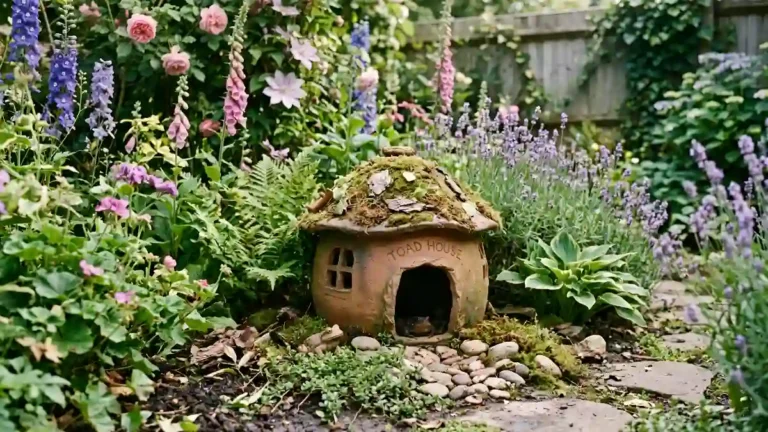
Decorative fairy-garden toad cottages
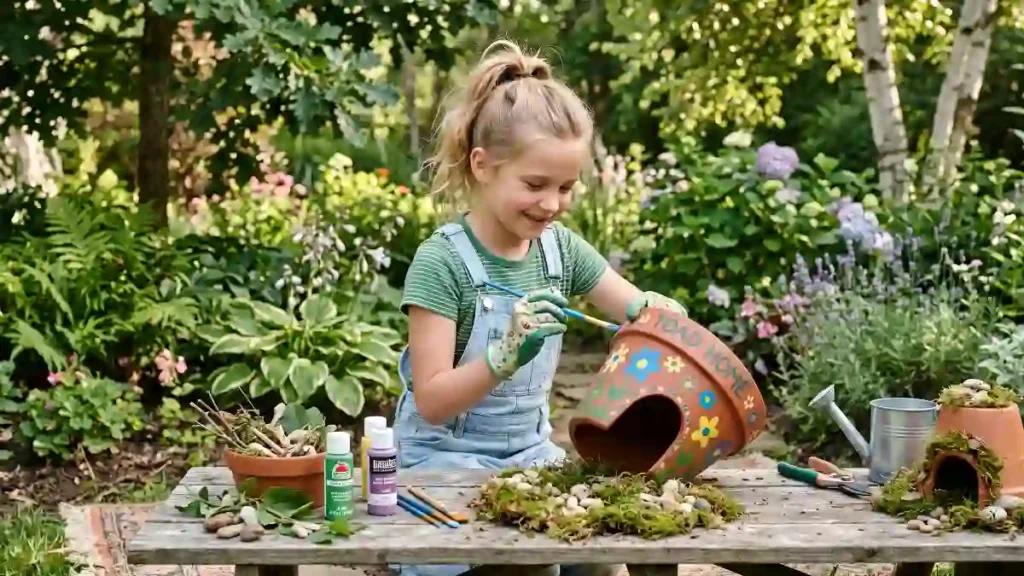
DIY options made from broken terracotta pots or stones
Whether you choose a charming hand-painted ceramic cottage or a simple overturned clay pot, the goal is the same: create a damp, shady microhabitat that makes toads feel at home.
The surprising benefits of attracting toads to your garden
Natural pest control — Zero chemicals needed
Toads eat slugs, snails, beetles, ants, earwigs, and mosquito larvae. One toad in your yard may devour thousands of bugs per season. Thousands of insects will not consume your veggies, flowers, or plants.
Better for bees and butterflies
When you skip pesticides and let toads handle pest control, beneficial insects like bees and butterflies thrive. A toad house indirectly makes your garden a richer, more biodiverse ecosystem.
Low maintenance, high reward
Once a toad home is placed in the appropriate location, nature takes care of the rest. No batteries, no refills, and no timetable. Just a happy toad doing what they do best.
Kid-friendly wildlife gardening
A toad house is a wonderful way to introduce children to wildlife gardening. Spotting a toad peeking from its little home is a magical moment that sparks curiosity about nature.
How to choose the best toad house for your garden
Not all toad houses are created equal. Here’s what to look for:
Size and entrance hole
The opening should be at least 3-4 inches wide, allowing a toad to enter comfortably. Avoid shelters with small ornamental holes that no genuine toad could pass through.
Material matters
Terracotta and ceramic — excellent for retaining moisture and staying cool; the classic choice
Wood — natural-looking and durable, but ensure it’s untreated to avoid chemical exposure
Resin or plastic — weather-resistant and often very decorative, though less breathable
Drainage
Look for a home that has a slightly higher foundation or built-in drainage. Toads like wet conditions rather than soggy ones. Instead, standing water in the shelter might attract mosquitos.
Aesthetic style
Garden toad houses range from rustic natural designs to whimsical fairy-tale cottages. Pick a style that complements your garden’s vibe — there’s genuinely something for everyone.
Where to place a toad house in your garden
Placement is everything. Even the finest toad house will sit empty if it’s in the wrong spot.
Golden rules for placement
Shade is essential. Place the house under a shrub, near a garden wall, or beneath large-leafed plants. Direct sunlight heats the shelter and drives toads away.
Near water if possible. Toads breed in ponds. If you have a garden pond, place the house within a few metres of it.
Facing north or east helps keep the interior cool during hot afternoons.
Low to the ground. Set the shelter directly on bare soil or leaf litter — toads love to burrow slightly and need ground contact.
Away from lawn chemicals. Never place a toad house near areas treated with pesticides or lawn fertilisers. These can be toxic to toads, who absorb substances through their skin.
DIY toad house for garden: Make your own in minutes
You don’t need to spend money to attract toads. Here’s the easiest DIY toad house ever:
What you need: One medium terracotta pot, a small stone or piece of tile
How to do it:
Take a clean terracotta pot (at least 6 inches wide).
Chip or break a small arch at the rim — just enough for a toad to squeeze through.
Turn it upside down in a shady, moist spot in the garden.
Place a flat stone slightly under one edge to elevate it for ventilation.
Optionally, bury the rim slightly in soil to stabilise it.
Done. You now have a toad house. Check back in a few days — you may find a new resident.
Toad house garden tips for long-term success
Add leaf litter or moss inside and around the shelter for extra insulation and moisture.
Install a shallow water dish nearby — even a buried terracotta saucer works. Toads absorb water through their skin rather than drinking.
Avoid disturbing the shelter once toads move in. Frequent handling will cause them to relocate.
Clean the shelter once a year in early spring before toads return from hibernation.
Conclusion:
A toad house in your garden is one of the most affordable, effective, and lovely improvements you can make to your outdoor environment. For a few pounds or dollars — or absolutely nothing if you install it yourself — you get a natural pest controller, increase your garden’s biodiversity, and add a fun little element that never gets old.
Place one today. Your plants will thank you tonight.
Frequently asked questions about toad house for garden
Q1: What type of toad house is best for gardens?
A1: Terracotta or unglazed ceramic toad houses are widely considered the best for maintaining natural temperature and moisture. Avoid fully glazed or plastic options if your climate is warm.
Q2: Are toads safe around children and pets?
A2: Common garden toads (such as the European common toad or American toad) secrete a mild toxin through their skin as a defence mechanism. This is generally harmless to humans with normal skin contact but can cause irritation if a pet mouths one. Always wash hands after handling toads.
Q3: Will a toad house really attract toads?
A3: Yes — but it depends on your garden’s habitat. If toads already live nearby (common in most UK and US gardens with any green space), a shaded, moist shelter placed near the ground will attract them within days to weeks.
Q4: How do I keep my toad house moist?
A4: Place it in natural shade and on bare soil. Occasionally mist the surrounding ground with plain water during dry spells. The soil itself provides most of the moisture toads need.
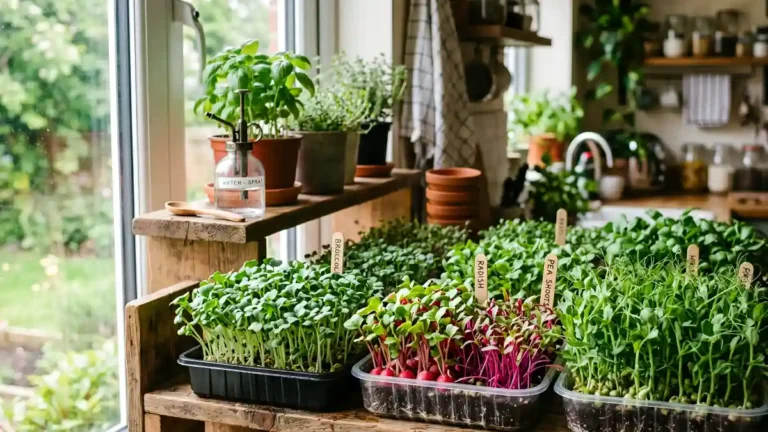
Imagine harvesting fresh, flavour-packed greens in just 7–14 days — no backyard, no experience, no fuss. That’s the magic of microgreens. Chefs pay premium prices for them. Nutritionists rave about their density. And the best part? You can grow them on a kitchen windowsill for pennies per tray.
Whether you’re a first-time grower or looking to level up your indoor gardening game, this guide covers everything you need to know about how to grow microgreens from seed to harvest — with zero guesswork.
What are microgreens (And why should you care)?
Microgreens are the seedling stage of vegetables and herbs, harvested just after the first true leaves appear — typically between 1 and 3 inches tall. They’re not sprouts (which are grown in water and eaten root-to-seed) and they’re not baby greens (which are older).
They are at the nutritional sweet spot. According to research, certain microgreens have up to 40 times more nutrients than their mature counterparts, such as vitamins C, E, and K, as well as antioxidants and beta-carotene.
Popular varieties include:
Sunflower — crunchy, nutty, filling
Pea shoots — sweet, delicate, brilliant in salads
Radish — spicy kick, ready in under 7 days
Broccoli — mild flavour, loaded with sulforaphane
Basil — aromatic, perfect for pastas and pizzas
Amaranth — stunning magenta colour, earthy taste
What you need to grow microgreens
Before you start, gather your supplies. The great news: it’s a short, affordable list.
Essential equipment
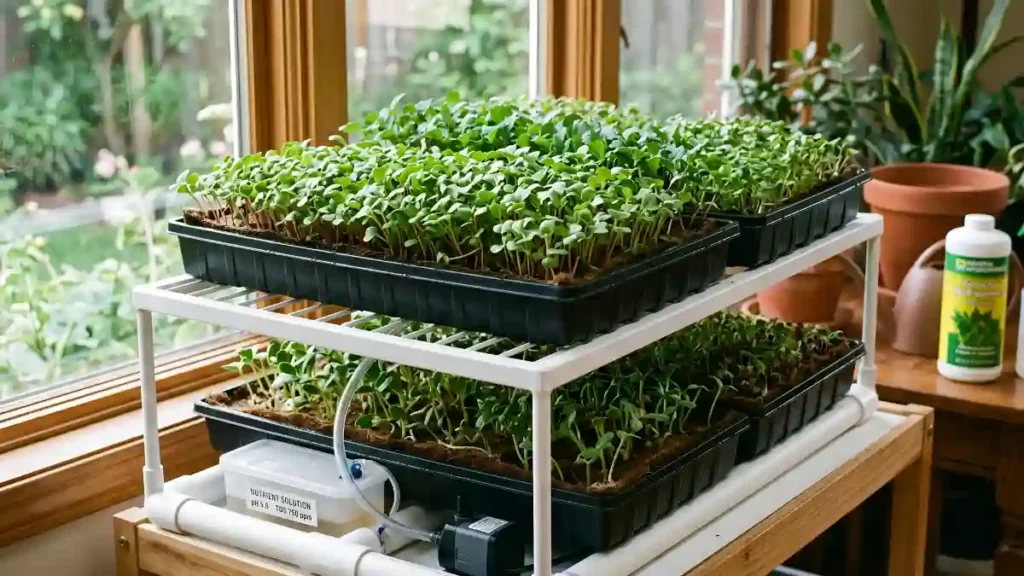
Growing trays: Use shallow trays (1010 size is usual, approximately 10×10 inches). You’ll need two: one with drainage holes (for the seeds) and one solid tray beneath to catch water.
Growing medium: A decent potting mix or coconut coir works great. Avoid garden soil, since it compacts quickly and can harbor illness. Coconut coir is very clean and sustainable.
Seeds: Purchase seeds labeled particularly for microgreens or sprouting. Regular vegetable seeds also work, but untreated, organic seeds produce the cleanest results. Aim for 1-2 oz (28-56g) of seeds per 10×10 tray, depending on the type.
Light source: A sunny south-facing windowsill works for many varieties. For consistent, year-round growing, a simple LED grow light (even a cheap one) makes a significant difference. Aim for 12–16 hours of light per day.
Spray bottle: For gentle, even watering during germination without disturbing seeds.
A weight or cover: A second tray or a dark lid used to press seeds down and encourage germination (the “blackout method”).
Optional but helpful
A small fan for airflow (reduces mould risk)
pH strips if you’re using tap water (aim for pH 6.0–7.0)
A kitchen scale for precise seeding
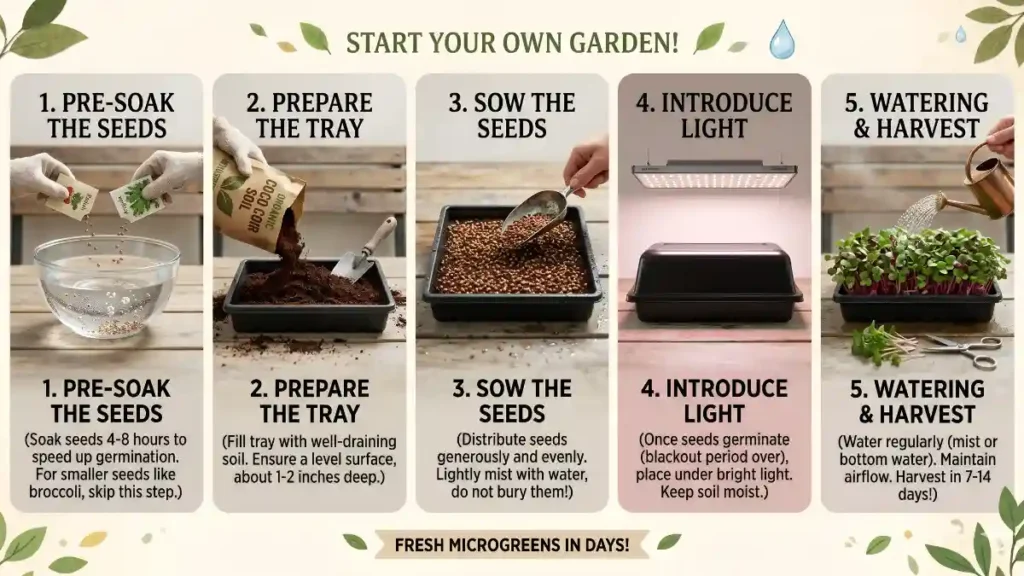
How to grow microgreens: Step-by-Step
Step 1: Pre-soak your seeds (Optional but recommended)
Larger seeds, such as sunflower, peas, and beets, benefit from an 8-12 hour soak before planting. This weakens the seed coat, accelerating germination. Small seeds, such as radish or broccoli, do not require soaking.
Soak the seeds in room temperature water and thoroughly clean them thereafter.
Step 2: Prepare your tray
Fill your tray (with holes) with 1-1.5 inches of wet growth material. Press it down gently so the surface is flat and even — not compacted, just firm. An uneven surface causes uneven germination.
Step 3: Sow your seeds
Scatter seeds evenly across the surface of the growing medium. Aim for a dense single layer — seeds should be close together but not piled on top of each other. Different varieties have different seeding rates:
Variety
Seeds per 10×10 Tray
Radish
1 oz (28g)
Broccoli
0.5 oz (14g)
Sunflower
2 oz (56g)
Pea shoots
3 oz (85g)
Basil
0.5 oz (14g)
Step 4: The blackout period (Days 1–4)
Place your solid tray on top of the seeded tray and weight it (a full water bottle works well). This causes darkness and downward pressure, like what occurs beneath. It promotes healthy root formation and straight stem growth.
Maintain a warm environment, ideally 65-75°F (18-24°C). Check once a day and spray if the surface seems dry.
After 2-4 days, you’ll notice seeds pushing up against the top tray, which is your cue to proceed to the next phase.
Step 5: Introduce light (Days 4–10)
Remove the cover tray and transfer your microgreens to the light source. At this point, they will be pale and slightly leggy (etiolated), which is just typical. After being exposed to light for 12 to 24 hours, they will quickly become green thanks to photosynthesis.
Watering method switch: From this point, bottom-water your tray instead of misting. Pour water into the solid bottom tray and let the growing medium absorb it upward. This keeps leaves dry, dramatically reducing the risk of mould.
Water once or twice each day, depending on how rapidly the medium dries.
Step 6: Watch and wait (Days 7–14)
Most microgreens are ready to harvest when they reach 1-3 inches in height and the first real leaves (the second to develop) have just begun to emerge. The cotyledons, or seed leaves, should be completely open and a rich, brilliant green.
Taste one to see! The flavor peaks shortly before the actual leaves fully mature.
How to harvest microgreens
Harvesting is the most satisfying part. Use sharp, clean scissors or a knife and cut the stems just above the soil line. Aim to harvest all at once rather than in stages — microgreens don’t regrow well after a full harvest.
Rinse and spin dry before eating or storing.
Storage: Wrap loosely in a paper towel, place in an airtight container, and refrigerate. Most microgreens stay fresh for 5–7 days.
Troubleshooting common microgreen problems
Mould on the growing medium
Cause: Overwatering, poor airflow, or seeds too densely packed.
Fix: Switch to bottom-watering, introduce a small fan, and reduce seeding density next time.
Leggy, weak stems
Cause: Not enough light, or the blackout period extended too long.
Fix: Move closer to your light source or add a grow light. Remove the cover tray as soon as seeds are pushing against it.
Uneven germination
Cause: Uneven seed spread, dry patches in the medium, or temperature fluctuations.
Fix: Level your growing medium carefully before seeding and ensure consistent warmth.
Seeds not germinating
Cause: Old seeds, seeds too cold, or growing medium too dry or too wet.
Fix: Buy fresh seeds from a reputable supplier, keep the tray at 68°F+ (20°C+), and ensure consistent moisture during the blackout phase.
Best microgreens for beginners
If you’re just starting out, these five varieties are fast, forgiving, and delicious:
1. Radish — Fastest grower (5–7 days), spicy and satisfying. Perfect for testing your setup.
2. Sunflower — Big, crunchy, nutty cotyledons that are deeply satisfying to eat. Kids love them.
3. Pea Shoots — Surprisingly sweet, they bulk out salads and stir-fries beautifully.
5. Mustard — Peppery punch, vivid green, and incredibly fast-growing.
The nutritional power of microgreens: What the science says
You’ve definitely heard that microgreens are “super nutritious” – but what exactly does that imply, and is it supported by evidence?
A landmark research published in the Journal of Agricultural and Food Chemistry (2012) examined 25 commercially available microgreens and discovered that the majority had much greater amounts of vitamins and carotenoids than their mature plant counterparts. Red cabbage microgreens, for example, were discovered to have 6 times more vitamin C and 69 times more vitamin K than mature red cabbage.
Key nutrients found in microgreens
Vitamin C — critical for immune function and skin collagen production. Found in high concentrations in red cabbage, broccoli, and radish microgreens.
Vitamin K — essential for blood clotting and bone health. Amaranth and red cabbage microgreens are among the richest sources.
Vitamin E — a powerful antioxidant that protects cells from oxidative stress. Sunflower and cilantro microgreens are particularly rich.
Beta-carotene — the precursor to vitamin A, important for eye health and immune response. Carrot, fennel, and beet microgreens are excellent sources.
Sulforaphane — a potent bioactive compound found in broccoli family microgreens, extensively studied for its potential anti-cancer, anti-inflammatory, and detoxifying properties.
Lutein and Zeaxanthin — carotenoids strongly linked to reduced risk of age-related macular degeneration (AMD) and cataracts. Found in pea shoots, spinach, and kale microgreens.
The reason microgreens are so nutritionally packed for their small size is due to nature. During germination, the seed uses all of its stored energy and nutrients to drive rapid initial development. The seedling stage is simply a concentrated package containing everything the plant requires to launch, which is precisely what you’re ingesting.
How to use microgreens in your kitchen
Growing microgreens is only half the story. Knowing how to actually eat them transforms your cooking.
Raw applications (Where they shine most)
Salads: Microgreens work as either a base or a garnish. Sunflower and pea shoots provide enough body to anchor a full salad. Radish, mustard, or watercress microgreens add a peppery top note to milder leaves.
Sandwiches and wraps: A handful of broccoli or alfalfa microgreens instantly upgrades a sandwich — adding texture, nutrition, and a fresh green flavour without the bulk of full lettuce.
Smoothies: Mild varieties like pea shoots or sunflower blend invisibly into fruit smoothies and add genuine nutritional value without changing the flavour.
Eggs: Scatter microgreens over scrambled eggs or an omelette the moment they come off the heat. The residual warmth wilts them slightly — just enough.
Avocado toast: A classic pairing. Radish microgreens on avocado toast have become a cafe staple for good reason.
Light cooking applications
Microgreens lose some heat-sensitive nutrients (particularly vitamin C) when cooked, but remain nutritious and delicious when used as a last-minute addition to hot dishes.
Soups: Stir into the bowl right before serving — the heat wilts them down like spinach.
Stir-fries: Add pea shoots or sunflower microgreens in the final 30 seconds. They soften quickly and absorb surrounding flavours.
Pasta and risotto: A small handful stirred in at the end adds colour and a mild freshness that contrasts beautifully with rich, creamy sauces.
Pizza: A favourite among chefs — bake the pizza normally, then pile fresh arugula or radish microgreens on top immediately before serving.
Microgreen pairings by variety
Microgreen
Flavour Profile
Best Paired With
Radish
Spicy, peppery
Avocado, cured meats, Asian dishes
Sunflower
Nutty, crunchy
Salads, wraps, hummus bowls
Pea shoots
Sweet, fresh
Stir-fries, soups, smoothies
Broccoli
Mild, earthy
Eggs, sandwiches, grain bowls
Basil
Aromatic, sweet
Pizza, pasta, caprese
Amaranth
Earthy, mild
Salads, decorative garnish
Mustard
Hot, pungent
Tacos, curries, cheese boards
Beet
Sweet, earthy
Goat cheese, citrus dressings
How to grow microgreens hydroponically
Soil is not the sole choice. Hydroponic microgreen cultivation, which uses water and a growing mat rather than soil, is gaining popularity because to its cleanliness, uniformity, and quickness.
What is hydroponic microgreen growing?
Instead of a soil-based growth medium, seeds are grown on a customized mat (hemp, jute, or coconut fibre) submerged in a shallow pool of water. The roots drink straight from the reservoir, so there is no dirt to bother with.
Advantages
Cleaner: No soil mess. Harvested greens are cleaner at the root end and easier to rinse.
Faster: Some growers report 10–20% faster germination and growth in hydroponic systems, as roots access water immediately without having to search through a growing medium.
Lighter: Soil trays are heavy. Hydroponic mats are minimal in weight — ideal if weight is a concern on shelving.
Less mould risk: Good-quality growing mats have naturally lower mould susceptibility than some soil mixes if managed correctly.
Disadvantages
Cost: Growing mats cost more per tray than bulk potting mix or coconut coir.
Nutrients: Soil provides trace minerals that water alone doesn’t. Some growers add a diluted hydroponic nutrient solution to the reservoir to compensate — though for the short grow cycle of microgreens, it’s rarely necessary.
Learning curve: Getting water levels right in a hydroponic tray requires more attention than soil-based growing, at least initially.
Conclusion:
Learning how to grow microgreens is one of the most rewarding, lowest-barrier ways to produce real food at home. No outdoor space. No green thumb required. Just a tray, some seeds, water, and a little light, and within two weeks you’re harvesting something genuinely nutritious and delicious.
Whether you grow a single tray on your kitchen counter or build a shelf system that feeds your whole household (and maybe a local restaurant), the fundamentals never change: healthy seeds, clean medium, moisture, darkness, then light. That’s the whole system.
Start with one tray of radish this weekend. You’ll be hooked by harvest day. And a month from now, you’ll wonder how your kitchen ever functioned without them.
Frequently asked questions about how to grow microgreens
Q1: Do microgreens need sunlight?
A1: Microgreens need bright light but not necessarily direct sunlight. A south-facing windowsill works well in summer, but an inexpensive LED grow light provides more consistent results year-round, especially in winter or darker climates.
Q2: Can you grow microgreens without soil?
A2: Yes. Microgreens grow well in coconut coir, hemp mats, jute mats, or even paper towels for very small batches. These soil-free media are clean, lightweight, and ideal for beginners.
Q3: How much does it cost to grow microgreens at home?
A3: A basic starter setup — two trays, a bag of coconut coir, and a packet of seeds — costs around £10–£20 / $12–$25. Each subsequent tray costs only the price of seeds and growing medium, typically under £1–$1.50 per harvest.
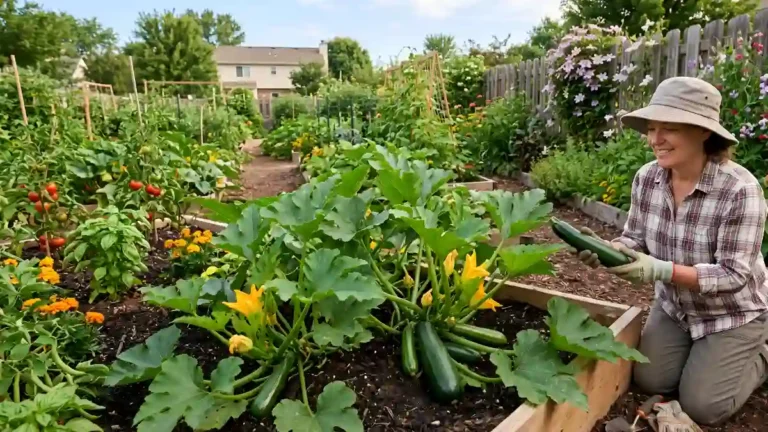
If you’ve ever wanted a vegetable that practically grows itself, zucchini is your answer. One plant can produce dozens of fruits over a single season, making it the ultimate bang-for-your-buck crop for home gardeners. But growing zucchini well — juicy, flavour-packed, and pest-free — takes a little more than just throwing seeds in the ground.
This guide covers everything about how to grow zucchini, from choosing the right variety to preparing your soil, planting, watering, troubleshooting, and knowing exactly when to harvest. Whether you’re a first-timer or a seasoned grower, you’ll find actionable tips to maximize your yield.
What you need to know before you plant
Zucchini basics at a glance
Factor
Ideal Condition
Sunlight
Full sun (6–8 hours/day)
Soil pH
6.0–7.0
Planting depth
1 inch (2.5 cm)
Spacing
2–3 feet apart
Days to harvest
45–65 days
Watering
1–2 inches per week
USDA Zones
3–10 (warm season)
Best zucchini varieties to grow
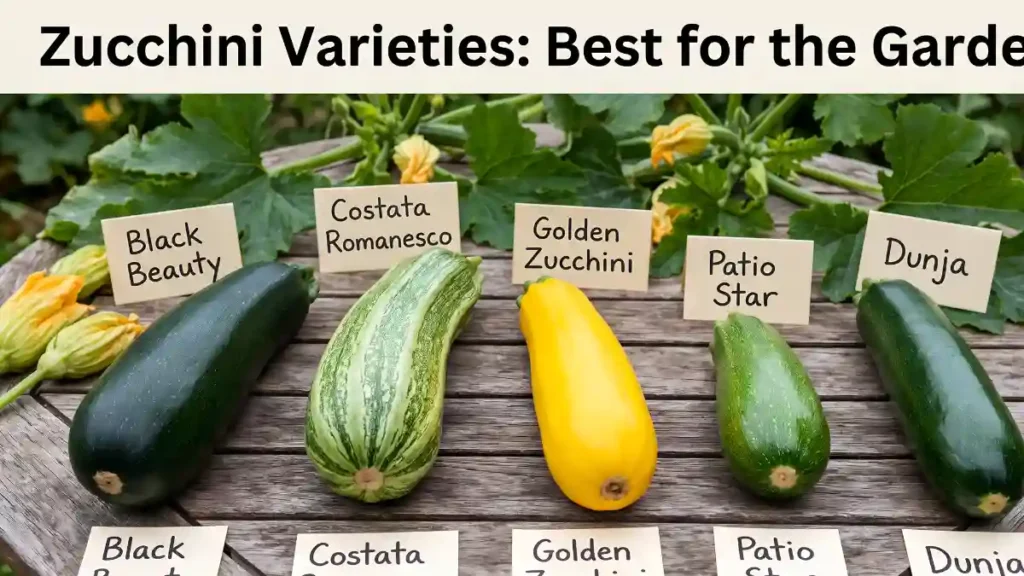
Not all zucchini are equal. Here are the top varieties worth planting:
Black Beauty — The classic. Dark green, reliable, and incredibly productive. Best for beginners.
Costata Romanesco — An heirloom Italian variety with ridged skin and a rich, nutty flavour. Great for foodies.
Golden Zucchini — Yellow-skinned with a slightly sweeter taste. Adds colour to salads and stir-fries.
Patio Star — Compact and bushy, perfect for containers and small gardens.
Dunja — Powdery mildew-resistant, making it ideal for humid climates.
How to prepare the soil for growing zucchini
Zucchini are heavy feeders. Getting the soil correct before planting is the single most important element in determining harvest size.
Step 1: Choose the right location
Choose a location that receives at least 6-8 hours of direct sunshine every day. Zucchini will thrive in partial shade, but fruit yield is severely reduced. Avoid planting in low-lying, moist areas to ensure proper air circulation.
Step 2: Enrich your soil
Dig the planting area to a depth of 12 inches (30 cm). Work in:
2–4 inches of compost to boost organic matter and drainage
A balanced slow-release fertilizer (10-10-10) at planting time
A handful of aged manure per planting hole, if available
Zucchini prefer a slightly acidic to neutral pH of 6.0–7.0. If your soil is too acidic, add agricultural lime. Too alkaline? Work in sulphur or peat moss.
Step 3: Create hills or raised beds (Optional but Recommended)
Many experienced gardeners plant zucchini on little mounds or “hills” — elevated areas around 6-8 inches tall. This promotes drainage, heats the soil faster in the spring, and prevents roots from resting in soggy circumstances.
How to grow zucchini: seeds vs. transplants
Starting from seeds indoors
Start seeds indoors 2–4 weeks before your last expected frost date. Zucchini doesn’t like its roots disturbed, so use biodegradable peat pots that can go straight into the ground.
Fill peat pots with seed-starting mix
Sow 2–3 seeds per pot, about 1 inch (2.5 cm) deep
Water gently and cover with plastic wrap
Place in a warm spot (70–85°F / 21–29°C) — seeds germinate in 7–10 days
Once seedlings appear, remove the plastic and thin to the strongest plant
Harden off for 7–10 days before transplanting outdoors
Direct sowing outdoors
Direct sowing is actually preferred by zucchini. Sow seeds directly into warm soil after the last frost, when soil temperature reaches at least 60°F (15°C).
Sow 2–3 seeds per hole, 1 inch deep
Space holes 24–36 inches apart (or 3–4 feet for bush varieties)
Thin to one plant per spot once the true leaves appear
Transplanting store-bought seedlings
If buying seedlings, transplant on a cloudy day or in the evening to reduce transplant shock. Water thoroughly and avoid disturbing the root ball.
Watering zucchini: getting it right
Zucchini need regular moisture—but not wet feet. Inconsistent watering causes blossom end rot, deformed fruit, and bitter meat.
How much water does a zucchini need?
Aim for 1-2 inches of water every week, either by rainfall or irrigation. During heatwaves during peak fruiting season, raise to two inches each week.
Watering Best Practices
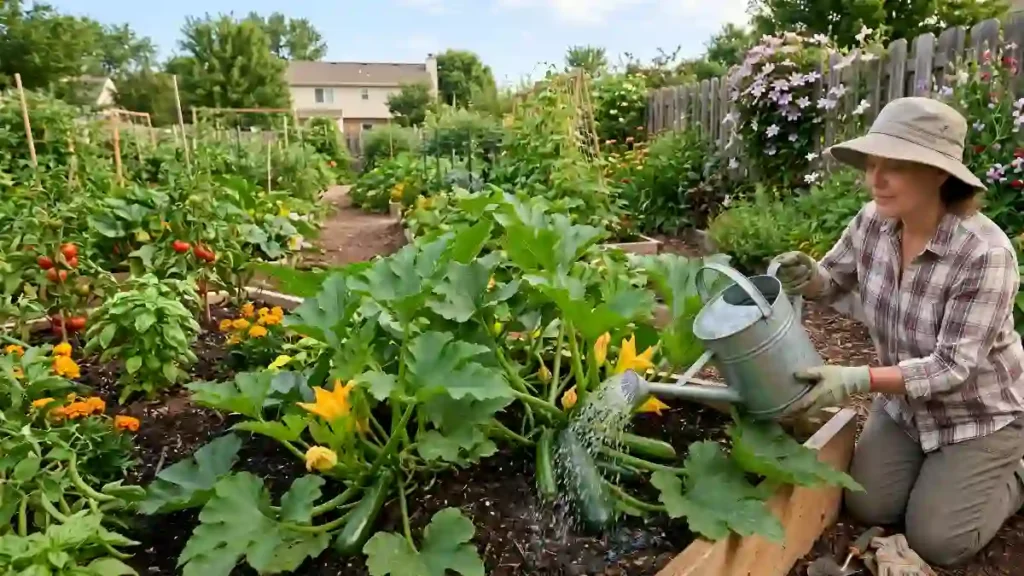
Water at the base of the plant, not over the leaves — wet foliage invites powdery mildew
Water deeply and less frequently rather than shallow and daily — this encourages deeper root growth
Use drip irrigation or a soaker hose for the most efficient delivery
Check soil moisture by pushing a finger 2 inches into the soil — if it’s dry, it’s time to water
Mulch heavily with straw or wood chips to retain moisture and suppress weeds
Feeding your zucchini for maximum yield
Zucchini are greedy plants that reward generous feeding.
Fertilising schedule
Stage
Fertiliser Type
Frequency
At planting
Balanced 10-10-10 (granular)
Once
First 4 weeks
Nitrogen-rich (e.g., 21-0-0)
Every 2 weeks
Flowering begins
Low-nitrogen, high potassium (e.g., 5-10-10)
Every 2 weeks
Mid-season
Compost tea or liquid seaweed
Weekly
Once flowers bloom, switch to a low-nitrogen fertilizer; too much nitrogen at this point promotes green growth at the price of fruit.
Pollination: The secret to fruit production
Many first-time zucchini growers are baffled when their plants flower beautifully but produce no fruit. The culprit? Poor pollination.
Male vs. female flowers
Zucchini produces separate male and female flowers on the same plant:
Male flowers appear first, on straight, thin stems
Female flowers appear a week or two later and have a small miniature zucchini at their base
Only female flowers produce fruit — and only if they’re pollinated.
Avoid pesticides during flowering, especially during morning hours when bees are most active
Hand-pollinate if bees are scarce: use a small paintbrush to transfer pollen from a male flower’s centre to a female flower’s centre, or break off a male flower and dab it directly into the female
Common zucchini pests and diseases — and how to beat them
Pests to watch for
Squash Vine Borer: The most damaging zucchini pest. The larvae crawl into the stems, resulting in abrupt withering. Prevention is crucial.
Cover the plants with row cover until blossoming starts.
Check the stems regularly for sawdust-like frass (excrement).
Rotate crops annually.
Cucumber beetles are yellow and black striped or spotted insects that consume plants and transmit bacterial wilt. Handpick them or use yellow sticky traps.
Aphids Clusters form on the undersides of leaves. Remove with a vigorous water jet or neem oil spray.
Diseases to prevent
Powdery Mildewis a white, flour-like covering on leaves. Very prevalent in late summer. Choose resistant kinds (such as Dunja), provide adequate ventilation, and spray with a weak baking soda solution (1 tbsp per litre of water) at the first symptom.
Blossom End Rot: A soft, black spot on the bloom end of the fruit. Calcium insufficiency is caused by uneven watering. Fix: distribute water evenly and add calcium to the soil.
Mosaic Virus causes mottled, deformed leaves. Aphids are responsible for their spread. There is no treatment; thus, damaged plants should be removed and destroyed promptly.
When and how to harvest zucchini
Knowing when to harvest is the difference between a soft, tasty zucchini and a watery, seed-filled club that went unnoticed for a week.
The golden harvest window
Harvest zucchini when it is 6-8 inches (15-20 cm) long and 2 inches (5 cm) in diameter. At this size, they are:
Tender with thin skin.
Flavorful with little and delicate seeds.
At maximal nutritional value.
How to harvest without damaging the plant
Using a sharp knife or garden scissors, cut the zucchini from the stem, leaving approximately 1 inch attached. Never twist or pluck the main vine; this might destroy it and spread illness.
How often should you harvest?
Check plants every 1-2 days during peak season. Zucchini grow quite quickly; a fruit overlooked after three days might develop into a marrow-sized giant. The more often you harvest, the more the plant produces.
How to grow zucchini in Containers
No garden? No problem. Zucchini can thrive in containers with the right setup:
Use a container at least 15–20 gallons in volume with excellent drainage
Choose compact varieties like Patio Star or Bush Baby
Fill with a premium potting mix blended with compost
Water daily in hot weather — containers dry out fast
Feed every 7–10 days with a liquid fertilizer
Place containers in the sunniest spot available and expect slightly lower yields than in-ground plants.
Conclusion:
Learning how to grow zucchini is one of the most rewarding activities a home gardener can perform. With the correct soil, continuous water, diligent pollination, and a keen eye for pests, you’ll be drowning in fresh zucchini within two months of planting — and most likely exchanging bags with your neighbours.
What’s the true secret? Check your plants every day. Zucchini rewards diligent gardeners richly while punishing negligence with massive, seedy clubs that no one wants to eat.
Plant boldly, water regularly, and harvest frequently. Your garden will thank you.
Frequently asked questions about how to grow zucchini
Q1: Why is my zucchini plant wilting even though I’m watering it?
A1: Sudden wilting despite adequate watering is a classic sign of squash vine borer damage. Check the base of the stem for entry holes and sawdust-like frass. You can attempt to remove the larvae with a thin wire, then mound soil over the wound to encourage re-rooting.
Q2: Why are my zucchini flowers falling off without producing fruit?
A2: This is usually a pollination problem. The first flowers to appear are male flowers, which will drop naturally. Female flowers (with the tiny zucchini at the base) need bee visits to set fruit. If bees are scarce, try hand-pollinating using a paintbrush or a picked male flower.
Q3: How to grow zucchini vertically?
A3: Growing zucchini vertically is a brilliant space-saver for small gardens. Simply install a sturdy trellis, fence, or cage at least 5–6 feet tall at planting time, then gently train the main vine upward as it grows, securing it loosely with soft garden ties or strips of cloth every 6–8 inches. Choose vining varieties like Black Forest or Astia rather than bush types, as they naturally want to climb. As fruits develop, they’ll hang freely — though larger zucchinis may need a small fabric sling tied to the trellis for support so the weight doesn’t snap the vine. Water and feed exactly as you would for ground-grown plants, but check daily since vertical plants dry out slightly faster. The bonus? Better airflow means far less powdery mildew, and harvesting becomes effortless — no more crouching through giant leaves hunting for hidden fruits.
Somewhere in your supermarket, every tomato looks identical — perfectly round, uniformly red, and almost entirely flavourless. Now imagine biting into a deep-purple Cherokee Purple tomato, its flesh rich, sweet, and tangy all at once. Or slicing open a Chioggia beetroot to reveal concentric pink-and-white rings like a tiny, edible bullseye.
Welcome to the world of heirloom vegetables, which are making a strong resurgence in home gardens, farmers’ markets, and Michelin-starred restaurants.
This book will teach you all you need to know about heritage vegetables, including what they are, why they disappeared, why they are more important than ever, and how to start growing them now.
What are heirloom vegetables?
The term “heirloom vegetable” refers to any plant type that has been open-pollinated and passed down through generations, usually at least 50 years old, although many variations date back centuries. Unlike current hybrid types, heritage vegetables reproduce true from seed, which means you may store seeds from this year’s crop and raise the identical plant the next year.
Three key traits define an heirloom variety:
Open-pollinated: Pollinated naturally by insects, wind, or birds — not artificially controlled.
Genetically stable: Seeds produce offspring identical (or near-identical) to the parent plant.
Historical lineage: Most recognised heirlooms have documented histories of at least 50 years, with many tracing back to the 1800s or earlier.
Heirloom vs. Hybrid vs. GMO — What’s the Difference?
This distinction confuses many gardeners, so let’s clarify it once and for all.
Heirloom varieties are open-pollinated, genetically consistent, and may be saved as seeds. They illustrate the variety that predated modern agriculture.
Hybrid varieties (F1) are formed by purposely cross-breeding two different parent plants to generate offspring with certain desirable features such as disease resistance, higher yields, and uniformity. What about the trade-off? Seeds from hybrids do not breed true. Each generation loses the parent qualities, rendering seed saving unreliable.
GMO (Genetically Modified Organisms) involve laboratory-level genetic engineering — inserting genes from entirely different species. These are a separate category altogether and are not available to home gardeners in most countries.
Heirloom vegetables are on the opposite end of the spectrum: no laboratory, no patents, no corporate seeds, just thousands of years of meticulous human cultivation.
A brief history of heirloom vegetables
For most of human history, all vegetables were heirlooms. Farmers carefully selected the best plants each season, saved their seeds, and traded varieties with neighbours and travellers. Over millennia, this created an extraordinary genetic library — thousands of distinct varieties adapted to specific climates, soils, and culinary traditions.
The mid-20th century changed everything.
The green revolution’s unintended consequence
The post-World War II agricultural revolution emphasized production, shelf life, and consistency in industrial transportation. Seed corporations began to create and patent hybrid types. Supermarkets need product that appeared identical and could withstand long-distance shipping. In the 1970s and 1980s, hundreds of traditional cultivars had silently gone from commercial agriculture.
According to the Food and Agriculture Organisation (FAO), approximately 75% of the world’s plant genetic diversity was lost between 1900 and 2000. What took thousands of years to cultivate was nearly erased in a single century.
The heirloom revival
Fortunately, a subtle opposition was constantly brewing. Home gardeners, seed savers, and small-scale farms continued to cultivate traditional types. Organisations such as the Seed Savers Exchange (established in 1975 in the United States) and the Heritage Seed Library (UK) began collecting, cataloging, and sharing at-risk types before they lost forever.
Today, the heirloom vegetable movement has spread throughout popular culture. These ancient plants are now getting the attention they deserve, from seed exchanges in community gardens to upscale restaurant menus that prominently display variety names.
Why heirloom vegetables are worth growing
1. Extraordinary flavour
This is why most people convert—and stay converted. Heirloom veggies were chosen over ages for their flavor, not their mobility. The distinction is not subtle.
A Brandywine tomato tastes not just “more tomatoey” than a retail variety, but also like a tomato: nuanced, acidic, sweet, and strongly aromatic. The Dragon Tongue beans snap with a delightful crunch. When Jimmy Nardello peppers are cooked in olive oil, they caramelize and become nearly jammy.
Modern commercial cultivars emphasise thick skins (for mechanized harvesting), consistent ripening (for logistics), and long shelf life. Flavour is rarely at the top of the list.
2. Biodiversity and food security
A world that relies on just a handful of crop varieties is a vulnerable world. The Irish Potato Famine of the 1840s, which killed over a million people, was exacerbated by an overreliance on a single potato type. When a new illness emerged, there was no genetic backup.
Heirloom vegetables provide unique genetic variety. Different cultivars have varying tolerance to diseases, pests, and climatic conditions. Maintaining this DNA library isn’t a nostalgic gesture; it’s an insurance policy for humanity’s food security.
3. Seed saving = seed freedom
Growing heirloom vegetables means you can save seeds at the end of the season and grow the same variety again next year — indefinitely, for free. Over time, your saved seeds even adapt subtly to your specific local conditions, making each generation slightly better suited to your garden.
Hybrid seeds must be repurchased each year. With heirlooms, you invest once and grow forever.
4. Potential nutritional advantages
The nutritional science is still developing, but some studies indicate that heritage varieties may have more antioxidants, vitamins, and phytonutrients than commercial types. One explanation is that many of the molecules that give veggies their vibrant colors and diverse flavors (anthocyanins, lycopene, and beta-carotene) also act as potent antioxidants. Many of these chemicals were lost as flavor was bred out.
5. Connection to culture and history
Heirloom vegetables are living cultural artefacts. The Mortgage Lifter tomato was bred in the 1930s by a man who sold plants to pay off his house. Bloody Butcher corn has been grown in Appalachian communities since the early 1800s. Costoluto Genovese tomatoes have graced Italian tables for centuries.
Growing these varieties is participating in an unbroken chain of human cultivation — there’s something genuinely moving about that.
Drunken Woman Frizzy Headed — Yes, that’s its real name. Loose-leaf, heat tolerant, and superb texture.
How to grow heirloom vegetables: A practical guide
Start with quality seeds
Source seeds from reputable suppliers who specialise in heirlooms: Real Seeds (UK), Seeds of Change, Baker Creek Heirloom Seeds, or your local seed library. Seeds or a local seed library. Check that the kinds are clearly labeled as open-pollinated.
Soil preparation
Heirloom vegetables generally reward rich, healthy soil. Before planting:
Add generous amounts of well-rotted compost or manure.
Aim for a loose, well-draining structure.
Test your soil pH — most vegetables prefer a pH of 6.0–7.0.
Starting from seed
Most heirloom tomatoes, peppers, and aubergines must be started indoors six to eight weeks before the latest frost date. Sow in trays or small pots, maintain warm (20-25°C), then transfer outside once frost has past.
Hardier crops like beetroot, beans, salad leaves, and courgettes can be direct-sown outdoors once the soil has warmed.
Spacing and support
Check the precise needs for each variety; heirloom tomatoes, in example, vary greatly, from compact bush varieties to spreading indeterminate vines that can exceed 2 meters. Most will require staking or caging.
Watering and feeding
Consistent watering is key, especially for tomatoes — irregular watering causes blossom end rot and fruit splitting. A mulch layer around plants helps retain moisture. Feed with a balanced liquid fertiliser once plants start flowering.
Saving seeds for next year
This is where heirloom growing becomes truly sustainable:
Tomatoes: Scoop out seeds, ferment in water for 2–3 days (this removes the gel coating), rinse, and dry thoroughly on paper.
Beans and Peas: Let pods dry completely on the plant before harvesting. Shell and store.
Squash: Scoop seeds from fully ripe fruit, rinse, and dry.
Store seeds in labelled paper envelopes in a cool, dark, dry location. Most heirloom seeds remain viable for 3–5 years or longer.
Where to buy heirloom vegetables
If you’re not growing your own yet, heirloom vegetables are increasingly available at:
Farmers’ markets — the best source, with vendors who can tell you exactly what you’re buying.
Farm box subscriptions — many small farms specialise in unusual heirloom varieties.
Specialist greengrocers — in larger cities especially.
Community gardens and seed swaps — free, social, and brilliant.
When shopping, look for labels that say “heirloom,” “heritage,” or list a specific variety name (e.g., “Brandywine tomatoes” rather than just “tomatoes”).
Heirloom vegetables in the kitchen
The best advice: get out of their way. Heirloom vegetables are at their finest with simple preparation that lets their flavour shine.
Heirloom tomatoes: Slice thickly, drizzle with good olive oil, sea salt, and torn basil. Nothing more needed.
Heirloom beans: Blanch briefly and dress with butter and fresh herbs.
Delicata squash: Halve, roast cut-side down until caramelised — no peeling required.
Chioggia beetroot: Roast whole, peel while warm, and serve with whipped goat’s cheese. The rings fade when cooked, so slice raw for visual impact.
The kitchen rewards you for choosing well at the seed catalogue or market.
Conclusion:
Heirloom vegetables are more than just a garden trend. They signify a return to flavor, variety, and the painstaking, deliberate effort of generations who grew these plants long before anybody considered patenting a seed. In a world of homogenized commercial food, they represent a radical act of taste.
Begin with one variety. Taste the difference. Then attempt to go back.
Frequently asked questions about heirloom vegetables
Q1: Are heirloom vegetables more nutritious than regular vegetables?
A1: Emerging research suggests some heirloom varieties may contain higher levels of certain antioxidants and phytonutrients, particularly compounds linked to rich colour and complex flavour. However, growing conditions, freshness at harvest, and preparation methods also significantly affect nutritional content.
Q2: Can I save seeds from heirloom vegetables?
A2: Yes — this is one of their greatest advantages. Because heirloom vegetables are open-pollinated, their seeds produce offspring true to the parent plant. Save seeds each year, and you’ll build up a personal seed bank adapted to your local conditions.
Q3: Are heirloom vegetables organic?
A3: Not automatically. “Heirloom” refers to the variety’s genetics and history, not how it’s grown. You can grow heirloom vegetables conventionally (with synthetic fertilisers and pesticides) or organically. Many heirloom growers do choose organic methods, but the two terms are separate.
Your neighbor’s yard is thick, green, and practically care-free — and they haven’t mowed in weeks. Chances are, they’ve made the switch to a clover lawn.
Once considered as a “weed,” clover is now one of the most popular lawn trends in sustainable gardening. Homeowners around the country are praising it for its velvety texture, drought resilience, and ability to remain green without fertilizer. And honestly? This makes a lot of sense.
Whether you’re beginning from scratch or overseeding an existing grass lawn, this book will teach you all you need to know about planting, establishing, and keeping a beautiful clover lawn that also works hard.
What is a clover lawn?
A clover lawn is one that employs clover as the primary ground cover or in combination with grass, rather of (or in addition to) standard turfgrass. The most common kind is white clover (Trifolium repens), a low-growing perennial that spreads by stolons and produces tiny white blooms that bees like.
Other popular varieties include:
Microclover — A finer-leafed, less flowering variety bred specifically for lawns. It blends seamlessly with grass and creates a dense, carpet-like surface.
Red Clover (Trifolium pratense) — Taller, with vibrant pink-red blooms. Better suited for meadows or low-traffic areas.
Strawberry Clover (Trifolium fragiferum) — Excellent for wet or saline soils; very drought-tolerant once established.
Most homeowners opt for white clover or microclover for a traditional “lawn” look.
Top benefits of a clover lawn
It fixes nitrogen — naturally
Clover has a superpower: it extracts nitrogen from the air and changes it into a form that plants can utilize. This implies your grass will fertilize itself. There are no synthetic fertilizer bags, no runoff damaging surrounding rivers, and no brown areas caused by overapplication. Neighboring grass even benefits when clover is blended in.
It stays green through drought
While grass turns straw-brown in summer heat, clover stays remarkably green with minimal water. Its deep roots allow it to access moisture that shallow turfgrass simply can’t reach.
It rarely needs mowing
When let to grow naturally, a white clover can reach a height of 2-8 inches. Many clover lawn owners mow only once a month or fewer. Microclover grows much lower and can survive longer between cuttings.
It’s a haven for pollinators
A clover lawn in bloom is a buffet for bees and butterflies. If you’re concerned about bee stings, simply mow before bloom or choose microclover, which flowers far less.
It outcompetes weeds
Clover spreads aggressively and forms a dense mat that leaves little room for weeds to take hold. It’s natural ground cover — no herbicides needed.
It saves you money
Less mowing. No fertilizer. Less water. The long-term savings on lawn care are real.
How to plant a clover lawn
Step 1: Choose the right time
The best time to plant a clover lawn is spring (late March through May) or early fall (August through September). Clover germinates best when soil temperatures are between 50–65°F (10–18°C). Avoid planting in midsummer heat or when frost is expected.
Step 2: Prepare the soil
Clover thrives in slightly acidic to neutral soil with a pH of 6.0–7.0. Before seeding:
Mow existing grass short or remove it entirely for a pure clover lawn.
Loosen the top inch of soil with a rake or aerator — clover seeds are tiny and need soil contact.
Do a simple soil test if possible. Amend with lime if pH is too low, or sulfur if too high.
Avoid applying herbicides at least 4–6 weeks before seeding.
Step 3: Seed the right amount
Clover seed is fine and lightweight, so a little goes a long way.
Pure clover lawn: Use 2–8 oz of seed per 1,000 sq ft.
Overseeding into existing grass: Use 2–4 oz per 1,000 sq ft.
Mix the seed with sand or dry soil to make spreading easier and more even.
Step 4: Spread and press the seed
Spread the seed using your hands or a spreader. After application, gently rake or push the seeds into the ground using a lawn roller or just walking over the area. Do not bury the seed; clover need sunshine to germinate.
Step 5: Water consistently
Keep the seeded area moist (but not waterlogged) until germination occurs — typically 7–15 days. Water lightly once or twice daily if there’s no rain. After the clover is established (4–6 weeks), deep watering once or twice a week is plenty.
How to grow a healthy clover lawn
Sunlight requirements
Clover likes full sun over partial shade. White clover can withstand more shade than other turfgrasses, making it an excellent choice for problematic situations beneath trees or along fence lines. Microclover grows best in full light.
Soil and fertilization
Here’s the greatest part: clover requires no fertilizer. Its capacity to fix nitrogen eliminates the need for synthetic feeding. In fact, high-nitrogen fertilizers can reduce clover while promoting weeds. If a soil test shows a shortfall, add phosphorus or potassium.
Watering after establishment
Once planted, clover is extremely drought resistant. In most areas, natural rainfall is sufficient. During long dry conditions, water deeply once a week.
Dealing with clover pests and disease
Clover lawns are generally resilient, but watch for:
Clover mites — Tiny red mites that appear in dry, hot weather. They rarely cause serious damage.
Root rot / crown rot — Caused by poor drainage. Avoid waterlogging and improve soil structure if needed.
Slugs — Common in damp climates. Iron phosphate bait is a safe, effective control.
How to maintain a clover lawn
Mowing
Mow clover at 3–4 inches for the best appearance. Cut too short and you’ll stress the plants; let it get too tall and it can become unruly. Mow every 3–4 weeks in the growing season — far less frequently than grass. Use a sharp mower blade to avoid tearing the soft stems.
Overseeding and filling bare spots
Clover spreads naturally, but if bare patches appear, simply scratch the soil and sprinkle fresh seed. No fuss required.
Weed management
Established clover is naturally resistant to most weeds. Hand-pull any aggressive weeds like as thistle or dock in the weeks leading up to establishment. Avoid broadleaf herbicides, since they will harm your clover too.
Foot traffic and wear
Clover handles moderate foot traffic well, but it isn’t as tough as bermuda or zoysia under heavy use. For high-traffic areas like play zones or pathways, consider a clover-grass blend (50/50 with tall fescue works beautifully) to add durability.
Reseeding in fall
Clover is a perennial and returns each spring, but reseeding lightly every 2–3 years helps maintain density, especially after harsh winters.
Using nitrogen-heavy fertilizer. It suppresses clover. Just don’t do it.
Planting too deep. Clover seed is tiny — cover it with no more than ¼ inch of soil, or simply press it into the surface.
Skipping the soil prep. Poor seed-to-soil contact is the #1 reason clover fails to germinate. Take the extra 15 minutes to rake.
Applying weed killer after seeding. Post-emergent broadleaf herbicides will destroy young clover. Time it carefully.
Expecting instant results. Clover takes 2–4 weeks to germinate and 6–8 weeks to fully establish. Patience pays off.
Conclusion:
If you’re tired of the endless cycle of fertilizing, mowing, watering, and weeding — a clover lawn is a genuinely smart alternative. It’s softer, greener, and better for the environment than most traditional grass lawns. And with the right setup, it practically takes care of itself.
Whether you go full clover or blend it with grass, the results speak for themselves: a lush, living lawn that works with nature instead of against it.
Start small, stay patient, and let the clover do what it does best.
A1: Yes! Clover is non-toxic to children, dogs, and cats. The soft texture is actually more comfortable barefoot than many grass types.
Q2: How long does it take a clover lawn to establish?
A2: Expect germination in 7–15 days and full establishment within 6–8 weeks. Fall-planted clover will fully fill in by the following spring.
Q3: Is a clover lawn cheaper than a grass lawn?
A3: Yes, significantly. With no fertilizer, less mowing, and minimal watering, the annual cost of maintaining a clover lawn is considerably lower than a traditional grass lawn.
Imagine waking up every morning to the sound of cardinals, bluebirds, and goldfinches right outside your window — not because you hung a feeder, but because your garden itself became their natural home.
That’s the quiet magic of bird-friendly plants.
Across America, native bird populations are declining. Habitat loss, pesticide usage, and the expansion of ornamental-only gardens have depleted the food, shelter, and nesting supplies that birds rely on. What is the good news? You don’t need a lot of land to make an impact. The correct plants, strategically chosen, may transform even the smallest residential garden into a healthy wildlife corridor.
This guide covers the best bird-friendly plants for every region of America, why native species outperform exotic ones, and exactly how to design a yard that birds will never want to leave.
Why bird-friendly plants matter more than feeders
Most bird lovers start with a feeder. It’s simple, enjoyable, and functional—to a point. However, feeders simply supply supplementary nutrients. Bird-friendly plants go much further:
They produce natural food — berries, seeds, nectar, and insects that birds are biologically adapted to eat.
They offer shelter and nesting sites year-round, not just during feeding hours.
They support insect populations — the real foundation of most bird diets, especially during breeding season.
They’re self-sustaining, requiring far less maintenance than a feeder stocked with seed.
The Cornell Lab of Ornithology routinely finds that yards with native plants attract much more bird species than yards with standard landscaping, regardless of whether feeders are provided.
The secret ingredient? Native plants co-evolved with native birds. They produce the correct berries at the right time, attract the right insects, and grow in ways that birds naturally use for shelter.
Top bird-friendly plants for american backyards
1. Eastern red cedar (Juniperus virginiana)
If you could plant only one tree for birds, many ornithologists would recommend this one. Eastern Red Cedar yields rich, blue-gray berries that are eaten by over 50 species, including Cedar Waxwings, American Robins, Bluebirds, and Yellow-rumped Warblers.
Its lush evergreen foliage also makes it the best winter roosting and nesting location in the eastern United States. It tolerates drought, grows quickly, and flourishes from the Gulf Coast to southern Canada.
Best for: Eastern and Central U.S. Birds attracted: Cedar Waxwing, Eastern Bluebird, American Robin, Purple Finch
2. Oak trees (Quercus spp.)
Oaks are possibly the most significant genus of animals in North America. A single mature oak tree may host over 500 types of caterpillars and insects, which provide the necessary protein for juvenile birds to thrive. Acorns nourish woodpeckers, jays, turkeys, and ducks.
There are natural oaks for every location, including White Oak and Red Oak in the East, Valley Oak and Blue Oak in California, and Texas Live Oak in the south. Plant an oak, no matter where you live.
Best for: All regions (species vary by area) Birds attracted: Red-headed Woodpecker, Blue Jay, Wild Turkey, Wood Duck, Brown-headed Nuthatch
3. Serviceberry (Amelanchier spp.)
Serviceberry, one of spring’s most generous presents to birds, yields little red-to-purple berries in late spring, just as migrating songbirds arrive. It’s one of the earliest fruiting trees of the season, and birds flock to it in droves.
Beautiful white blooms in early spring make it a landscape treasure as well. Multiple kinds are suitable for diverse temperatures, ranging from the multi-stemmed Shadblow Serviceberry in the east to the Western Serviceberry in drier areas.
Best for: All regions Birds attracted: Baltimore Oriole, Rose-breasted Grosbeak, Scarlet Tanager, Hermit Thrush
4. American holly (Ilex opaca)
Holly berries bloom in the fall and last into winter, offering a vital food source when other options are few. The thick, prickly evergreen foliage provides ideal nesting and roosting habitat. American Holly is an excellent food source for winter birds.
Plant male and female trees together (both are required for berry production), and your yard will convert into a winter bird magnet.
Best for: Eastern U.S. Birds attracted: American Robin, Eastern Bluebird, Cedar Waxwing, Mockingbird
5. Beautyberry (Callicarpa americana)
Few plants can rival Beautyberry’s visual drama in the fall, when its branches are completely covered in clusters of vibrant purple berries. It’s beautiful in the garden, and the birds can’t get enough.
Native to the southeastern U.S. but adaptable across much of the country, it’s fast-growing, low-maintenance, and works beautifully as a mid-border shrub. Over 40 bird species have been observed eating the berries.
Best for: Southeast and Mid-Atlantic U.S. Birds attracted: Brown Thrasher, Eastern Towhee, American Robin, Northern Mockingbird
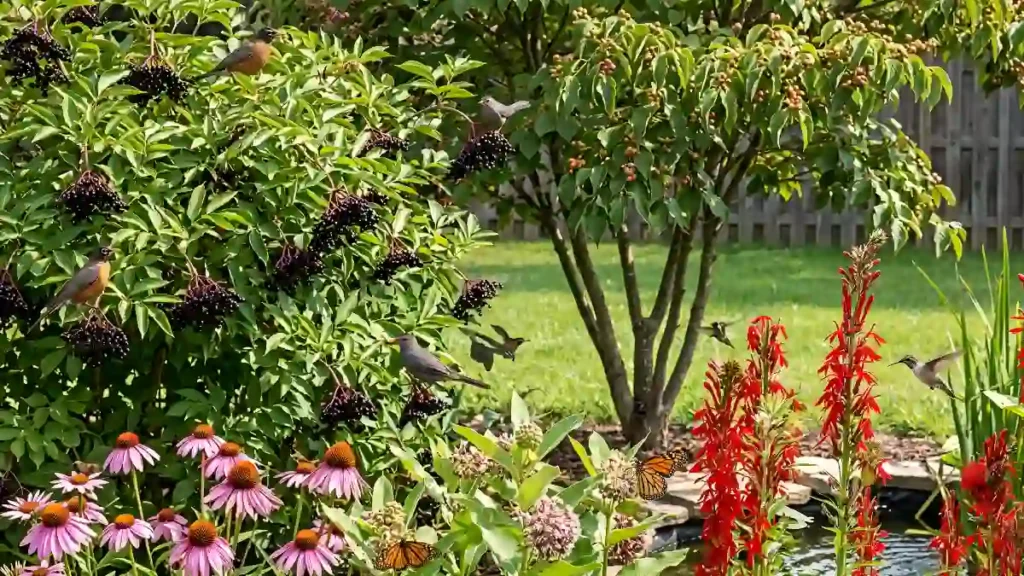
6. Elderberry (Sambucus canadensis)
Elderberry is one of the most prolific, bird-friendly plants you can grow. It produces massive clusters of small black berries in late summer, which birds of all sizes eat, from little warblers to bigger thrushes and catbirds.
It also attracts dozens of moth and butterfly species, providing an insect smorgasbord for insectivorous birds. Elderberry grows quickly, tolerates moist circumstances, and may be heavily pruned each year to maintain its neat appearance.
Best for: Eastern and Central U.S. Birds attracted: Gray Catbird, Red-eyed Vireo, Swainson’s Thrush, Indigo Bunting
7. Dogwood (Cornus florida and other natives)
Flowering Dogwood is a classic American native that provides year-round value, including gorgeous spring blooms, summer foliage, fall color, and bright red berries that mature in late summer and early October, just in time for southern migration to refuel.
The berries are heavy in fat, which is exactly what migrating birds require throughout their lengthy flights. Few plants attract a wider variety of migratory songbirds.
Best for: Eastern U.S. Birds attracted: American Robin, Wood Thrush, Eastern Bluebird, Pileated Woodpecker
8. Purple coneflower (Echinacea purpurea)
Coneflower is the ultimate bird-friendly perennial. Its enormous seed heads last into the fall and winter, making it a favorite of American Goldfinches, House Finches, and Dark-eyed Juncos. The blooms also attract insects that warblers, wrens, and chickadees feed on.
Leave the seed heads hanging throughout winter – don’t trim them back in the fall — and you’ll have a steady stream of finches and sparrows visiting even in the coldest months.
Best for: Eastern and Central U.S. Birds attracted: American Goldfinch, House Finch, Dark-eyed Junco, Chickadees
9. Milkweed (Asclepias spp.)
Beyond its famous role supporting Monarch butterflies, milkweed is an exceptional bird-friendly plant. Its fluffy seed pods are harvested by Yellow Warblers and American Goldfinches for nest lining. The insects it attracts — particularly aphids and beetles — feed many insectivorous species.
Common Milkweed, Butterfly Weed, and Swamp Milkweed are all excellent native options depending on your moisture conditions.
Best for: All regions (species vary) Birds attracted: Yellow Warbler, American Goldfinch, Baltimore Oriole (for nesting fiber)
10. Cardinal flower (Lobelia cardinalis)
Named for the brilliant red color of its blooms (not the bird, interestingly), Cardinal Flower is the top hummingbird plant native to the eastern U.S. Ruby-throated Hummingbirds are powerfully drawn to it, and its tubular red flowers are perfectly shaped for their bills.
It thrives in moist, partly shaded spots — along streams, at pond edges, or in rain gardens — and self-seeds reliably once established.
Best for: Eastern U.S. Birds attracted: Ruby-throated Hummingbird
Switchgrass, Big Bluestem, and other native grasses offer something many gardeners overlook: dense, low cover for ground-foraging birds and sparrows, as well as seed-filled heads that last into the winter. Grasses also support a vast number of insects, notably leafhoppers and grasshoppers, which ground birds hunt.
Once grown, they require very little maintenance, and their winter structure enhances any landscape.
Best for: Central and Eastern U.S. Birds attracted: Song Sparrow, Field Sparrow, American Tree Sparrow, Bobolink
Designing your bird-friendly backyard: practical tips
Layer your plantings
Birds use different vertical zones. Aim for:
Canopy trees (oaks, elms) for aerial hunters and large frugivores
Understory trees (serviceberry, dogwood) for songbirds and thrushes
Shrubs (elderberry, holly, native viburnums) for ground-feeders and nesters
Herbaceous layer (coneflowers, grasses, milkweed) for finches, sparrows, and hummingbirds
Go native — always
Exotic decorative plants such as Burning Bush, English Ivy, Bradford Pear, and Japanese Barberry may appear appealing, yet they give absolutely little benefit to birds. Many are invasive, aggressively degrading natural habitat. Replace them one by one with natural counterparts and watch your bird diversity increase.
Skip the pesticides
Pesticides not only kill insects, but they also deplete the food sources that birds require the most. Insect-eating birds such as warblers, flycatchers, and swallows rely nearly completely on insects during the mating season. A yard with bird-friendly vegetation but high pesticide use remains a food desert for birds.
Add water
A shallow birdbath or small pond dramatically increases your yard’s attractiveness. Birds that rarely visit feeders — warblers, vireos, tanagers — are reliably drawn to moving water. Keep it clean and refill it frequently.
Let some things be “Messy”
Leave leaf litter beneath trees and plants. It is an ideal hunting field for thrushes, towhees, and sparrows. Leave dead stems remaining throughout winter because they attract insects and offer perches. Allow some regions to get a little wilder. Birds thrive on that.
Regional quick reference
Region
Top Bird-Friendly Plants
Northeast
Serviceberry, Oak, Coneflower, Eastern Red Cedar
Southeast
Beautyberry, American Holly, Elderberry, Coral Honeysuckle
Creating a garden with bird-friendly plants is simple; all you have to do is choose plants with purpose. Every native plant you add is a modest step toward habitat restoration, and birds notice it immediately.
Begin with one berry-producing bush. Create a patch of coneflowers. Allow the leaf litter to rest. Over time, your yard will transform into something quite extraordinary: a living piece of native habitat in the heart of the suburban landscape, teeming with birds and song in every season.
The birds are seeking for exactly what you can offer them. All you need to do is plant it.
Frequently asked questions about bird-friendly plants
Q1: What are the best bird-friendly plants for a small backyard?
A1: For limited space, prioritize multi-purpose plants that provide food, shelter, and insect habitat simultaneously. Serviceberry, native viburnums, coneflowers, and a single oak or native holly can support dozens of bird species even in a small yard. Vertical layering — shrubs beneath a small tree with perennials in front — maximizes habitat value per square foot.
Q2: Do bird-friendly plants attract only certain bird species?
A2: Different plants attract different birds. Berry-producing plants like dogwood and holly attract thrushes and waxwings. Seed-producing plants like coneflower draw finches and sparrows. Tubular flowers like Cardinal Flower attract hummingbirds. Oaks and other insect-hosting trees attract warblers and chickadees. The more plant diversity you create, the greater your bird diversity will be.
Q3: Are there bird-friendly plants that work in containers or on balconies?
A3: Yes. Native salvia species, coneflowers, and native grasses all grow well in large containers and attract hummingbirds, finches, and insectivorous birds. Even a single container planting of native flowers on a balcony can attract migrants during fall and spring movements.
Q4: Should I remove exotic ornamental plants to add bird-friendly plants?
A4: Replacing non-native ornamentals with native bird-friendly plants is one of the most effective things a homeowner can do to help local bird populations. Prioritize removing invasive exotics (English Ivy, Japanese Barberry, Burning Bush, Multiflora Rose) first, since they aggressively destroy nearby environment. Replace them one at a time with native replacements.
You’re on a path when you notice a beautiful flower you’ve never seen before. Or maybe something’s sprouting in your garden, and you have no idea if it’s a weed — or worse, something toxic. You pick out your phone, take a picture, and within seconds, you have a name, care instructions, and even a toxicity warning.
Welcome to the era of plant identification apps, which have never been smarter.
Whether you’re a seasoned horticulturist, a curious hiker, or a new plant parent, these apps have quietly become one of the most useful tools on your smartphone. In this guide, we break down everything you need to know: what they are, which ones are genuinely worth your time, and how to pick the right one for you.
What are plant identification apps?
Plant identification apps employ artificial intelligence (AI), primarily image recognition and machine learning based on millions of botanical photos, to identify plants from photographs. Point your camera at a leaf, blossom, bark, or even a seed, and the app will cross-reference visual data against enormous plant databases to provide a match, usually with a confidence percentage.
Modern apps go far beyond just naming a plant. The best ones offer:
Care and watering guides tailored to your climate
Toxicity alerts for pets and children
Disease and pest diagnosis from leaf photos
Invasive species warnings
Community forums for gardening advice
Offline modes for use in remote areas
The technology has matured significantly. Top apps now claim accuracy rates above 95% for common species, and even rare plants are increasingly within reach.
Why use plant identification apps?
For gardeners
Gardening has exploded in popularity over the past few years, and with more people growing their own food and curating home gardens, knowing what’s in your soil matters. Apps may help you detect sick-looking leaves before they spread, identify mystery seedlings that appear unexpectedly, and determine exactly what fertiliser or watering schedule a plant requires.
For hikers and nature lovers
Plant identification apps can also serve as safety tools when hiking. Knowing whether a fruit is edible or a plant is harmful may practically save lives. They also make wildlife walks more instructive and enjoyable, particularly for youngsters.
For new plant parents
The houseplant trend isn’t slowing down. New owners sometimes struggle to match a name to their green acquisition; applications address this problem immediately and walk beginners through maintenance procedures with no botanical knowledge necessary.
The 6 best plant identification apps in 2026
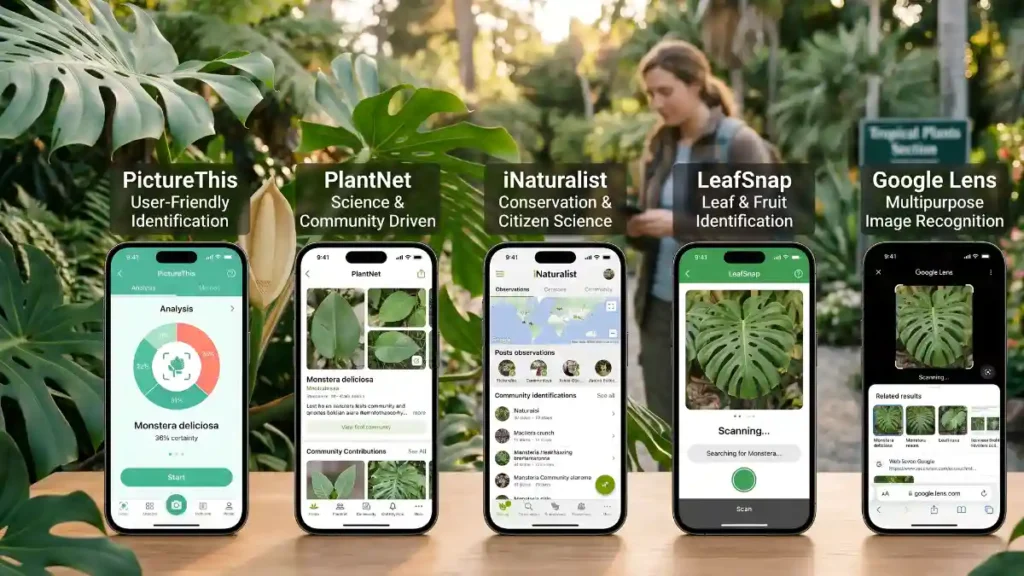
1. PictureThis — best overall
PictureThis is frequently rated as the most accurate and comprehensive plant identification app available. It recognises plants with remarkable precision, thanks to a database of over 1 million plant species and an AI engine improved over years of real-world use.
Standout features:
Real-time identification with the camera viewfinder
Detailed care reminders with push notifications
Plant doctor tool for diagnosing diseases and pests
Watering schedules and seasonal care advice
Best for: Plant parents, gardeners, and beginners who want an all-in-one solution.
Pricing: Free with limited identifications; premium subscription unlocks unlimited use.
2. PlantNet — best free option
PlantNet, created by a partnership of French research institutes, is a scientifically rigorous, community-driven software that is absolutely free to use. Although it lacks the polish of expensive programs, its botanical correctness for wild and native species is remarkable.
Standout features:
Completely free with no paywall
Identified by flower, leaf, fruit, or bark
Contributes data to real scientific research
Works well for European and North American flora
Best for: Budget-conscious users, students, and nature enthusiasts who want scientific reliability.
3. iNaturalist — best for community and science
iNaturalist is more than just an identification tool; it’s also a citizen science platform where your observations help to advance global biodiversity study. Naturalists and AI collaborate to crowd-verify identifications.
Standout features:
Community verification adds a second layer of accuracy
Connects users to local naturalist groups
Documents sightings with GPS and timestamps
Observations fed into global biodiversity databases
Best for: Hikers, citizen scientists, and anyone who wants their nature observations to mean something beyond their phone screen.
4. Seek by iNaturalist — best for kids and families
Seek is iNaturalist’s family-friendly branch, with a focus on safety, education, and gaming. Children earn badges for identifying various species, and no account is necessary.
Standout features:
Real-time identification using live camera view
Age-appropriate interface with no social features
Challenges and badges to encourage exploration
Works without an account — no data privacy concerns
Best for: Parents, teachers, and families exploring nature together.
5. LeafSnap — best for trees
If trees are your priority, LeafSnap is unrivalled. Developed by Columbia University, it specialises in recognising trees based on leaf form and contains an extremely extensive database of North American and European tree species.
Standout features:
Precise leaf identification algorithm
Detailed tree profiles, including ecology and timber use
High-resolution image galleries for comparison
Ideal for arborists and forestry students
Best for: Anyone with a specific interest in trees, forests, or dendrology.
6. Google Lens — best quick-glance tool
Google Lens isn’t a plant identification app, but it deserves to be on our list since it’s so convenient. Built into Android cameras and available for iOS, it identifies plants quickly and links directly to Google Search results for deeper research.
Standout features:
No download required on most Android devices
Instant results with Wikipedia and Google links
Free with no subscription
Useful for quick checks when you don’t have a specialist app open
Best for: Casual users who want a zero-friction option without installing another app.
How accurate are plant identification apps?
Accuracy is the first question everyone asks — and the honest answer is: it depends.
Top-tier apps like PictureThis and PlantNet routinely hit 90–97% accuracy for common species. Factors that affect results include:
Part of the plant photographed — flowers typically yield more accurate IDs than bare stems
Geographic region — apps trained on North American and European data may struggle with tropical or rare species
Species commonality — widespread plants are identified more reliably than obscure regional varieties
Tips for getting the best results from plant identification apps
1. Shoot in natural light. Avoid flash — it flattens texture and colour. Morning or overcast-day light is ideal.
2. Fill the frame. Get close. A leaf that fills 70% of the photo will ID far better than one in the corner.
3. Photograph multiple parts. Leaf, flower, stem, and fruit together give the AI more data to work with.
4. Note your location. Many apps use GPS data to narrow results to regionally plausible species, cutting out false matches from other continents.
5. Cross-check for safety. If you’re identifying something you plan to eat or handle, always verify with a second app or a local expert. No app is 100% infallible.
Are plant identification apps safe to trust for foraging?
This is critically important: use plant identification apps as a starting point, not a final authority for foraging.
Several examples have been documented worldwide when people used plant applications to identify wild mushrooms or berries and made hazardous errors. Apps are clever, but lookalike species—plants that superficially resemble each other but range greatly in toxicity—remain a barrier for AI.
If you forage, always:
Cross-reference with at least two independent sources
Consult a printed field guide specific to your region
Join a local foraging or mycology group
If in doubt, don’t eat it
Conclusion:
Plant identification apps have changed how individuals connect with the natural environment. What used to take years of study or a worn-out field guide now takes three seconds and a smartphone camera. Whether you’re saving a drooping houseplant, touring a national park, or educating youngsters about wildlife, there’s an app for that.
Begin with a free alternative like PlantNet or iNaturalist to investigate the concept, then consider upgrading to Picture.This is if you find yourself reaching for it on a daily basis. Your garden—and your curiosity—will reward you.
Frequently asked questions about plant identification apps
Q1: Can plant identification apps work offline?
A1: Some premium apps, including PictureThis (with a subscription), offer limited offline identification. Most free apps require an internet connection to query their databases. If you hike in remote areas regularly, check offline capability before downloading.
Q2: Are plant identification apps free?
A2: Many are free with limitations. PlantNet and iNaturalist are fully free. PictureThis, LeafSnap, and others offer free tiers with a limited number of daily identifications, with premium plans for unlimited use.
Q3: Can these apps identify poisonous plants?
A3: Yes — most plant identification apps flag toxic and poisonous plants prominently and warn about dangers to humans, pets, and children. However, always treat this as supplementary information and consult a medical professional or poison control centre in any suspected poisoning situation.
Q4: Do plant identification apps work for houseplants?
A4: Absolutely. In fact, houseplant identification is one of the most popular use cases. Apps like PictureThis excel here and provide detailed care schedules, watering reminders, and light requirement guides once a houseplant is identified.
Q5: Which plant identification app is best for beginners?
A5: PictureThis is the most beginner-friendly thanks to its intuitive interface, care guides, and notification reminders. Seek by iNaturalist is the top pick for younger users or families due to its gamified, account-free approach.
Your neighbors’ lawns appear pristine. What’s their secret? They haven’t used a mower in months.
Robot lawn mowers in 2026 have crossed a major threshold — they’re no longer gadgets for tech enthusiasts or premium-only purchases for the well-heeled. They’ve grown more clever, shockingly inexpensive, and simple to set up than a new smartphone. AI-powered obstacle recognition, centimeter-accurate GPS navigation, and wire-free limits have transformed these devices into the most appealing lawn care update in years.
If you’ve been debating between two options, 2026 is the year to make a decision. Here’s all you should know.
Why 2026 is the breakout year for robot lawn mowers
The robotic mower market has been building momentum since the early 2010s, but 2026 represents something of a tipping point. Three converging forces are making these machines better than ever:
AI has finally come to your garden
The biggest leap in 2026 models isn’t battery life or cutting width — it’s intelligence. New-generation robot mowers utilize integrated AI cameras and machine learning to tell the difference between a football left on the grass, a sleeping cat, and a decorative stone. They avoid collisions by navigating around them. Some models also learn your lawn’s specific patterns over time, optimizing their courses for optimal efficiency.
Wire-free technology is now the norm
Until recently, installing a robot mower included spending a Saturday afternoon laying boundary wires around your whole lawn, a tedious and error-prone task. In 2026, RTK-GPS (Real-Time Kinematic GPS) navigation became commonplace, providing centimetre-level precision without a single cable in the ground. Map your lawn once using an app, confirm your no-go zones, and you’ll be done in less than an hour.
Prices have dropped significantly
Premium features that cost £2,000 or more two years ago may now be found in mid-range devices priced between £700 and £1,000. Entry-level robot mowers cost roughly £350, bringing the technology available to the majority of UK homes for the first time.
How robot lawn mowers work in 2026
Understanding the technology makes choosing the right mower much easier.
Navigation methods
RTK-GPS wire-free (recommended for 2026 purchases): Premium features that cost £2,000 or more two years ago may now be found in mid-range devices priced between £700 and £1,000. Entry-level robot mowers cost roughly £350, bringing the technology available to the majority of UK homes for the first time.
Traditional perimeter wire: A low-voltage wire defines the mowing boundary. Still reliable and often more affordable, but installation is time-consuming and wires can be accidentally cut during gardening.
Vision-based navigation: The most advanced 2026 models pair GPS with AI cameras to build a live visual map of the lawn, detecting changes like newly placed furniture, garden toys, or pets in real time.
The cutting process
Robot mowers employ tiny, razor-like cutting blades placed on a spinning disk. They cut continually in overlapping patterns, using either random (earlier approach) or systematic grid/parallel passes (newer models). Clippings are sliced so finely they fall back into the soil as natural fertiliser through a process called mulching, which actively improves lawn health over time. No collection box, no disposal, and no garbage.
Charging and scheduling
When the battery gets low, the mower automatically returns to its docking station, recharges, and begins from where it left off. Modern scheduling via app allows you to arrange it to mow overnight, throughout the week while you are at work, or on a bespoke rotating schedule over various grass zones.
What to look for: The 2026 robot mower buying checklist
Lawn size rating — Go one tier up
Always get a model rated larger than your real grass size. A mower rated for 800 m² on a 600 m² area requires fewer cycles, saves battery life, and lasts longer. Size values provided by manufacturers are based on ideal conditions; actual gardens rarely meet these standards.
Wire-free vs. perimeter wire
For most buyers in 2026, wire-free RTK-GPS is the smarter choice — faster setup, easier relocation, and no risk of accidentally severing a buried wire. Perimeter wire models remain a solid choice if you’re on a tight budget or have a very simple rectangular lawn.
Slope capability
One of the most commonly overlooked specs. Slopes are measured as a percentage gradient:
Up to 35% — suitable for most domestic gardens
35–45% — mid-tier and premium models
45–50%+ — AWD (all-wheel drive) specialist models only
Buying underpowered for your slope leads to slipping, poor coverage, and premature motor wear.
Obstacle detection quality
Look for ultrasonic + camera AI detection as a minimum in 2026. Basic bump-and-reverse sensors are adequate for empty lawns, but they are inconvenient if you have children’s toys, beautiful pots, or dogs who spend time outside.
App quality and smart integration
A excellent app alters the user experience. Key features include easy scheduling, real-time GPS monitoring, zone management, firmware upgrades, rain delay options, and interaction with Alexa or Google Home. Read user evaluations that are particular to the app; hardware and software quality may not always match.
Security features
Robot mowers are a common target for thieves. Prioritise: PIN lock, motion-triggered alarm, GPS monitoring, and lift detection with alert. Several 2026 models offer geofencing notifications in case the mower leaves your yard.
Blade replacement ease
Blades need replacing every 1–3 months. On the best models, this is a 60-second, tool-free job. On poorly designed ones, it’s a frustrating chore. Check this in reviews before buying.
The best robot lawn mowers in 2026
Best overall: husqvarna automower 430X NERA
The standard for serious gardeners. Husqvarna’s EPOS precision navigation allows for wire-free operation and can manage up to 3,200 m² and 45% slopes. It also connects with most smart home ecosystems. The application is top-tier. Expensive but bulletproof—owners usually claim 7-10 years of dependable service.
Ideal for medium to large gardens, slope-heavy terrain, and tech-savvy users.
Price range: £2,200 to £2,600.
Best value: mammotion LUBA 2 AWD 3000H
The most talked-about robot mower of 2026 among value-conscious buyers. Wire-free RTK-GPS navigation, all-wheel drive for complex terrain, handles up to 3,000 m², and has multi-zone capability. The companion app is intuitive and frequently updated. Delivers premium features at a genuinely mid-range price.
Best for: Value seekers, gardens with varied terrain, first-time buyers upgrading to wire-free Price range: £900–£1,200
Best for small gardens: gardena sileno life 1000
Quiet, stylish, and really easy to use. Gardena’s Bluetooth app allows for scheduling and coverage of up to 1,000 m², including slopes up to 35%. Its whisper-quiet operation (57 dB) makes it suitable for urban gardens where noise is an issue. One of the most straightforward configurations accessible.
Best for: Gardens under 1,000 m², first-time robot mower owners, quiet neighbourhoods Price range: £550–£700
Best AI obstacle detection: ecovacs GOAT G1-2000
The top performer for obstacle-filled gardens. GOAT’s AI Vision system can detect and avoid items as tiny as 10 cm, including as dogs, toys, and uneven terrain characteristics. GPS navigation system with 2,000 m² capacity and no wires. The camera-based intelligence adds to the sense of being truly cutting-edge.
Best for: Families with children/pets, complex gardens, obstacle-rich environments Price range: £1,100–£1,400
Best budget entry: worx landroid M700 plus
For anyone who wants to explore robot mowing without making a large financial investment. Covers 700m² with perimeter wire navigation and features. OLGa AI anti-collision features a useful companion app for scheduling and zone administration. Wire installation is required, however the product gives outstanding dependability for the price.
Setting up a wire-free robot mower in 2026: step by step
Gone are the days of complex multi-hour installations. Here’s what modern wire-free setup actually looks like:
Charge the mower fully before first use — typically 2–3 hours
Download the companion app and create your account
Place the charging station in a flat, sheltered spot accessible from all areas of your lawn
Walk the boundary — carry the mower slowly around your lawn’s perimeter while the app records the GPS path, or draw it manually on the app’s satellite map
Mark no-go zones — tap out areas you want the mower to avoid (flower beds, vegetable patches, play areas)
Set your mowing schedule — most users choose 4–5 sessions per week during growing season
Run a test cycle — watch the first mow to confirm zones and obstacle detection are working correctly
Total setup time: 45–75 minutes for most gardens.
Caring for your robot mower: A simple maintenance routine
Robot mowers are low maintenance by design — but not zero maintenance. Keep yours running perfectly with this easy routine:
Every 1–2 weeks:
Rinse the underside with a garden hose to remove clippings and debris
Check cutting blades for wear or nicks
Every 1–3 months:
Replace the cutting blades (quick, cheap, tool-free on most 2026 models)
Clean the charging contacts on the mower and dock
Every season:
Check for app/firmware updates
Inspect the charging station cable for wear
Re-calibrate GPS boundary if you’ve rearranged the garden
Annually (pre-winter storage):
Full clean and blade replacement
Battery health check
Store at room temperature with a 50–80% charge
The bottom line: should you buy a robot lawn mower in 2026?
Yes — and here’s the honest case for it.
Robot lawn mowers in 2026 are no longer a compromise. They don’t require a weekend of installation, they don’t need a massive budget, and they don’t produce patchy results. They cut better than most weekend mowing sessions, promote healthier grass through consistent mulching, run almost silently, and cost next to nothing to operate.
The question isn’t really whether robot mowers are worth it in 2026 — the technology has definitively answered that. The real question is which model fits your garden, your budget, and your lifestyle.
Pick your size, pick your budget, set it up on a Sunday afternoon, and enjoy every Saturday morning you get back from here on out. Your lawn has never been in better hands — even when those hands are entirely mechanical.
Frequently asked questions about robot lawn mowers in 2026
Q1: Can robot lawn mowers handle uneven or bumpy lawns?
A1: Yes, performance varies per model. Standard models can handle slight undulations easily. For really uneven or rugged terrain, seek for AWD (all-wheel drive) models with active suspension, such as the Mammotion LUBA 2 AWD, which are particularly intended for such circumstances.
Q2: How long do robot lawn mowers last?
A2: With proper maintenance, a quality robot mower should last 7–12 years. Battery packs typically last 5–7 years before needing replacement, which costs £100–£250 depending on the model. Cutting blades are consumables replaced every 1–3 months at minimal cost.
Q3: How much does it cost to run a robot lawn mower per year?
A3: Running costs are remarkably low. Electricity expenditures normally range from £15 to £35 per year. Add cutting blade replacements (about £10-£25 per year), and the total yearly cost is frequently less than £60 — a fraction of petrol mower upkeep, gasoline, and your own time.
Q4: Are robot lawn mowers worth buying in 2026?
A4: Absolutely – 2026 is likely the finest year ever to purchase one. Prices are lower, AI technology is more powerful, and wire-free GPS setup has eliminated the most significant barrier to entrance. For anyone with a regularly mowed lawn, the time savings alone justify the purchase within a single growing season.
Your backyard is a blank canvas — and with the right plan, it can become your most-used room in the house. Here’s everything you need to know about how to design a backyard from scratch, whether you’re working with a modest patch or a sprawling lot.
Why backyard design actually matters
A well-designed backyard not only looks wonderful, but it also increases your home’s value, expands your living area, and provides a place for your family to breathe, play, and gather. According to studies, outdoor additions produce some of the strongest returns on home improvement investments.
But, beyond the numbers, a well-designed backyard alters how you live. That overgrown nook is transformed into a fire pit lounge. That muddy region becomes a raised herb garden that your children can really use. Design transforms potential into purpose.
Step-by-step: how to design a backyard
Assess your space: Measure dimensions, note sun/shade patterns, and identify slopes or drainage issues.
Define your zones: Decide on areas: dining, play, garden, relaxation, or a combination.
Sketch a layout: Draw a rough floor plan. Use graph paper or free tools like Canva or RoomSketcher.
Choose materials: Decide between decking, pavers, gravel, or lawn for each zone.
Plan your planting: Select plants suited to your climate, sun exposure, and maintenance level.
Add lighting & features: Finish with outdoor lighting, furniture, water features, or fire pits.
1. Start with a site assessment
Before you spend a single rupee or dollar, stroll across your yard and collect notes. Where does the morning light fall? Where does water collect after a rain? Are there any tree roots, slopes, or utility lines? These factors decide what is achievable – and what will spare you from costly blunders in the future.
2. Define functional zones
Imagine your backyard as an open-plan living space. Great design divides cooking from reclining, and play from solitude. Common zones include a dining/grilling space, a seating relaxation nook, a children’s play area, a kitchen garden, and a visual anchor such as a main tree or water feature.
You don’t need them all, but specifying what you want helps you to make wise decisions before you start laying bricks.
3. Choose the right surfaces
Surfaces set the tone. Timber decking gives off a pleasant, resort-like vibe. Natural stone pavers provide a timeless, quality feel. Concrete is affordable and low-maintenance. Gravel is ideal for drainage and footpaths. Lawns remain traditional, but demand the most attention.
Mix materials wisely – a paver patio rimmed with gravel and surrounded with lawn generates rhythm and visual appeal without becoming chaotic.
Planting for visual impact and low maintenance
The plants you select will make or break your garden design. The golden guideline is: right plant, right spot. Tropical-looking plants may live in moderate settings if you select the proper variety. Native plants are your hidden weapon since they are tailored to your local rainfall and soil, using less water and attracting fewer pests.
Use a three-layer planting strategy: tall structural trees or large shrubs for seclusion and canopy, mid-height plants for color and shape, and low ground covers or ornamental grasses to fill gaps and control weeds.
Backyard lighting: the most underrated design element
Lighting changes a backyard after dark, but most homeowners overlook it until it’s too late to prepare appropriately. Layer three types of lighting: ambient (overhead or string lights for a general glow), task (for grilling and eating areas), and accent (tree uplights, route lights, feature spotlights).
Solar-powered stick lights are both inexpensive and simple. For a more finished appearance, consider low-voltage landscape wiring, which is a weekend job with long-term benefits.
Budget-friendly backyard design ideas
Great backyards do not demand a large expenditure. Some of the most effective renovations are surprisingly inexpensive: a fresh coat of deck stain, a simple gravel walk bordered with timber, a raised vegetable bed created from reused wood, or a fire pit made from a simple metal bowl. Prioritize the modifications that you will notice and utilize on a daily basis; the remainder may be implemented over time.
Conclusion:
A well-designed backyard is more than just an outdoor space — it’s an extension of your home and your lifestyle. Learning how to design a backyard is an excellent experience. By starting with a clear plan, defining functional zones, choosing the right materials and plants, and adding thoughtful lighting, you can transform any yard into a space you’ll genuinely love spending time in. Whether you’re working with a compact city garden or a generous suburban lot, the principles remain the same: design with purpose, prioritise what matters to you, and build it one step at a time. Your dream backyard isn’t out of reach — it just needs a good plan and the confidence to start.
Frequently asked questions about how to design a backyard
Q1: How do I design a backyard on a tight budget?
A1: Start with a clear plan so you don’t waste money on mistakes. Focus on high-impact, low-cost changes first: mulching garden beds, adding a gravel path, painting fences, and buying plants from local nursery sales. DIY where you can — raised beds, simple paving, and basic lighting are all beginner-friendly projects.
Q2: What is the best layout for a small backyard?
A2: For small spaces, vertical design is your best friend. Use tall fencing with climbing plants to draw the eye upward. Choose multi-functional furniture (storage benches, folding tables). Define one clear zone rather than cramming in several. Light-coloured surfaces and mirrors can also make tight spaces feel larger.
Q3:What plants are best for a low-maintenance backyard ?
A3: Native plants are always the top pick for low maintenance. Other excellent choices include ornamental grasses, lavender, agapanthus, succulents (in warm climates), and hardy groundcovers like mondo grass or clumping bamboo. Avoid plants that need regular pruning, staking, or frequent watering.
Imagine stepping outside on a warm evening and seeing your garden glow — no electrician, no running cables, no electricity bill. That is exactly what solar garden lights offer. Whether you’re framing a pathway, emphasizing flower beds, or creating a cozy atmosphere on your patio, solar-powered lighting has become one of the most popular and cost-effective garden enhancements of the decade.
However, with dozens of types, brands, and specifications on the market, selecting the perfect ones might be difficult. This guide cuts right through the noise.
How solar garden lights actually work
Solar garden lights are elegantly simple. A tiny photovoltaic (PV) panel on top of each lamp receives sunlight during the day and turns it into electrical energy, which is then stored in a rechargeable battery, often NiMH or lithium-ion. When darkness falls, a built-in photosensor automatically turns on the light, taking power from the stored energy.
Most excellent solar lights give 6-10 hours of lighting on a full day’s charge, making them dependable even in mild regions. The better versions now have dusk-to-dawn sensors, motion detection, and customizable brightness modes.
The real benefits of going solar
Zero Running Costs
Free energy from the sun, every single night
No Wiring
Simple DIY install — no electrician needed
Eco-Friendly
Powered by clean, renewable energy
Safer Home
Lit paths deter intruders and prevent falls
Beyond convenience, solar garden lights contribute to meaningful reductions in household carbon emissions. A conventional set of ten solar pathway lights may save up to 150 kWh of electricity per year when compared to mains-powered alternatives, representing a small but significant step toward a greener living.
Types of solar garden lights
Not all solar lights serve the same purpose. Matching the type to your garden’s needs is the key to a stunning result.
Pathway lights — Low-profile stakes that line walkways and driveways, guiding footsteps safely after dark.
Spotlights — Directional beams ideal for highlighting statues, trees, or architectural features.
String lights — Festive, decorative strands for fences, pergolas, or outdoor dining areas.
Flood lights — High-lumen output with motion sensors for security and wide-area illumination.
Lanterns & decorative lights — Style-forward designs that double as garden ornaments by day.
Deck & step lights — Flush-mount options for patios, decking edges, and garden steps.
What to look for when buying
1. Lumens, not watts
With solar lights, lumens (brightness output) are significantly more important than watts. Pathway lights normally require 10-50 lumens, whereas security flood lights should provide 700 lumens or more. Always verify the lumen rating before purchasing.
2. Battery capacity
Look for lights with a battery capacity of at least 1,200 mAh for dependable nighttime use. Lithium-ion batteries beat NiMH batteries in cold weather and survive longer—typically 2-3 years before needing replacement.
3. IP rating (weatherproofing)
Outdoor lighting must be weatherproof. An IP65 classification indicates that the lamp is fully protected from dust and water jets, making it ideal for the majority of UK and European climatic conditions. Avoid anything less than IP44 for long-term outdoor use.
4. Solar panel quality
Monocrystalline panels are more efficient and perform better in low-light or cloudy environments than polycrystalline panels. If you reside in a foggy area, monocrystalline is worth the small additional expense.
Installation tips for maximum performance
Even the best solar garden lights will underperform if not installed correctly. Follow these easy guidelines: face the solar panels south (in the northern hemisphere), keep them away from overhanging branches or eaves, and wipe them periodically with a wet cloth to eliminate dust and bird droppings. Before you turn on your lights for the first time, charge them in direct sunshine for a full day.
Spacing also crucial. For paths, 1.5-2 meters between pegs produces a balanced, welcome glow without the “airport runway” look.
Conclusion:
Solar garden lights are no longer a novelty — they are a smart, sustainable, and stylish choice for any outdoor space. Free to run, easy to install, and kinder to the planet, they offer everything a modern homeowner needs from garden lighting. As the technology keeps improving and prices remain accessible, there has never been a better time to let the sun light up your garden after dark.
Frequently asked questions about solar garden lights
Q1: Do solar garden lights work in winter or cloudy weather?
A1: Yes, though less efficiently. Modern solar lights with monocrystalline panels can still charge on overcast days. Expect shorter run times in winter — typically 4–6 hours instead of 8–10. Lights with larger battery reserves handle seasonal variation best.
Q2: How long do solar garden lights last?
A2: The LED bulbs themselves can last 50,000+ hours (effectively decades). The limiting factor is the rechargeable battery, which typically needs replacing after 2–3 years. Many brands sell replacement battery packs, extending the light’s total lifespan significantly.
Q3: Can solar lights charge through glass (e.g., on a windowsill)?
A3: Glass filters out a significant portion of UV light, so charging through a window is far less efficient than direct outdoor exposure. It’s not recommended as a primary charging method, though it may work as a temporary solution.
Q4: Are solar garden lights bright enough for security?
A4: Solar security flood lights with motion sensors can currently output 1,000-2,000 lumens, which is entirely equal to mains-powered versions. For security, choose high-lumen versions with PIR (passive infrared) motion detection and a detection angle of at least 120 degrees.
Q5: What’s the best way to maintain solar garden lights?
A5: Clean the solar panels monthly, replace batteries every 2–3 years, and store lights indoors or switch them off during extended periods of very low sunlight (such as deep winter) to preserve battery health. A little maintenance goes a long way.
From rambling roses to wildflower meadows, transform any garden, large or small, into a beautiful, aromatic haven you’ll never want to leave.
A cottage garden has an undeniable mystical quality. Overflowing borders, self-seeding annuals vying for space, bee hums, and the aroma of lavender wafting through a summer afternoon—it’s a style that seems both effortlessly beautiful and incredibly personal. Whether you have a large rural plot or a small urban backyard, cottage garden ideas may make your outdoor area absolutely lovely.
This guide provides the most effective, tried-and-true cottage garden ideas, including plants, layout, color, and seasonal appeal, so you can begin creating your ideal garden now.
What is a cottage garden? (and why it works)
The cottage garden design emerged in rural England as a practical combination of herbs, vegetables, and flowers cultivated in abundance. Today, it is renowned for its relaxing, romantic style, which is defined by thick planting, a variety of textures and heights, and a purposefully “unplanned” appearance that needs meticulous planning to achieve well.
What about the appeal? It is forgiving, sympathetic to wildlife, and extremely personal. No two cottage gardens look the same.
Top cottage garden ideas to try this season
1. Embrace colour-rich mixed borders
Any outstanding cottage garden is characterized by a colorful, diverse border. Tall plants, such as delphiniums and foxgloves, should be planted in the rear, medium-height roses and geraniums in the middle, and low-growing pansies or sweet alyssum in the front. The idea is to achieve luxuriant density with no bare soil evident.
2. Use a soft, romantic colour palette
Classic cottage gardens have gentle pinks, lilacs, milky whites, and hazy blues. Think light roses, purple alliums, white cosmos, and silvery blue catmint. Avoid bright, saturated neons; the pleasure is in the soft, sun-faded look of cottage colors.
3. Plant for fragrance
Scent is one of the most memorable aspects of a cottage garden. Plant lavender along walks to brush against legs, train climbing roses around entrances, and place sweet peas near seating spaces. Jasmine, honeysuckle, and night-scented stock enhance the enchanting evening aroma.
4. Add a picket fence or rustic arch
Structure is important in the seemingly “wild” cottage garden. A white picket fence draped in rambling roses or a weathered wooden arch coated in clematis quickly sets the tone, framing the planting and providing climbers with a stunning canvas.
5. Let plants self-seed freely
One of the most attractive cottage garden ideas is to let hardy annuals and biennials self-seed from year to year. Leave the foxglove, aquilegia, and nigella (love-in-a-mist) seed heads on the plant at the end of the season. The next year, unexpected seedlings will sprout up in ideal, “accidental” locations.
6. Grow climbing roses and clematis together
The classic cottage combination of climbing roses and late-flowering clematis is unmatched. The clematis grows through the rose canes and blooms after the rose’s first flush, prolonging color until late summer. Try ‘New Dawn’ rose with ‘Perle d’Azur’ clematis for a pastel masterclass.
7. Create a winding gravel path
Rigid straight lines seem too formal for a rustic garden. A gently curving gravel or brick path that disappears around a corner adds mystery and depth, while also allowing low-growing plants like thyme and creeping chamomile to organically pour between the stones.
8. Incorporate a kitchen garden corner
The original cottage garden was more about food than flowers. Weave herbs such as rosemary, sage, and chives throughout your blossoms, or create a small raised bed for cut flowers and veggies. Scarlet runner beans on a wigwam frame, surrounded by zinnias, are both prolific and appealing.
Essential cottage garden plants
Choosing the right plants is everything. Here are the must-haves for an authentic cottage feel:
English Rose
Foxglove
Lavender
Delphinium
Sweet Pea
Hollyhock
Phlox
Geranium
Allium
Cosmos
Echinacea
Nigella
Seasonal cottage garden planner
A well-planned cottage garden delivers colour and interest across all four seasons:
Hellebores, snowdrops, seed heads, and evergreen structure
Cottage garden ideas for small spaces
No room for sprawling borders? No problem. Cottage garden charm scales beautifully to small gardens, courtyards, and even balconies:
Vertical planting: Train climbers up walls and fences to maximise height without using floor space. A single climbing rose can transform a bare fence into a showstopper.
Container cottage garden: Group terracotta pots of varying sizes, filled with lavender, geraniums, sweet peas, and trailing nasturtiums, for instant cottage charm on a patio.
Wildflower strip: Even a narrow strip of soil can be sown with a wildflower mix for a meadow-style, mini-cottage-garden edge with almost no effort.
Conclusion:
A cottage garden is one of the most rewarding styles you can create — it rewards patience, invites creativity, and genuinely improves with every passing year as plants naturalise and self-seed. Whether you’re starting from scratch or refreshing an existing space, even a handful of these cottage garden ideas can unlock something truly beautiful.
Start small, choose plants you love, and let nature do the rest. Your cottage garden will find its own character — and that’s exactly the point.
Frequently asked questions about cottage garden ideas
Q1: What are the best flowers for a cottage garden?
A1: Roses, foxgloves, delphiniums, lavender, sweet peas, hollyhocks, cosmos, and echinacea are popular cottage garden plants. A combination of perennials, biennials, and self-seeding annuals will provide year-round appeal with minimum replanting.
Q2: Can I create a cottage garden in a small garden?
A2: Absolutely. Small gardens benefit enormously from the cottage style. Dense planting in containers and raised beds, climbers trained up walls, and a simple gravel path make even the tiniest space feel abundantly lush and romantic.
Q3: How do I maintain a cottage garden without it becoming overgrown?
A3: The key is structured chaos — use larger shrubs and roses to provide anchoring structure, then allow smaller plants to fill in freely. Deadhead regularly to prolong blooming, cut back hard in autumn, and weed before plants set seed to prevent overcrowding.
Q4: What is the best soil for cottage garden plants?
A4: Most cottage garden plants thrive in well-drained, somewhat rich soil. Grit and compost can improve heavy clay soils, while compost can help sandy soils retain moisture. Avoid overfertilization, since too rich soil creates luxuriant foliage at the price of flowers.
Q5: When is the best time to plant a cottage garden?
A5: Spring and autumn are great. Autumn planting allows perennials and shrubs to grow before their first flowering season. Hardy annuals, such as sweet peas and cosmos, should be planted in early spring to provide stunning summer flowers.
Fresh curry leaves have a unique aroma that is both bright, lemony, and intensely savoury. If you’ve only ever cooked with dried leaves from a jar, planting a curry leaf plant at home will genuinely change the way you cook. This tutorial will explain everything: what it is, how to grow it, how to care for it, and why it deserves a permanent place on your windowsill or garden.
What is the curry leaf plant?
The curry leaf plant, known botanically as Murraya koenigii, is a tropical tree native to the Indian subcontinent and Sri Lanka. It belongs to the citrus family (Rutaceae) and grows naturally in warm, humid climates. Despite the name, it has no botanical connection to curry powder — but its distinctive leaves are indispensable in South Indian, Sri Lankan, and Southeast Asian cuisine.
Left unpruned, it can reach 4–6 metres outdoors. As a container plant, it stays compact and manageable, making it ideal for home growers even in cooler climates.
Fun fact: The curry leaf plant is not an ingredient in curry powder. It is, however, one of the most aromatic herbs used in tempering — that final flavour-building step where whole spices and leaves sizzle in hot oil before being poured over a dish.
How to grow a curry leaf plant
Starting from seed or cuttings
You can grow a curry leaf plant from fresh seeds, stem cuttings, or suckers (shoots that emerge from the base of a mature plant). Seeds from ripe blackberries germinate pretty well; the process is gradual (4-8 weeks). Stem cuttings and suckers root more quickly and are typically the favoured approach for home gardeners.
Best soil for curry leaf plant
Use a well-draining pot with ample drainage holes — at least 30 cm in diameter for a starter plant. A sandy loam or normal potting mix combined with perlite works nicely. Curry leaf plants dislike soggy roots and will produce yellowing leaves if drainage is inadequate.
Sunlight
Full sun, 6–8 hours daily. South-facing windowsill indoors.
Watering
Water deeply, then let the top inch of soil dry before the next watering.
Temperature
Thrives at 15–35°C. Bring indoors when temps drop below 10°C.
Fertiliser
Feed with a nitrogen-rich fertiliser monthly during the growing season.
Caring for your curry leaf plant year-round
How to prune the curry leaf plant and harvest
Regular pruning keeps the plant bushy and productive. Harvest sprigs from the top, never removing a branch completely. After harvesting, the plant regenerates in a few weeks. It is natural for the plant to go semi-dormant and drop leaves throughout the winter. Reduce watering and fertiliser use till spring.
Common problems and fixes
Yellow leaves are typically indicative of overwatering, inadequate drainage, or iron deficiency. A dosage of iron chelate or a diluted solution of rice-washed water is typically beneficial. Neem oil spray is effective for controlling scale insects and citrus psyllids. Fungal problems are infrequent if the plant has adequate ventilation and is not overwatered.
How to propagate a curry leaf plant
The easiest ways to propagate a curry leaf plant are through stem cuttings, seeds, or suckers. Cut a 10-15 cm semi-hardwood stem, remove the lower leaves, soak the cut end in rooting hormone, and plant in wet, well-drained potting soil. Maintain a warm and humid environment for 4-6 weeks until the roots form. For seeds, only utilise fresh ones taken from ripe blackberries; dry or old seeds seldom germinate. Remove the outer pulp, plant the seed around 1 cm deep, and maintain the soil moist in a warm location. Suckers (shoots emerging from the base of a mature plant) are the quickest and most dependable way; simply dig one up with its roots intact and pot it directly. Warmth, indirect light, and patience are essential components for whichever approach you pick.
Culinary uses: What to do with fresh curry leaves
Fresh curry leaves have a flavour that dried versions simply cannot replicate — earthy, citrusy, and almost nutty when fried in oil. Here’s how to use them:
Temper in hot oil or ghee with mustard seeds and dried chillies to start a dal or sambar
Add to coconut chutneys, rasam, and fish curries for an authentic South Indian flavour
Infuse into curd (yoghurt) for a fragrant raita
Fry until crisp and scatter over rice or soup as a garnish
Blend into curry leaf pesto or chutney with coconut and green chilli
Use in Sri Lankan dishes like ambul thiyal and chicken curry
Health benefits of the curry leaf plant
Used in Ayurvedic medicine for centuries, curry leaves contain alkaloids, antioxidants, and essential oils. Research suggests they may help manage blood sugar levels, support digestive health, protect liver function, and provide anti-inflammatory benefits. They are rich in iron, calcium, and vitamins A and C. While they are not a substitute for medical treatment, incorporating fresh curry leaves into a balanced diet is a simple, flavourful way to add nutritional value to everyday meals.
Conclusion:
The curry leaf plant is undoubtedly one of nature’s most generous gifts—it’s fragrant, gorgeous, therapeutic, and tasty all at once. Whether you plant it on a sunny windowsill or in your yard, it rewards even the most little effort with an inexhaustible supply of fresh leaves that no dry replacement can equal. This little plant subtly deserves a spot in every house, whether it is used to temper a dal or to promote health. If you haven’t grown one yet, there’s never been a better time to start — one plant, a little sunlight, and some patience is all it takes to bring the soul of Indian cooking right to your kitchen.
A1: A curry leaf plant may grow 30-60 cm per year under warm circumstances with plenty of light and frequent feeding. Container plants develop slower than those planted in the ground.
Q2: Can I grow a curry leaf plant indoors?
A2: Yes. Place it on a south-facing windowsill that gets at least 6 hours of sunshine. A grow light might help throughout the cold months. Avoid chilly drafts near the windows.
Q3: How often should I water a curry leaf plant?
A3: Water deeply when the top 2-3 cm of soil is dry to the touch. In the summer, this may occur every 2-3 days; in the winter, once a week or fewer. Never let the plant sit in standing water.
Q4: Why are my curry leaf plant’s leaves turning yellow?
A4: The most common reasons are excessive watering, inadequate drainage, and iron deficiency. Ensure that the pot drains well, water only when the top inch of soil is dry, and treat with iron chelate as needed.